25 Kitchen Cabinets Ideas That Transform Every Kitchen Into a Stunning Space
Kitchen Cabinets Ideas are the single most consequential design decision you will make in any kitchen renovation, because cabinetry covers more surface area than any other element in the room. Before you choose a countertop, a backsplash, or a light fixture, the cabinets have already set the tone, the mood, and the budget ceiling for everything else that follows.
Most homeowners begin a kitchen renovation with a rough sense of what they want but freeze the moment they walk into a showroom. The volume of styles, finishes, door profiles, and color options is genuinely overwhelming, and without a framework for narrowing things down, the decision ends up being made by default rather than by design.
The root cause of most disappointing kitchen renovations is treating cabinet selection as a storage problem rather than a design opportunity. When cabinetry is chosen purely for function, the kitchen ends up looking assembled rather than designed, and no amount of expensive hardware or countertops can fix that foundational disconnect.
This content was developed through a close study of how leading residential designers at firms like Studio McGee and DeVOL Kitchens approach cabinetry as the architectural backbone of a kitchen. The cabinet choice is not background. It is the statement. Every other element responds to it.
What follows is a curated collection of twenty-five distinct cabinet directions, each one developed with specific product references, trade-level details, and practical guidance that most renovation guides skip entirely. These are not mood board concepts. They are actionable ideas you can take directly to a contractor or showroom.
By the time you finish this list, you will have a clear and specific vision for your own space, along with the language to communicate it confidently. Whether you are starting from scratch or refreshing an existing layout, the right Kitchen Cabinets Ideas can redefine your entire home.
Before the list begins, understand this foundational rule: the cabinet finish you select dictates the palette of every other material in the room, from countertops to flooring to lighting fixtures. In 2026, interior designers are marking a decisive shift away from all-white kitchens toward layered, textural palettes that combine organic materials with intentional color. Choose a direction that feels personally resonant rather than purely trend-driven, and your kitchen will feel considered and current for many years ahead.
Shaker Style Cabinetry Concept
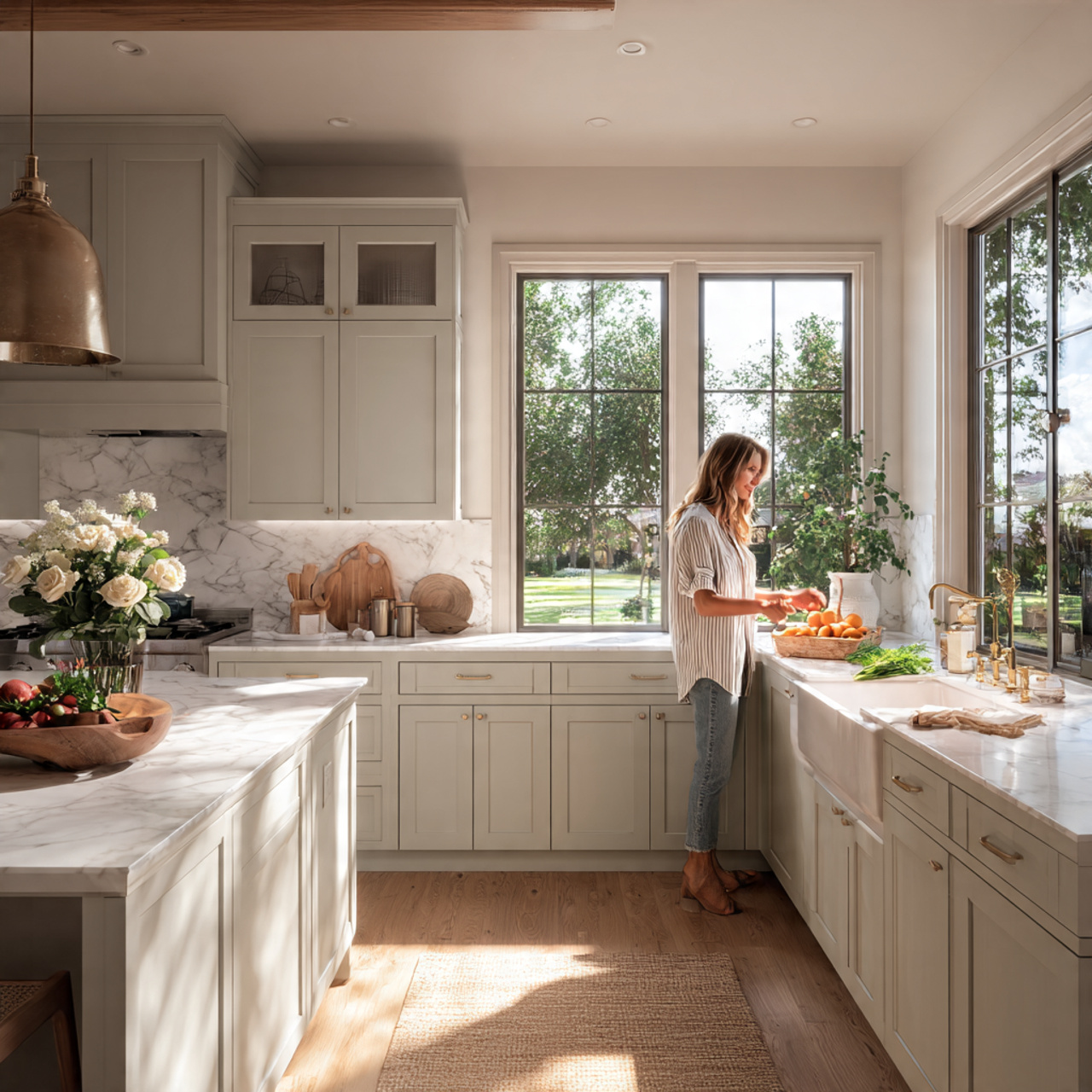
Shaker cabinetry has remained the most-installed cabinet style in North America for over a decade, and its staying power comes down to effortless adaptability. The recessed center panel and clean square frame work equally well in a farmhouse kitchen, a sleek urban flat, or a transitional suburban home without ever appearing out of place.
The real advantage of Shaker is how much creative range it gives you at the hardware and countertop stage. A white Shaker kitchen with black iron bin pulls and butcher block counters reads entirely differently from the same door in a deep green with unlacquered brass and Calacatta marble. The cabinet itself is the neutral canvas and every other element becomes the art.
Best for: Homeowners who want a classic, neutral foundation that supports bold hardware and statement countertops Product: IKEA SEKTION Shaker-style doors in white or pebble gray Pro tip: Choose matte nickel pulls over polished ones to keep the Shaker look grounded and current rather than slipping into a dated traditional feel. Room Fit: Living kitchens, family home kitchens, open-plan spaces Designer language: “Frame-and-panel millwork with a transitional profile” Room size: Works in all sizes, particularly effective in medium to large kitchens
Sleek Handleless Modern Design
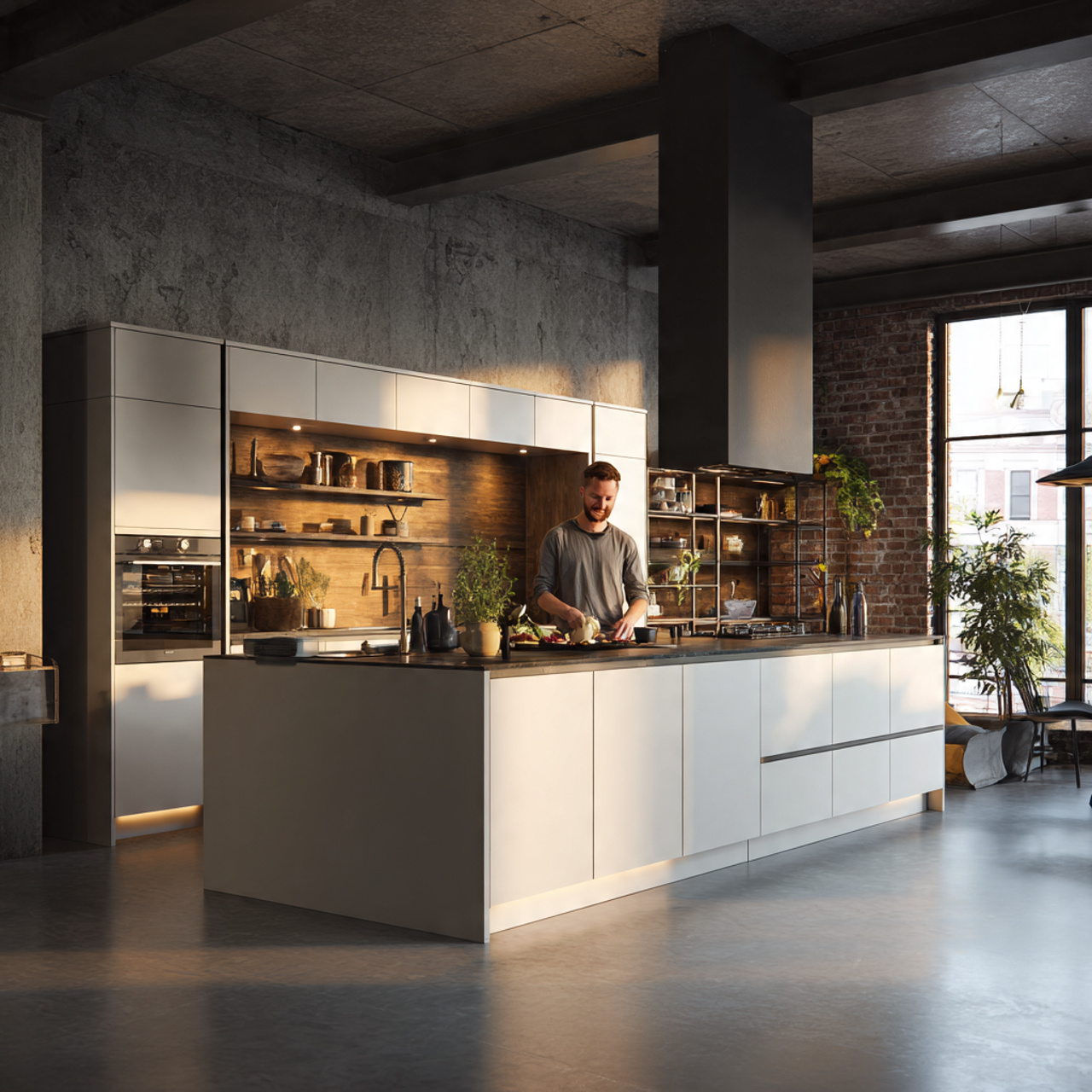
Nothing communicates intentional design faster than a kitchen with no visible hardware. Push-to-open mechanisms and J-pull channels allow the cabinet face to read as a single uninterrupted surface, drawing attention to the quality of the finish rather than the fixtures themselves.
This approach works particularly well when the cabinet material itself is worth highlighting. A handleless kitchen in a warm linen-textured laminate or a pale concrete-effect panel turns the surface into the statement in a way that knobs and pulls would only compete with and diminish.
Best for: Minimalists and those who want a clean, gallery-like kitchen aesthetic Product: Leicht Kitchens or Bulthaup B3 handleless cabinet system Pro tip: Pair handleless uppers with one integrated pull-out pantry column so the kitchen has a tactile anchoring point without breaking the seamless visual line. Room Fit: Contemporary apartment kitchens, studio layouts, compact modern homes Designer language: “Full overlay flat-front with integrated J-pull profile” Room size: Best in compact to medium kitchens where reducing visual clutter is the top priority
Open Shelving Integration Idea
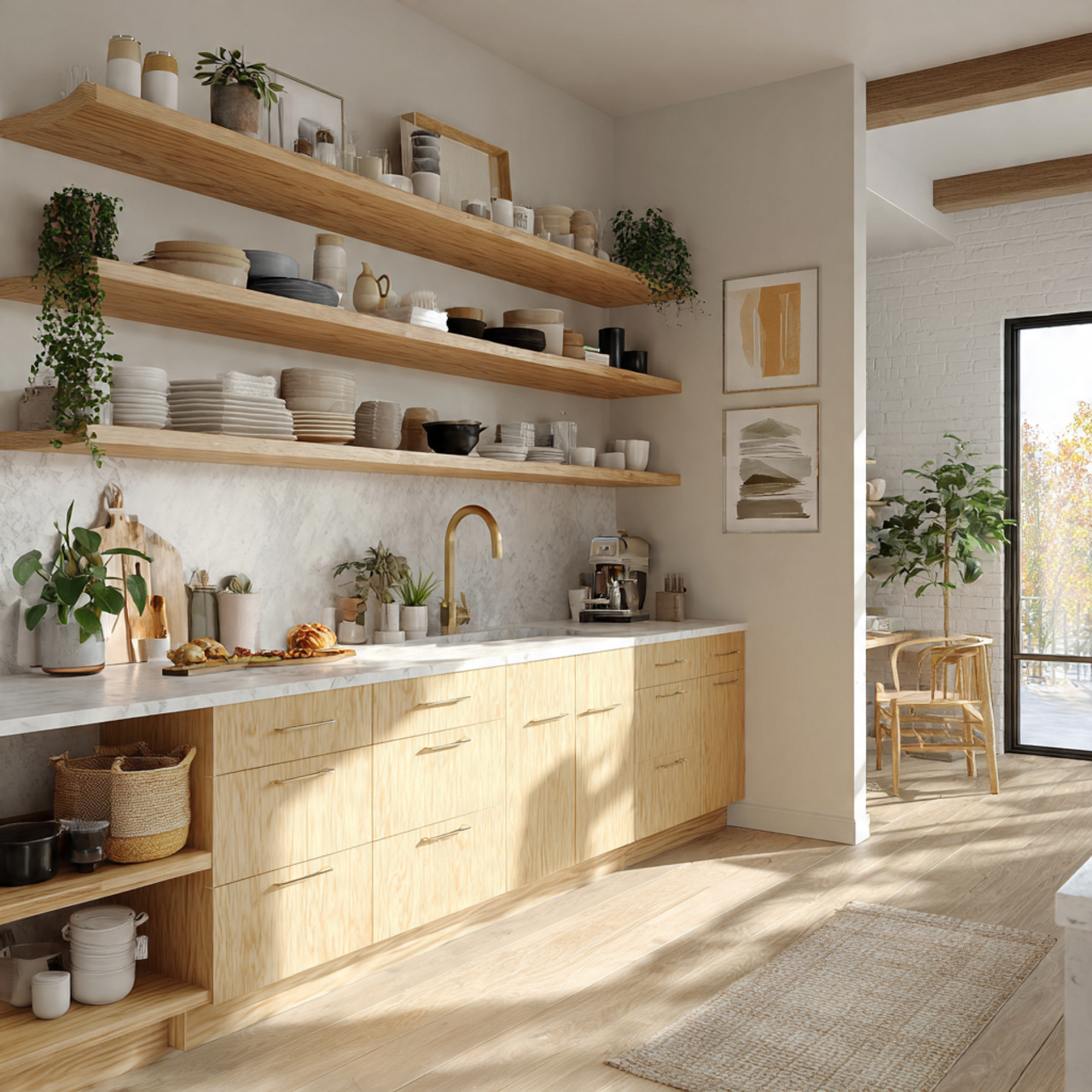
Replacing a few upper cabinets with open floating shelves instantly allows the kitchen to breathe. The visual weight of solid cabinetry drops, the eye rests on curated objects, and the whole space shifts from feeling like a storage facility to feeling like a thoughtfully designed room.
The most common mistake with open shelving is treating it like an overflow zone for things that do not fit elsewhere. The shelves that read beautifully in photographs are ones with no more than three or four categories of object, arranged with consistent spacing and a deliberate approach to color grouping. Restraint is the entire design principle.
Best for: Those who cook often and want their most-used items within immediate reach Product: Floating walnut shelves from Rejuvenation or West Elm’s wall-mounted oak shelf system Pro tip: Limit open shelf displays to items in a consistent color family so the exposed section reads as intentional decor rather than organized clutter. Room Fit: Galley kitchens, open-plan kitchens, breakfast nook areas Designer language: “Upper cabinet replacement with cantilevered floating shelf integration” Room size: Ideal for small to medium kitchens where maintaining visual openness is a design priority
Moody Charcoal Paint Inspiration
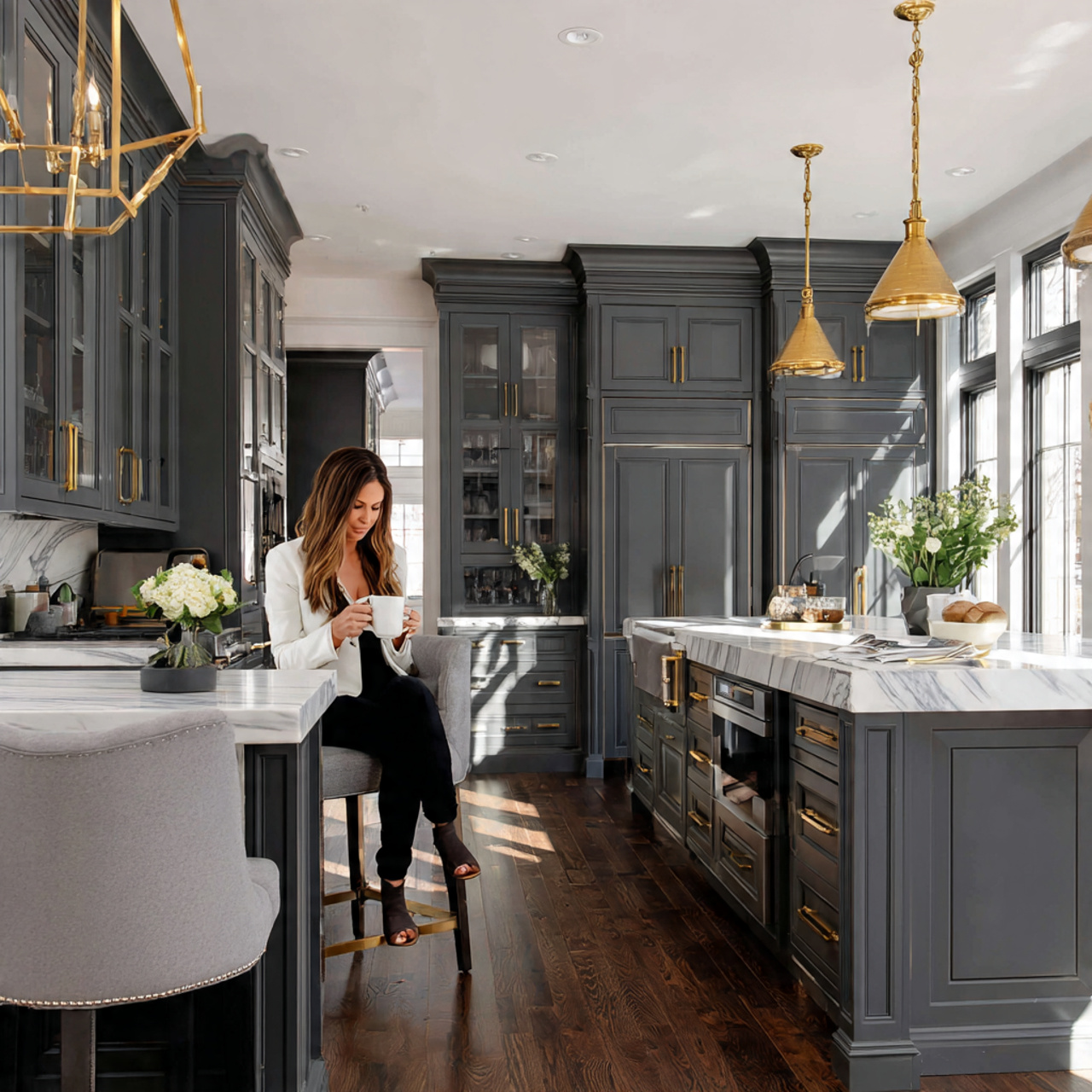
Charcoal gray occupies the sophisticated middle ground between stark black and the now-familiar deep navy. It absorbs just enough light to feel dramatic without closing the room in, especially when walls and ceiling stay light and pale.
Best for: Homeowners who want a high-end, moody kitchen without fully committing to black Product: Benjamin Moore Wrought Iron (2124-10) applied to ready-to-paint cabinets from IKEA or local custom millers Pro tip: Seal charcoal painted cabinets with a water-based satin topcoat rather than flat because flat finishes show grease marks within weeks on darker colors. Room Fit: Dining kitchens, chef-inspired layouts, formal entertaining kitchens Designer language: “Deep tone lacquered finish in a graphite or slate family” Room size: Works best in medium to large kitchens where natural light balances the depth of the dark color
Natural Oak Wood Grain Look
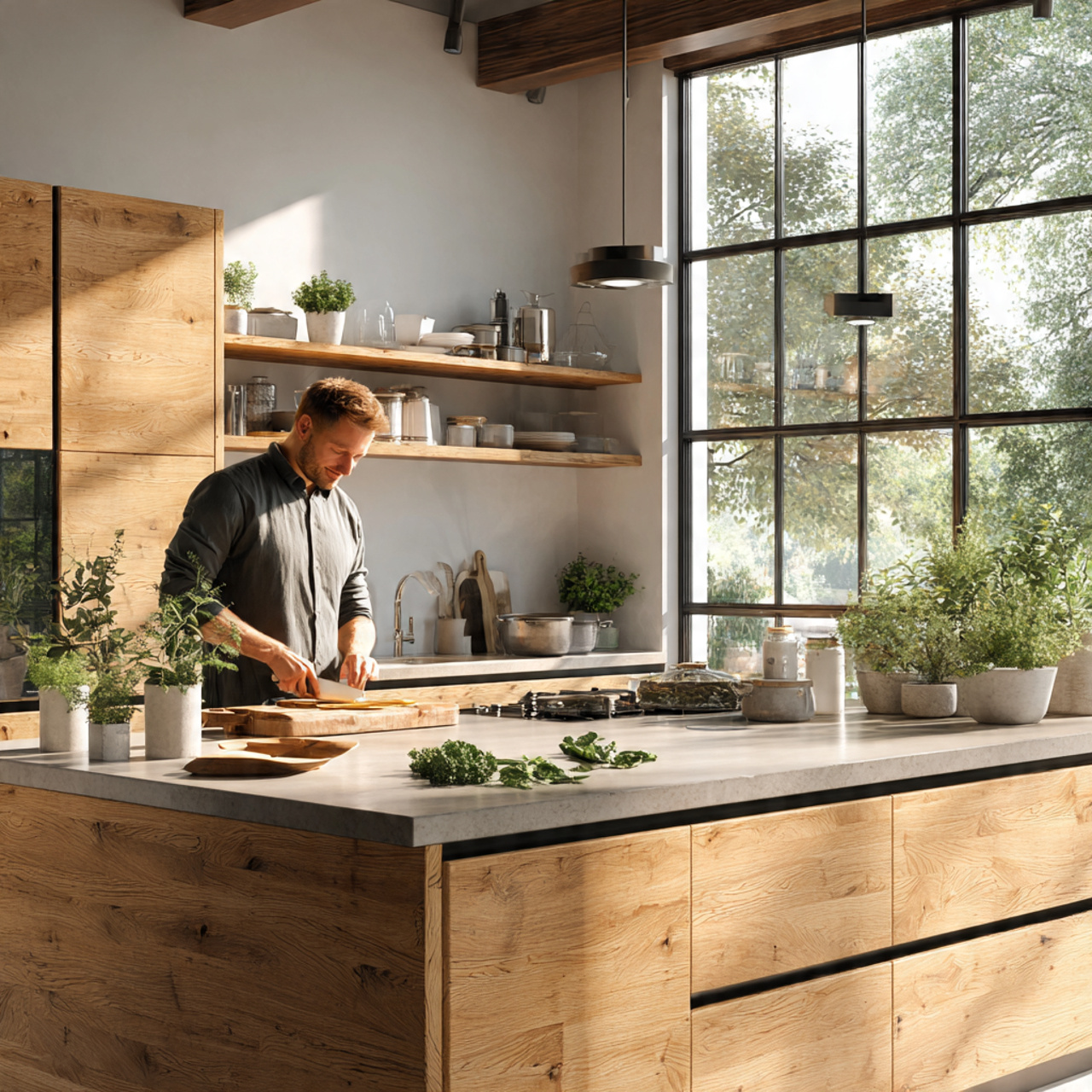
Natural oak is having its most significant moment in residential design since the 1970s, but today’s version bears no resemblance to what your grandparents had. Current oak cabinetry features a wire-brushed or lightly sanded matte surface that showcases the grain without amplifying the orange undertones that made earlier versions feel heavy and dated.
What separates a well-executed oak kitchen from a disappointing one is the cut of the wood itself. Rift-sawn oak planks run the grain vertically in a tight, linear pattern that reads as far more contemporary and architectural than flat-sawn boards with bold cathedral arches. Trade suppliers like Plywood Project and Madera Stix stock rift-sawn veneer-faced panels specifically for cabinetry, and the difference in the finished look is dramatic enough that experienced designers consider this one of the highest-value specification decisions in any wood kitchen.
Best for: Those drawn to natural materials and a warm, Scandinavian-inspired palette Product: IKEA ASKERSUND oak-effect doors or custom rift-sawn white oak panels from Plywood Project Pro tip: Apply a thin coat of Rubio Monocoat hardwax oil in Pure or White Mist to protect the oak while keeping the surface bone-dry and completely natural to the touch. Room Fit: Family kitchens, Scandinavian-inspired spaces, open-plan living areas Designer language: “Rift-cut white oak with a hardwax oil matte finish” Room size: Suits all sizes, especially powerful in large kitchens where the grain pattern creates warmth across an expansive wall
High Gloss Minimalist Finish
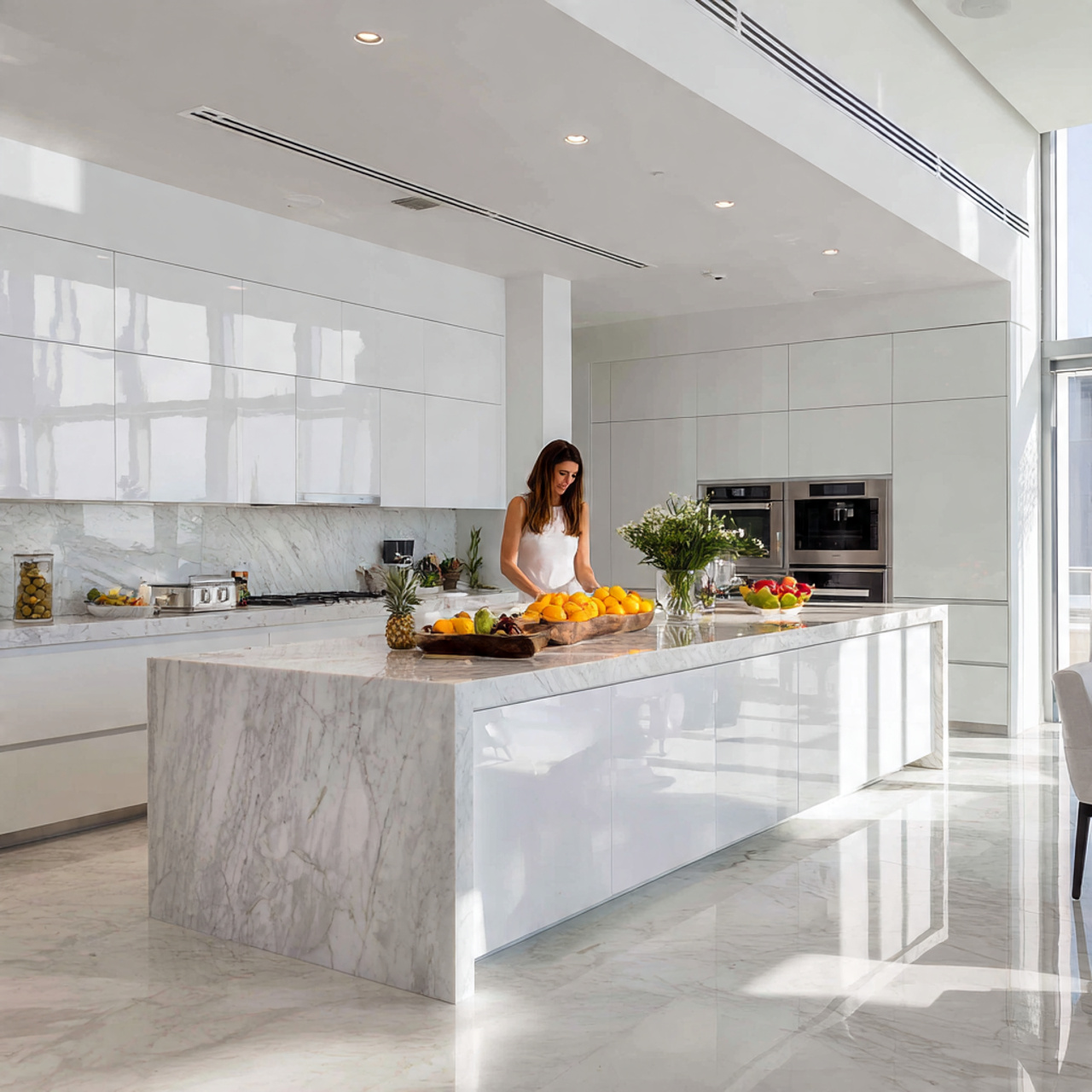
Gloss cabinetry functions like a mirror in the kitchen, bouncing light from windows and under-cabinet fixtures across the room in a way no other finish can replicate. Brands like Nobilia and Leicht have refined their high-gloss lacquers to a depth that feels closer to a piano finish than to the plasticky versions that defined the early 2000s.
Best for: North-facing or naturally dark kitchens that need every bit of light amplification available Product: Nobilia’s high-gloss lacquer line or Wickes Hi-Gloss kitchen range Pro tip: Use a damp microfiber cloth with a single drop of dish soap to wipe gloss panels rather than spray cleaners, which streak and dull the surface over time. Room Fit: Urban apartments, studio kitchens, compact modern homes Designer language: “Full-height high-gloss lacquered panel with a piano-quality finish” Room size: Particularly effective in small to medium kitchens where light amplification maximizes perceived space
Vintage Glass Front Displays
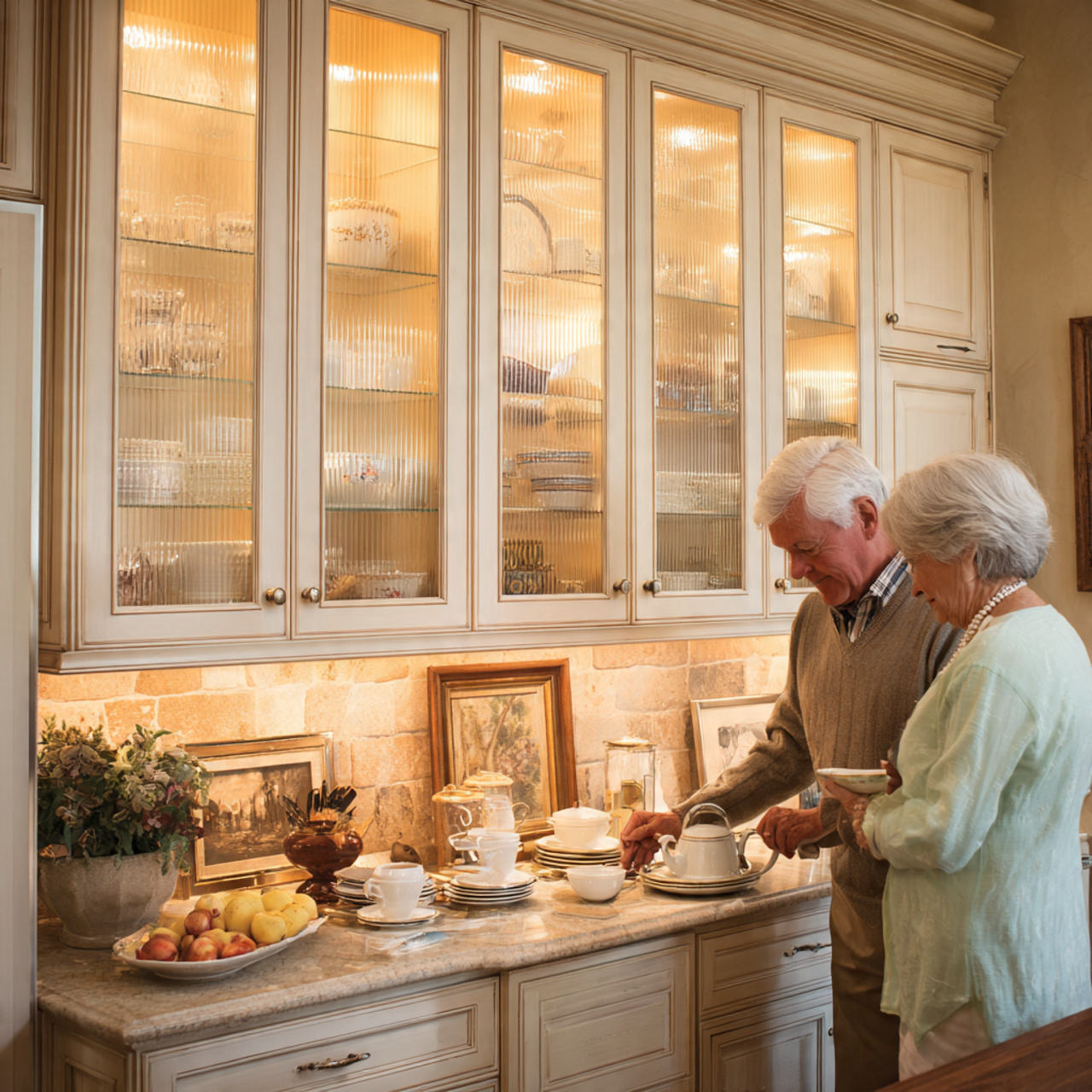
Glass-front cabinetry brings a layer of storytelling to the kitchen that solid doors cannot offer. The items stored inside become part of the design, so a row of matching white porcelain or amber glass vessels can elevate an entire wall into something that feels curated and collected over time.
The type of glass you specify matters significantly. Clear glass is the most revealing and requires disciplined interior organization. Reeded or fluted glass obscures the contents while still admitting light and shadow, which is a more forgiving option for most households. Seeded glass with its handmade bubbles sits in a middle ground that feels both vintage and current at the same time.
Best for: Homeowners who have beautiful dishware they want to showcase as part of the kitchen decor Product: Seeded or reeded glass inserts available through Rejuvenation or custom order through Signature Hardware Pro tip: Install puck LED lights inside glass-front cabinets so the display glows warmly in the evening without requiring significant electrical work. Room Fit: Formal kitchen dining areas, butler’s pantries, traditional kitchens Designer language: “Glazed cabinet door with mullion detailing and integrated interior lighting” Room size: Works across all sizes, most impactful as a single feature wall in small kitchens
Two Tone Color Contrast Style
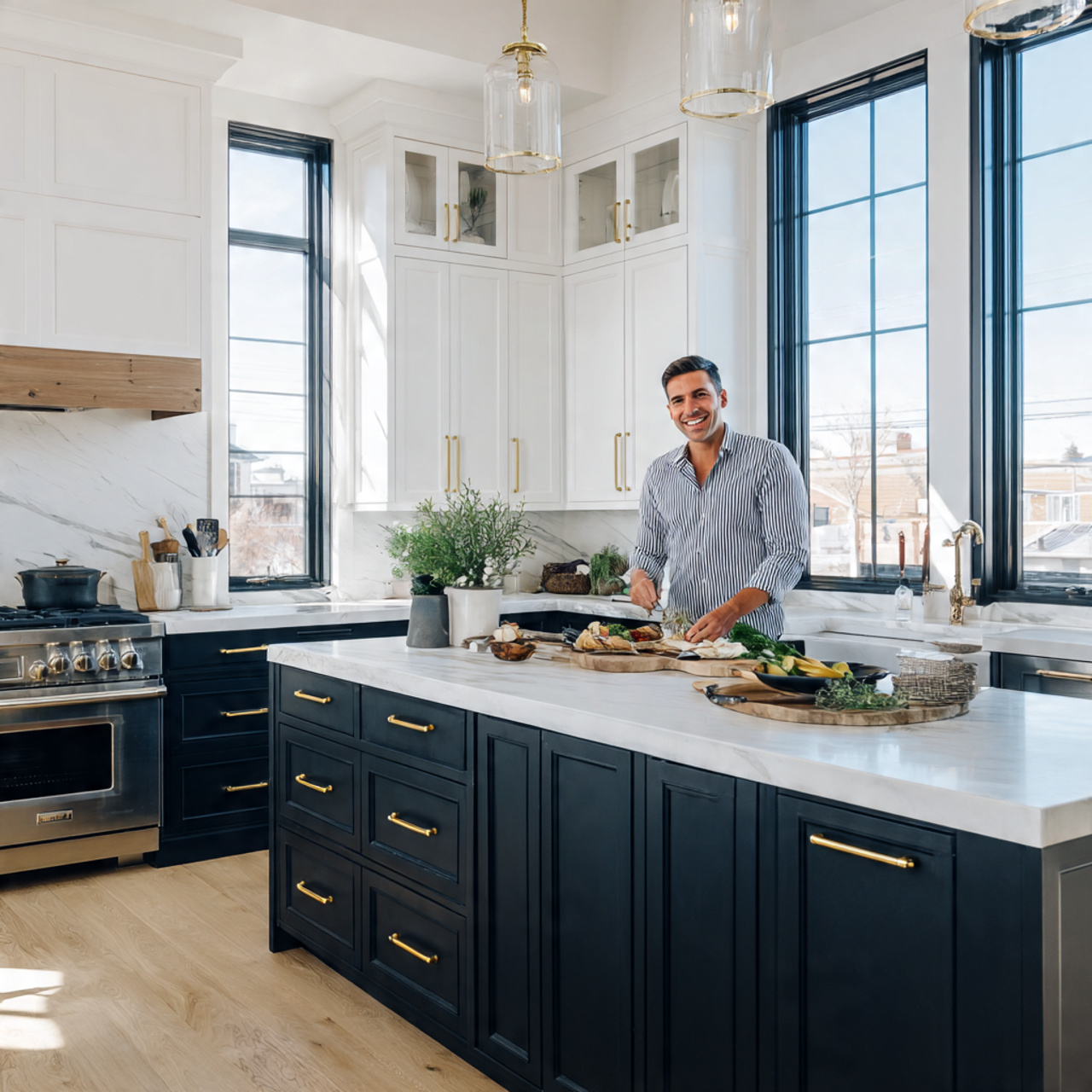
Using two distinct colors in the cabinetry layout is one of the most effective tools for creating visual hierarchy in the kitchen. The standard approach anchors the lower cabinets in a deeper, earthier tone while keeping the uppers light, which draws the eye upward and makes the ceiling feel taller.
Best for: Those who want a custom-designed feel without a fully bespoke budget Product: Lower cabinets in Sherwin-Williams Naval (SW 6244), uppers in Benjamin Moore White Dove (OC-17) Pro tip: Always specify the same door profile for both tones so the transition reads as deliberate contrast rather than a mix-and-match error. Room Fit: L-shaped kitchens, kitchens with islands, open-plan entertaining spaces Designer language: “Two-tone contrasting palette with matched door profiles and complementary hardware” Room size: Best in medium to large kitchens where the eye has enough space to move between the two tones
Distressed Farmhouse Aesthetic
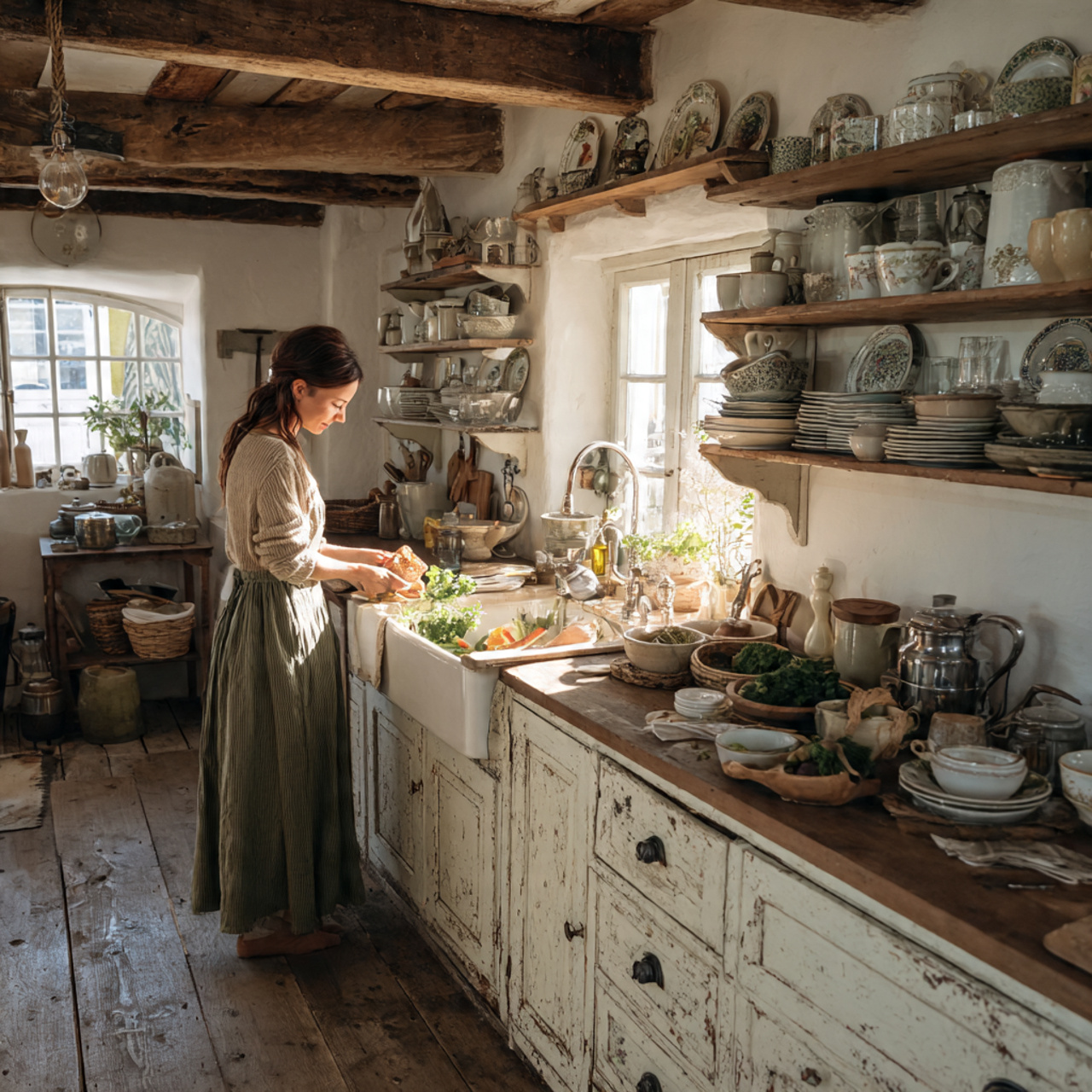
Farmhouse cabinetry is built around the idea that a kitchen should feel well-used and genuinely loved. Distressed finishes, soft chalk paint, and slightly irregular edges create a warmth that pristine factory-finished cabinets cannot manufacture regardless of price point.
Hardware selection is where the farmhouse aesthetic either lands or collapses. Black iron hinges, porcelain knobs, or aged bronze pulls all reinforce the lived-in feel. Shiny chrome or modern bar pulls immediately break the illusion, no matter how well the paint is applied. Treating the hardware as an equal design decision to the paint itself is the difference between a cohesive farmhouse kitchen and one that reads as a costume.
Best for: Families who want a durable, casual kitchen that absorbs the marks of daily life gracefully Product: Annie Sloan Chalk Paint in Old White or Country Grey applied to existing cabinets or Pottery Barn’s Benchwright kitchen line Pro tip: Distress painted edges with 120-grit sandpaper after the final coat, focusing on corners and contact points, to make the wear look organic rather than theatrical. Room Fit: Country homes, family kitchens, homes with large kitchen tables Designer language: “Hand-applied chalk finish with intentional edge wear in a matte patina” Room size: Suits medium to large kitchens, especially effective in spaces with high ceilings and exposed beams
Matte Black Contemporary Look
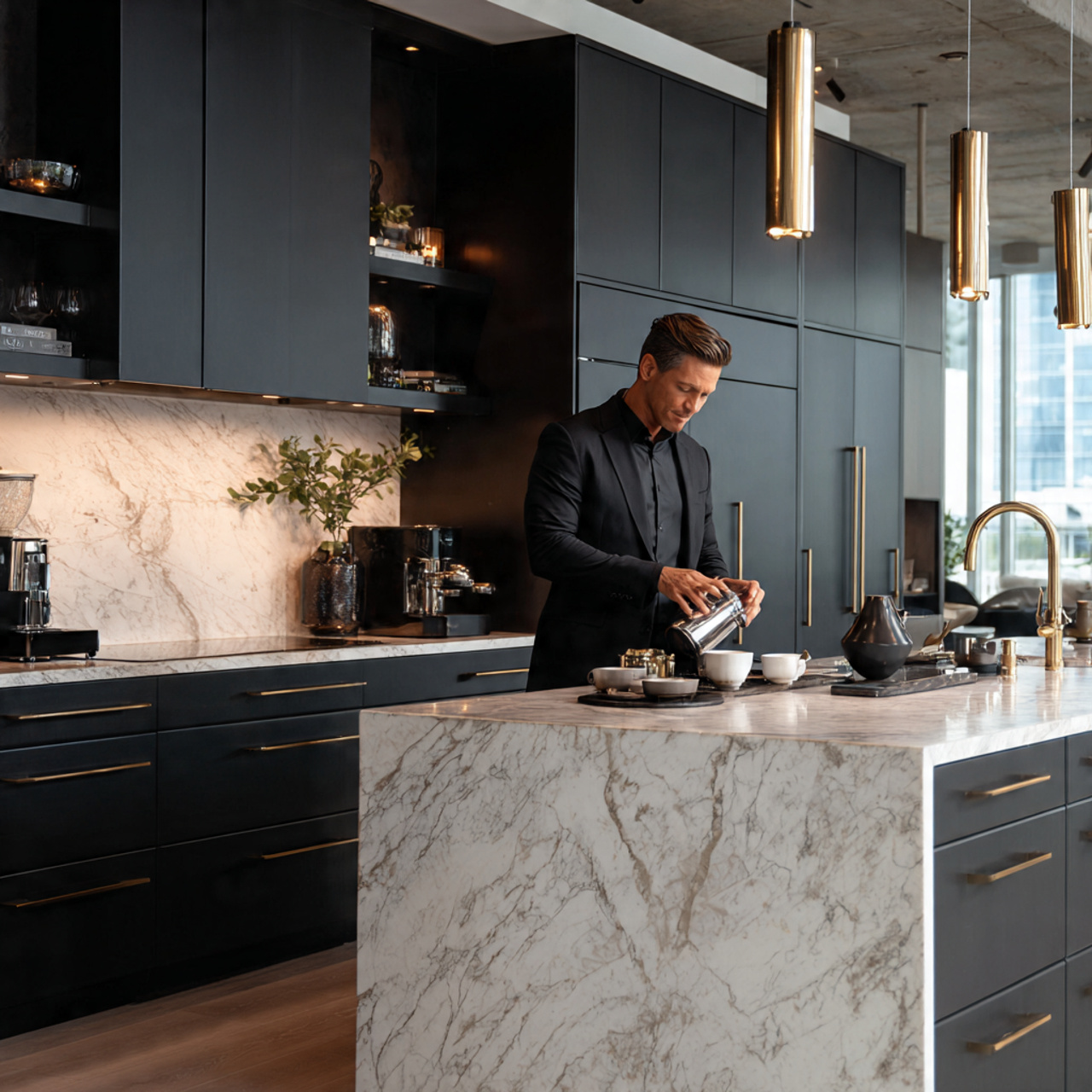
Matte black cabinetry is one of those rare design choices that photographs beautifully and also lives beautifully in daily use. The velvety texture absorbs light in a way gloss finishes cannot, so every surface reads as intentional depth rather than a reflective plane competing with everything else in the room.
One detail most homeowners miss is the difference between true matte and satin matte in black cabinetry. True matte has zero sheen and can feel slightly chalky to the touch if the substrate is not properly primed. Satin matte, available through Farrow and Ball in Off-Black (No. 57) as a specialist cabinet paint, carries just enough luster to feel luxurious without crossing into semi-gloss territory. Always request a physical finish sample and assess it under your kitchen’s actual lighting conditions before committing, because the difference between these two finishes changes dramatically under different bulb temperatures.
Best for: Those who want a bold, statement-level kitchen that reads as authoritative and high-end Product: Farrow and Ball Off-Black (No. 57) for painted cabinets or IKEA AXSTAD dark gray matte doors as a budget-conscious alternative Pro tip: Pair matte black cabinets with unlacquered brass hardware so the warm gold tones develop a natural patina that softens the contrast over time. Room Fit: Modern kitchens, open-plan chef spaces, high-contrast contemporary interiors Designer language: “True matte lacquered finish in a deep graphite or near-black tone” Room size: Most impactful in medium to large kitchens where the dark finish does not compress the visual space
Floor to Ceiling Storage Layout
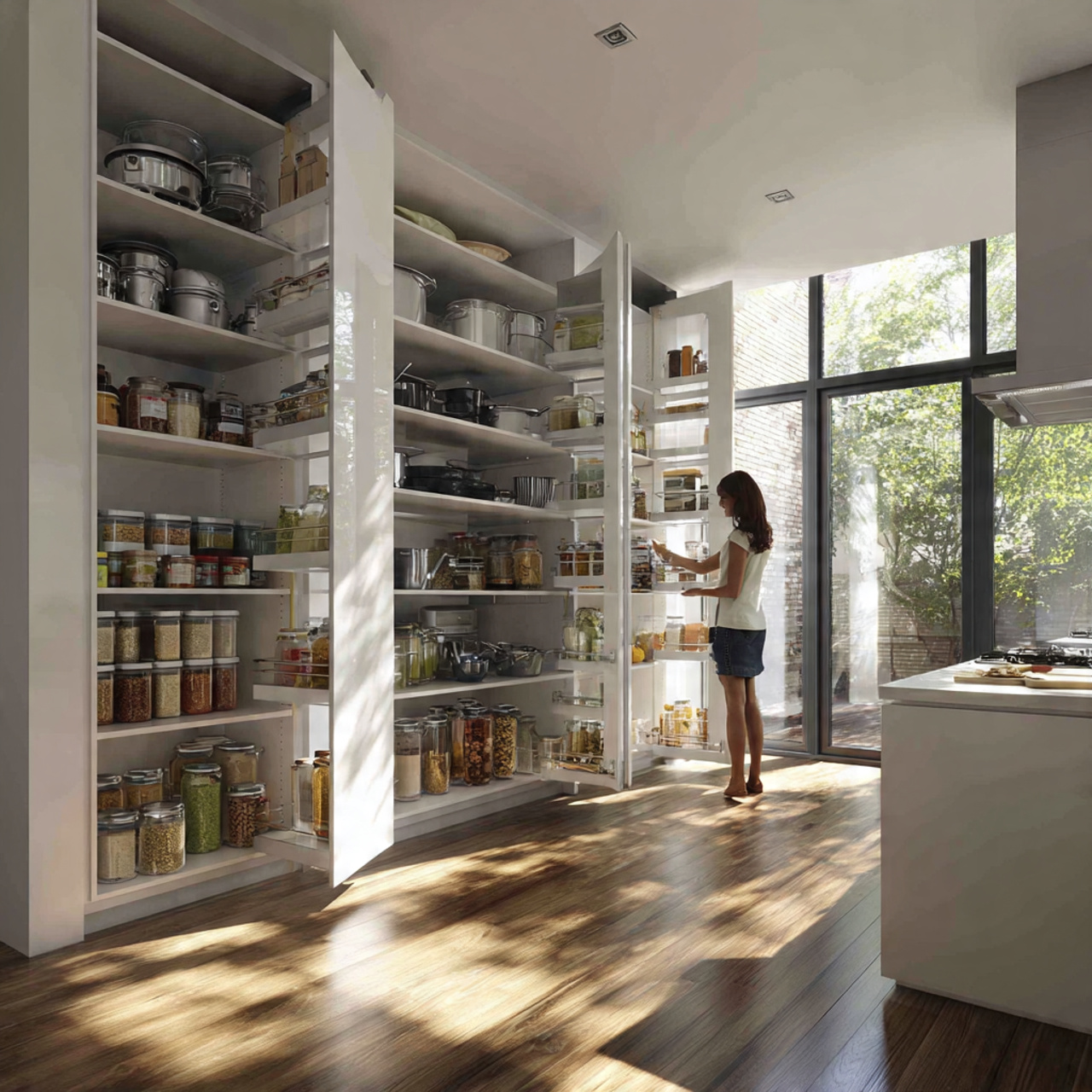
Taking cabinetry all the way to the ceiling is one of the highest-value decisions a homeowner can make during a kitchen renovation. Beyond eliminating the dust-collecting ledge above standard-height units, it creates a visual effect that makes the room feel taller and architecturally complete in a way nothing else achieves.
Best for: Homeowners who need serious storage capacity without compromising on aesthetics Product: IKEA SEKTION with extended top units reaching ceiling height or custom millwork through Cali Bamboo Cabinetry Pro tip: Reserve the section above the natural reach line for items used once a year, like serving platters and seasonal cookware, so everyday efficiency stays intact in the accessible zones below. Room Fit: Galley kitchens, narrow urban kitchens, high-ceilinged loft-style spaces Designer language: “Full-height integrated cabinetry with ceiling termination detail” Room size: Excellent in all sizes, transformative specifically in small kitchens where maximizing vertical storage is the primary challenge
Pastel Mint Green Inspiration
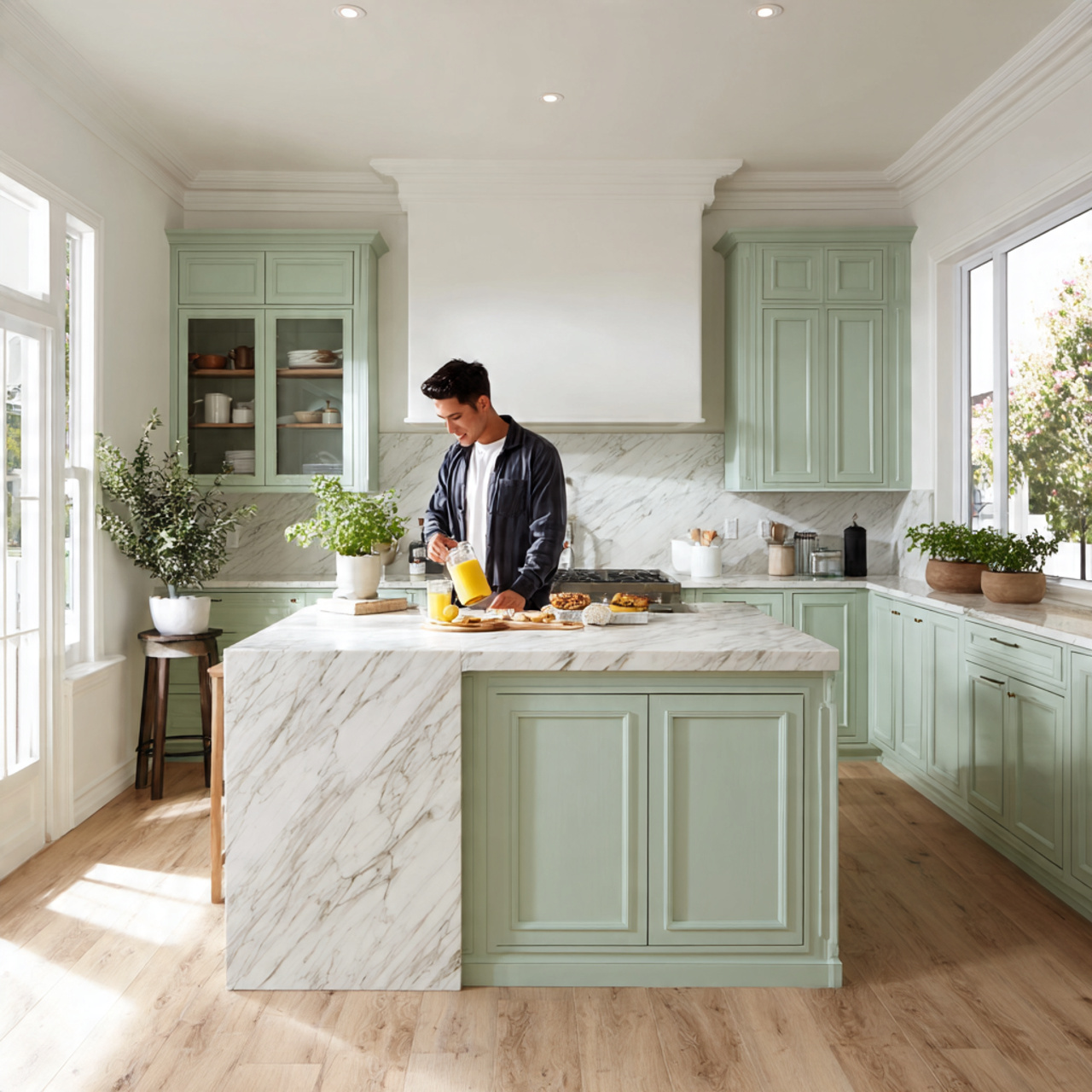
Mint green in cabinetry today is not the saturated seafoam that felt dated in the 1990s. The current version sits closer to a pale celadon with soft, desaturated tones that read almost as a warm neutral under certain light conditions, making it far more versatile than most homeowners expect.
This hue pairs best with natural and organic materials rather than polished or industrial ones. A mint green cabinet wall looks its absolute best alongside raw linen window treatments, a terracotta tile floor, or an unlacquered wood island top. The softness of the color calls for softness in every adjacent surface rather than the hard contrast of steel or stone.
Best for: Those who want a playful, spring-forward kitchen that still feels polished and intentional Product: Farrow and Ball Mizzle (No. 266) or Benjamin Moore Palladian Blue (HC-144) in an eggshell cabinet finish Pro tip: Pair mint cabinets with warm brass hardware rather than chrome so the green does not read too cool and clinical under artificial light. Room Fit: Cottage kitchens, beach house kitchens, small to mid-size home kitchens Designer language: “Celadon-toned lacquer with warm undertones in a soft chalky finish” Room size: Best in small to medium kitchens where the lightness of the hue keeps the space feeling open and airy
Exposed Reclaimed Wood Design
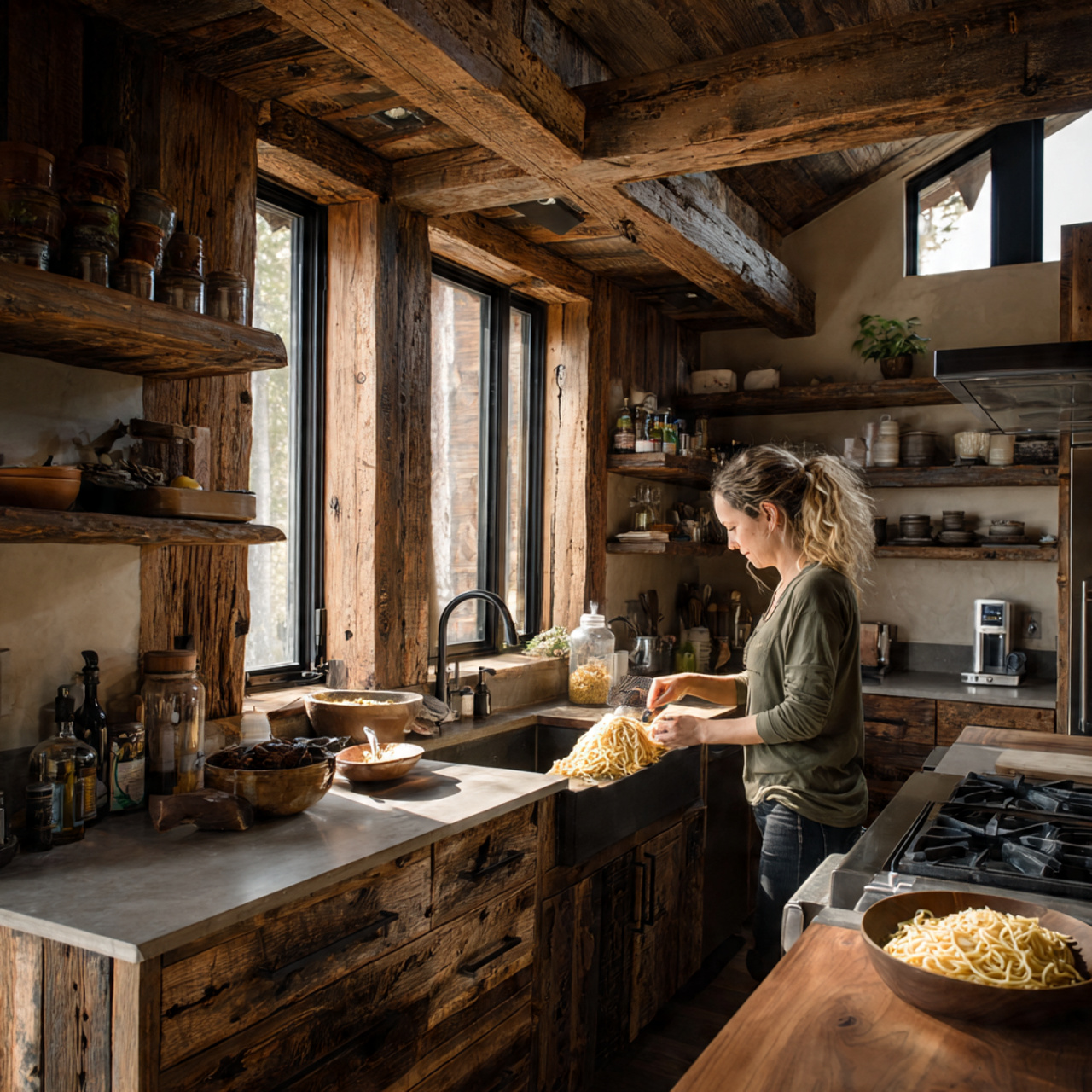
Reclaimed wood cabinetry brings a layer of narrative to the kitchen that no manufactured material can replicate. The nail holes, saw marks, and color variation in salvaged barnwood or factory timber are not defects. They are the entire point of the material.
Best for: Environmentally conscious homeowners who value authenticity and one-of-a-kind material quality Product: Reclaimed wood cabinet fronts from Elmwood Reclaimed Timber or custom doors through Build With Ferguson using salvaged stock Pro tip: Seal reclaimed wood cabinet faces with Osmo Polyx Oil in clear matte finish to protect against kitchen moisture while preserving the raw, weathered character of the grain. Room Fit: Rustic kitchens, lodge-style homes, industrial-rustic hybrid spaces Designer language: “Salvaged timber face frame with oxidized patina and visible material history” Room size: Most effective in large, open-plan kitchens where the texture has enough visual space to read as intentional rather than rough
Inset Cabinetry Craftsmanship
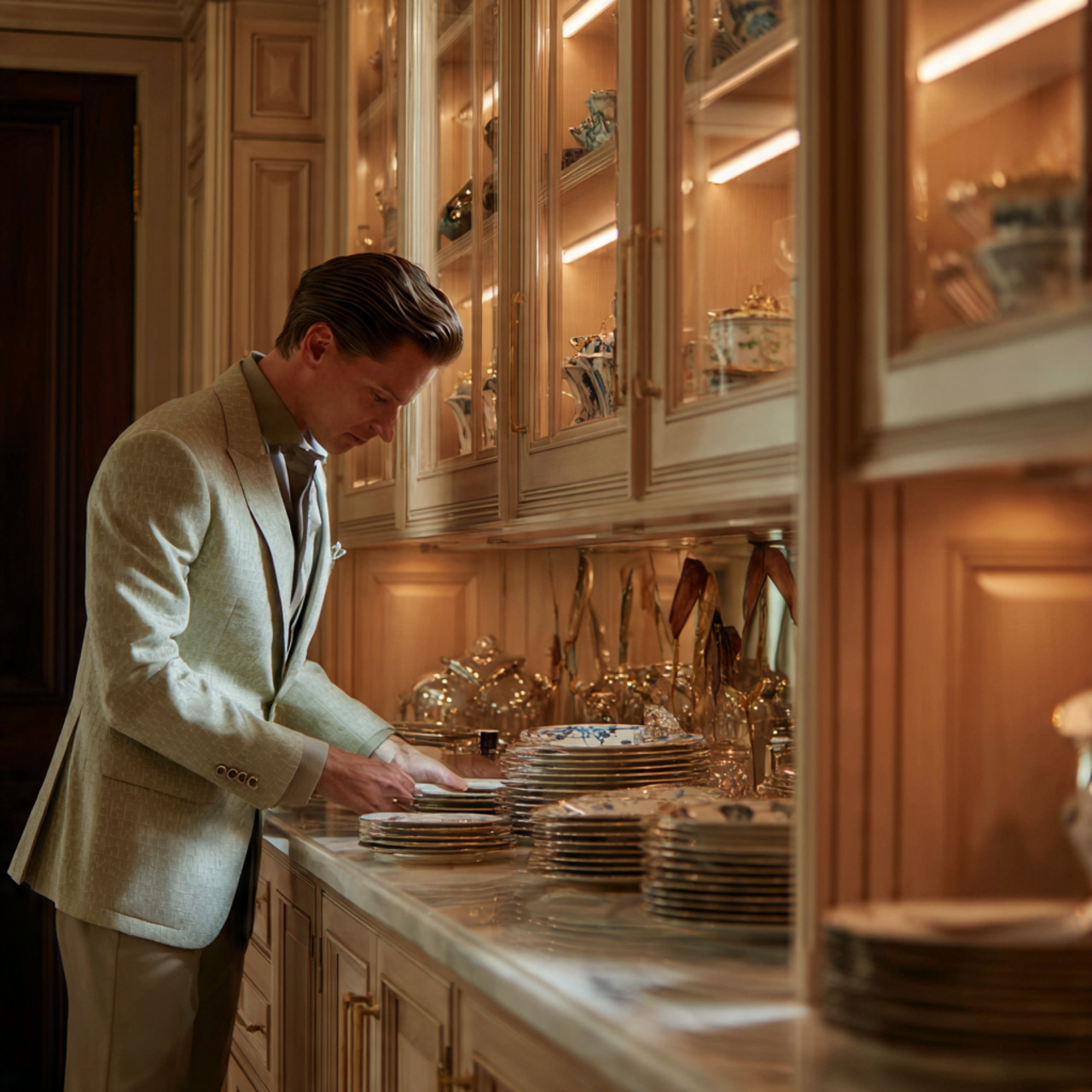
Inset cabinets represent the intersection of fine furniture and kitchen millwork. The door and drawer fronts sit flush inside the cabinet frame rather than overlaying it, requiring tighter tolerances and a level of craftsmanship that sets this style immediately apart from any flat-pack format.
Best for: Those investing in a long-term kitchen that reads with the quality of bespoke furniture Product: Plain English Cupboard Company or DeVOL Kitchens for high-end inset cabinetry Pro tip: Always specify soft-close inset hinges because standard hinges on flush doors create a visible gap that undermines the precision look and feel entirely. Room Fit: Traditional kitchens, English country kitchens, formal family kitchens Designer language: “Inset door and drawer construction with a furniture-grade face frame finish” Room size: Works beautifully at all scales, most refined in large kitchens where precision detailing reads across an expansive wall
Bold Navy Blue Statement Style
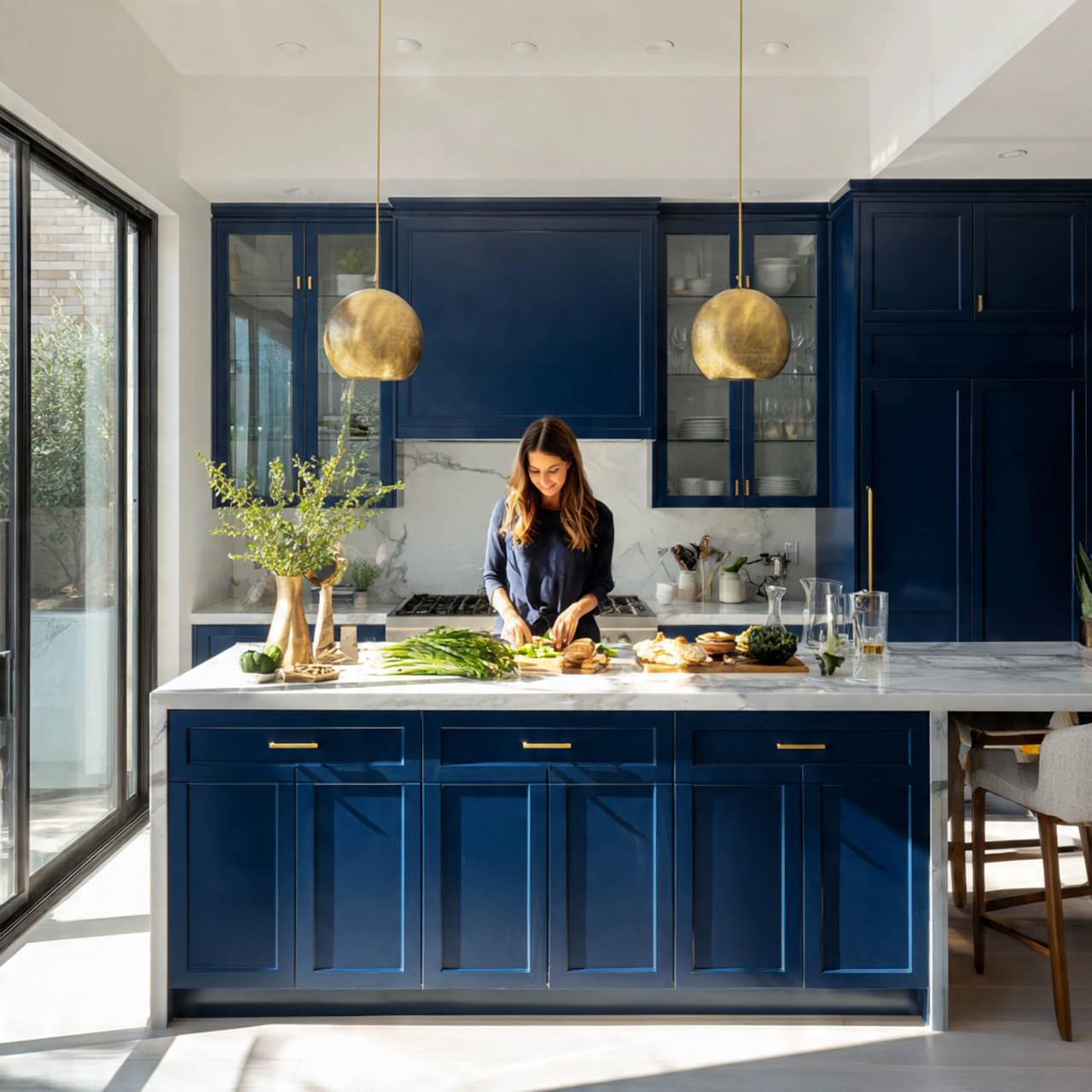
Navy has earned a permanent place in the kitchen cabinet palette not because it trends and fades but because it functions as a true deep neutral. It recedes visually like a dark color while carrying enough warmth and vibrancy to feel alive rather than oppressive, which is why designers return to it year after year.
The decision between a flat navy and a satin navy finish changes the entire character of the room. Farrow and Ball Hague Blue (No. 30) in a flat finish reads as composed and classic, suited for a traditional or transitional kitchen where restraint is the goal. Benjamin Moore Hale Navy (HC-154) in a satin finish creates more energy and light reflection that works better in open-plan contemporary spaces with strong natural light. Understanding this distinction before committing to a finish code can save both money and a costly repaint, which is the kind of specification-level knowledge that separates experienced designers from those working from inspiration boards alone.
Best for: Those who want a bold but enduring color that anchors the entire kitchen without feeling trendy Product: Farrow and Ball Hague Blue (No. 30) or Benjamin Moore Hale Navy (HC-154) in a satin cabinet finish Pro tip: Apply navy only to the lower cabinets first if you are uncertain about full commitment, then assess the balance before deciding whether the uppers need to match or contrast. Room Fit: Traditional kitchens, coastal-inspired kitchens, open-plan living and dining spaces Designer language: “Deep-toned lacquer in a blue-navy family with period-appropriate brass or iron hardware” Room size: Works in all sizes, most commanding in medium to large kitchens with good natural light
Industrial Metal Frame Concept
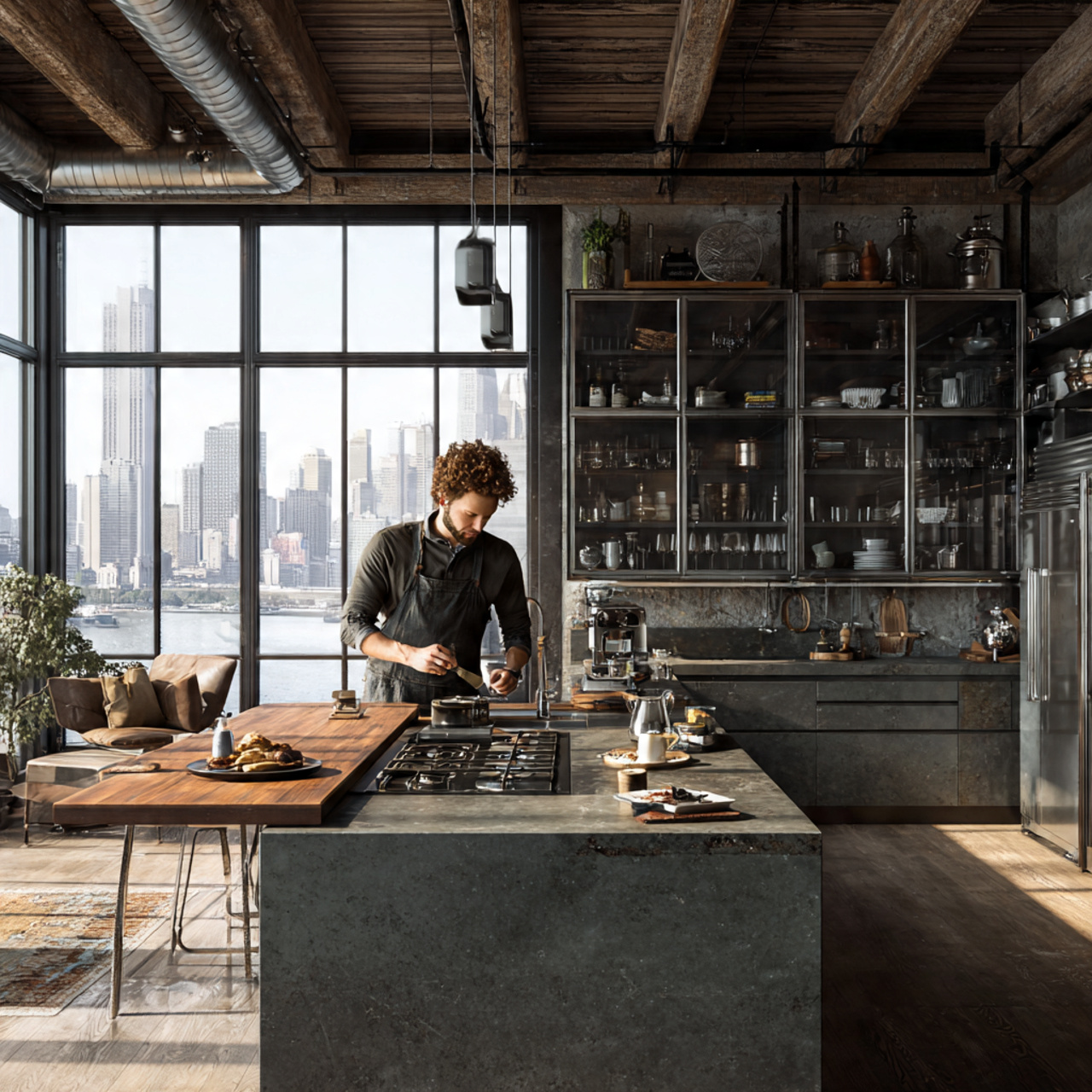
Steel and wire mesh cabinet frames belong in a category most kitchen suppliers do not carry off the shelf. This look requires custom metal-frame doors through fabrication shops or specialty retailers, and the result is a kitchen that feels genuinely singular rather than assembled from a catalog.
Best for: Urban loft dwellers and design-forward homeowners who want a commercial-inspired kitchen with real edge Product: Custom metal-frame doors through a local fabrication shop or Rejuvenation’s archive-style mesh cabinet panels Pro tip: Specify a matte black powder coat on all metal frames rather than a polished finish so dust and fingerprints stay invisible between cleaning sessions. Room Fit: Loft kitchens, open-plan industrial-style spaces, live-work studios Designer language: “Blackened steel frame with perforated or woven mesh inset door panel” Room size: Best in large, open-plan kitchens where the industrial aesthetic has enough space to breathe
Floating Cabinetry Configuration
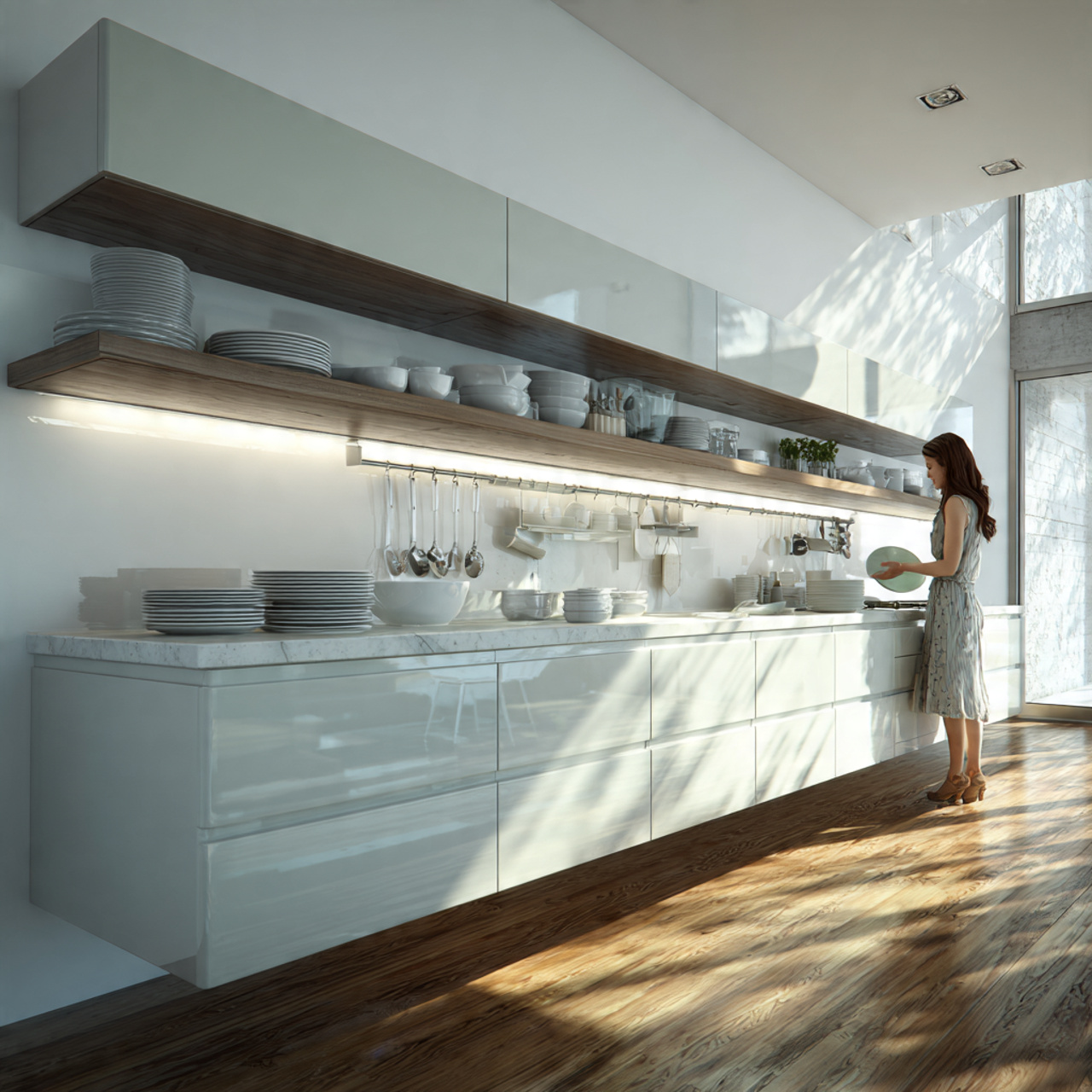
Wall-mounted base cabinets without floor contact create a visual gap beneath the unit that transforms the way the floor reads in the kitchen. Equally important, this gap accommodates integrated LED strip lighting that illuminates the floor and makes the cabinetry appear to hover above the surface.
Best for: Design-forward homeowners who want a gallery-like, furniture-quality kitchen presence Product: Bulthaup B3 wall-mounted base system or IKEA SEKTION base units with custom wall-mounting modifications Pro tip: Run a continuous LED strip along the entire underside of floating base units at 2700K warmth so the glow reads amber rather than blue-white and complements the kitchen’s overall palette. Room Fit: Minimalist and contemporary kitchens, open-plan spaces, large-format tile floor kitchens Designer language: “Elevated base cabinetry with concealed wall-mount hardware and integrated soffit lighting” Room size: Best suited to medium to large kitchens where the floor gap has enough visual space to create meaningful impact
Beadboard Panel Classic Look
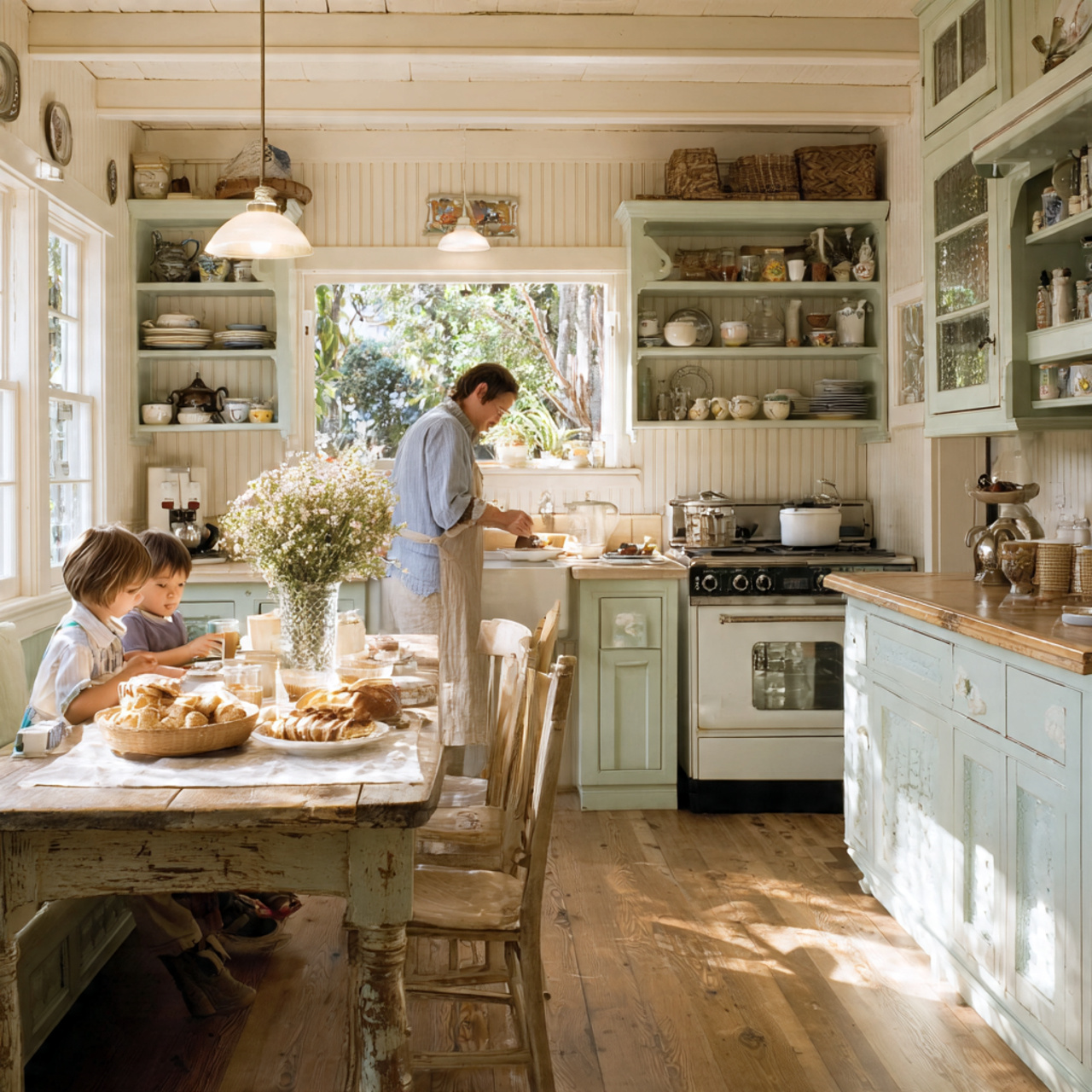
Beadboard brings a rhythmic, vertical texture to cabinet doors that reads differently depending on what surrounds it. Against an all-white kitchen, the thin grooves cast subtle shadow lines that prevent the room from feeling flat. Against a warm wall color, beadboard cabinetry evokes a well-appointed country house without requiring any period furniture.
One practical advantage of beadboard is that minor dings and scratches along the vertical grooves become almost invisible because the eye is already reading the surface as textured and varied. This makes it one of the more forgiving cabinet styles for households with children, since wear patterns blend into the existing visual rhythm rather than standing out as damage.
Best for: Those who want classic tactile texture without the weight of solid raised paneling Product: Beadboard cabinet doors from Kraftmaid or custom routed doors through Home Depot’s cabinet department Pro tip: Paint beadboard doors in an off-white like Benjamin Moore Chantilly Lace (OC-65) rather than stark bright white so the shadows in the grooves read as warm rather than cold gray. Room Fit: Cottage kitchens, traditional homes, coastal beach houses Designer language: “Vertical-groove beadboard panel door in a furniture white or soft cream painted finish” Room size: Works at all scales, most charming in small to medium kitchens where textural detail adds richness without requiring extra space
Warm Walnut Mid Century Style
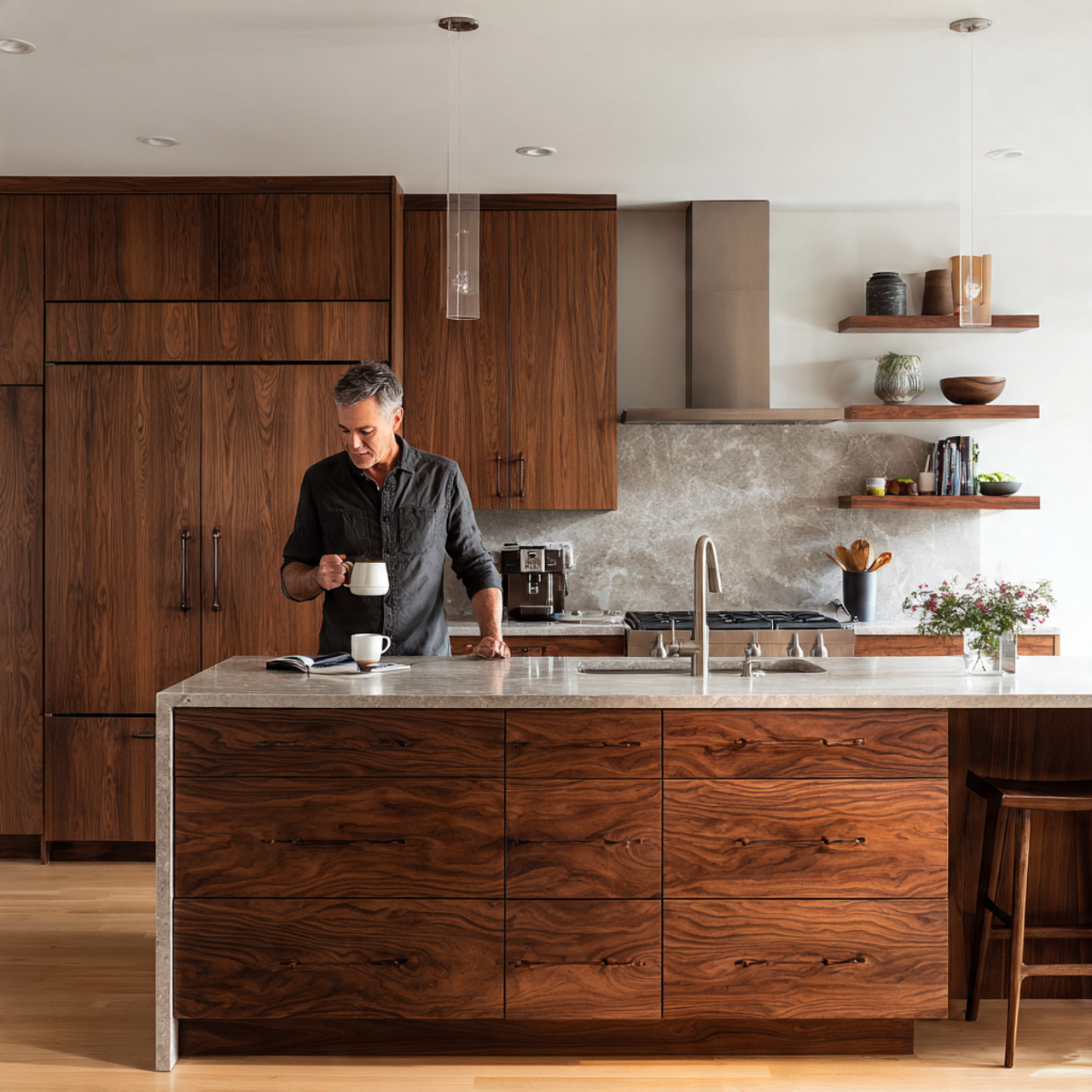
Walnut cabinetry occupies a rare position in the design world where it holds both deep historical roots and strong current commercial relevance. The dark honey to chocolate grain pattern is distinctive enough to serve as the visual anchor for the entire kitchen without needing help from bold paint or statement hardware.
Best for: Mid-century modern enthusiasts and those who want rich, warm wood tones as the primary focal point Product: Plywood Project walnut-veneer cabinet fronts or Semihandmade Shaker-style walnut doors sized for IKEA SEKTION carcasses Pro tip: Orient walnut door panels horizontally rather than vertically on lower cabinets to flatten the grain pattern and make the kitchen read as wider and more contemporary. Room Fit: Mid-century modern homes, open-plan living spaces, architect-designed interiors Designer language: “American black walnut veneer millwork in a natural or lightly fumed finish” Room size: Most effective in medium to large kitchens where the richness of the material does not feel visually dense
Hidden Walk In Pantry Design
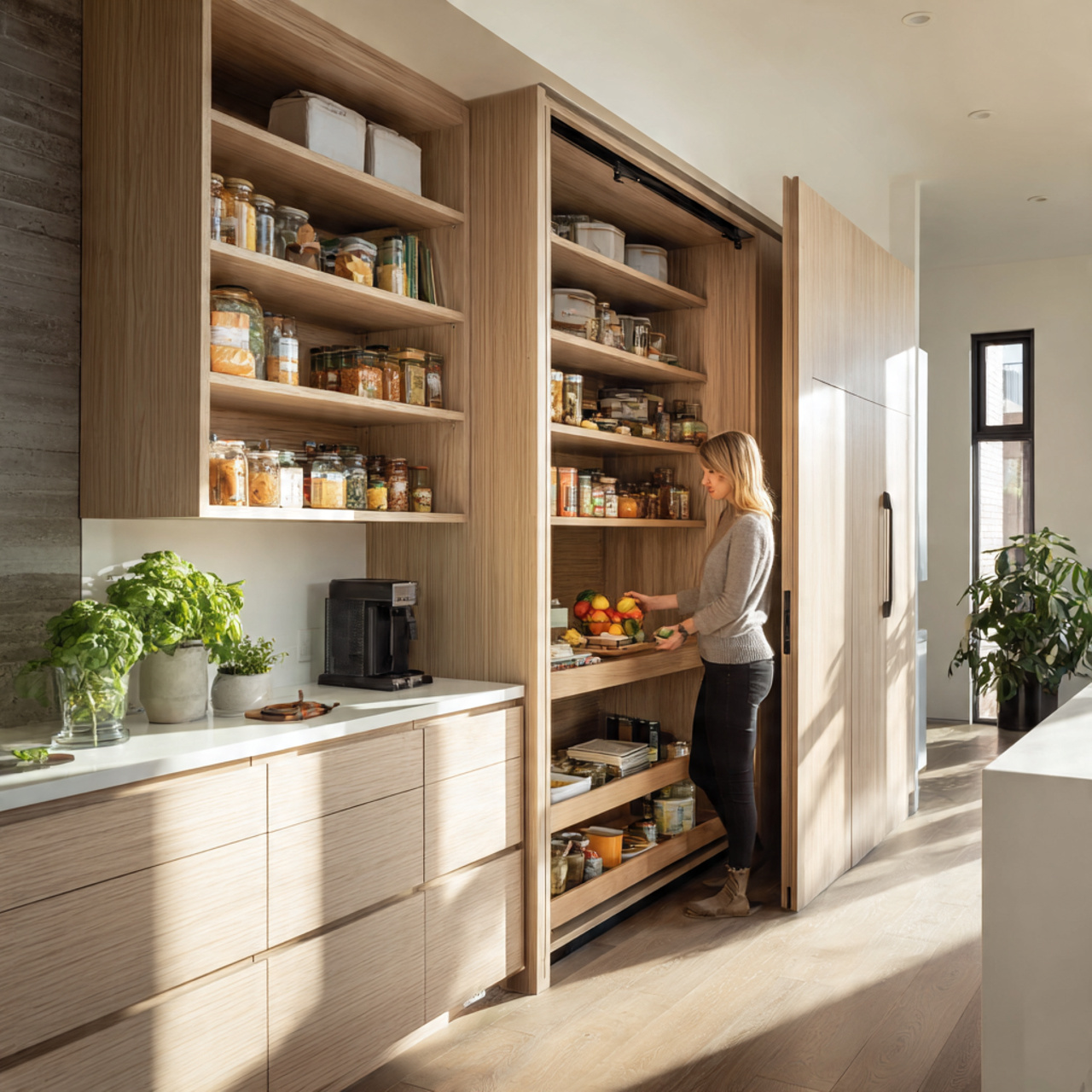
A pantry concealed behind a wall of matching cabinetry is one of the most compelling organization solutions in residential kitchen design. When executed correctly, the hidden door aligns seamlessly with adjacent cabinet panels, creating a continuous elevation that reveals the pantry only when you know exactly where to look.
The key to making a hidden pantry work is the door hardware. A pivot hinge rather than a standard butt hinge allows the door to swing open without an exposed pin barrel or a gap at the reveal that breaks the continuous panel line. Specialty hardware manufacturers like Sugatsune and Hafele both produce concealed pivot systems that professional cabinetmakers specify for exactly this application. Matching the hinge load capacity to the door weight is a non-negotiable technical detail, because a heavy solid wood panel on an undersized hinge will sag within eighteen months and destroy the seamless effect entirely.
Best for: Homeowners who want maximum storage concealed behind a clean, uninterrupted kitchen wall Product: Hafele concealed pivot hinge system paired with custom matching cabinet panels through a local millwork shop Pro tip: Include a magnetic touch-latch on the hidden pantry door so no handle is visible and the surface reads as a true unbroken cabinet wall. Room Fit: Large family kitchens, open-plan entertaining spaces, luxury kitchen renovations Designer language: “Flush-panel concealed door with integrated pivot hardware and continuous matching finish” Room size: Requires a medium to large kitchen footprint to accommodate the pantry depth behind the entry point
Visit Also: Bathtub Ideas
Arched Glass Door Aesthetic
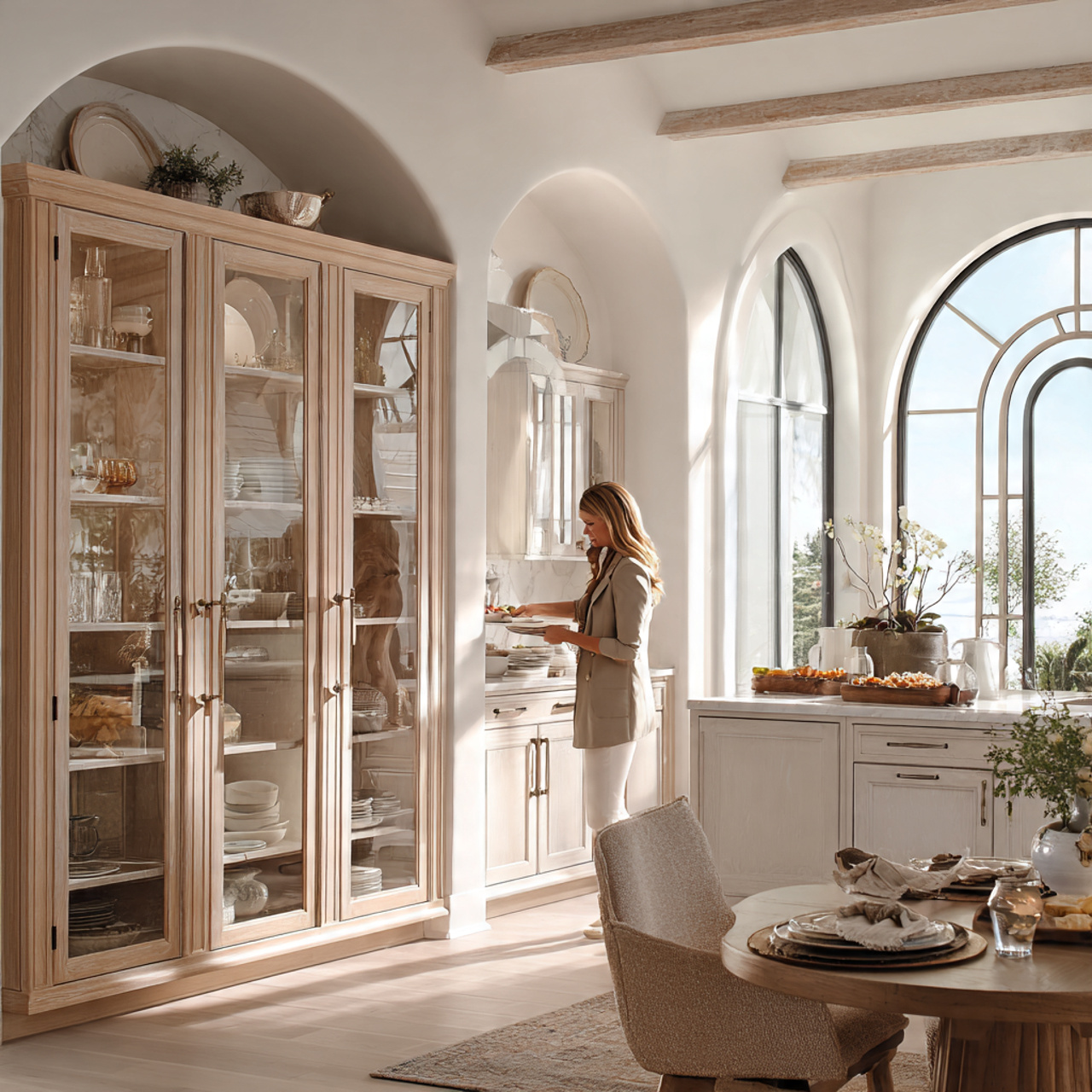
Arched cabinet doors introduce a vocabulary into the kitchen normally associated with European architecture and formal residential interiors. The curved top draws the eye upward and creates a sense of handcraft that square doors cannot replicate regardless of material quality or price.
Best for: Those who want European elegance and a bespoke feel that elevates a kitchen beyond standard layouts Product: Arched glass cabinet doors through Signature Hardware or custom millwork through Aya Kitchens Pro tip: Specify a consistent arch radius across all doors so the repeating curves create a visual rhythm rather than varying widths that look inconsistent when viewed from across the room. Room Fit: Traditional kitchens, formal dining kitchens, European-inspired interiors Designer language: “Arched-top glazed door with muntin grid and a period profile frame” Room size: Works at all sizes, most dramatic when used across a full upper cabinet wall in medium to large kitchens
Soft Sage Green Earthy Look
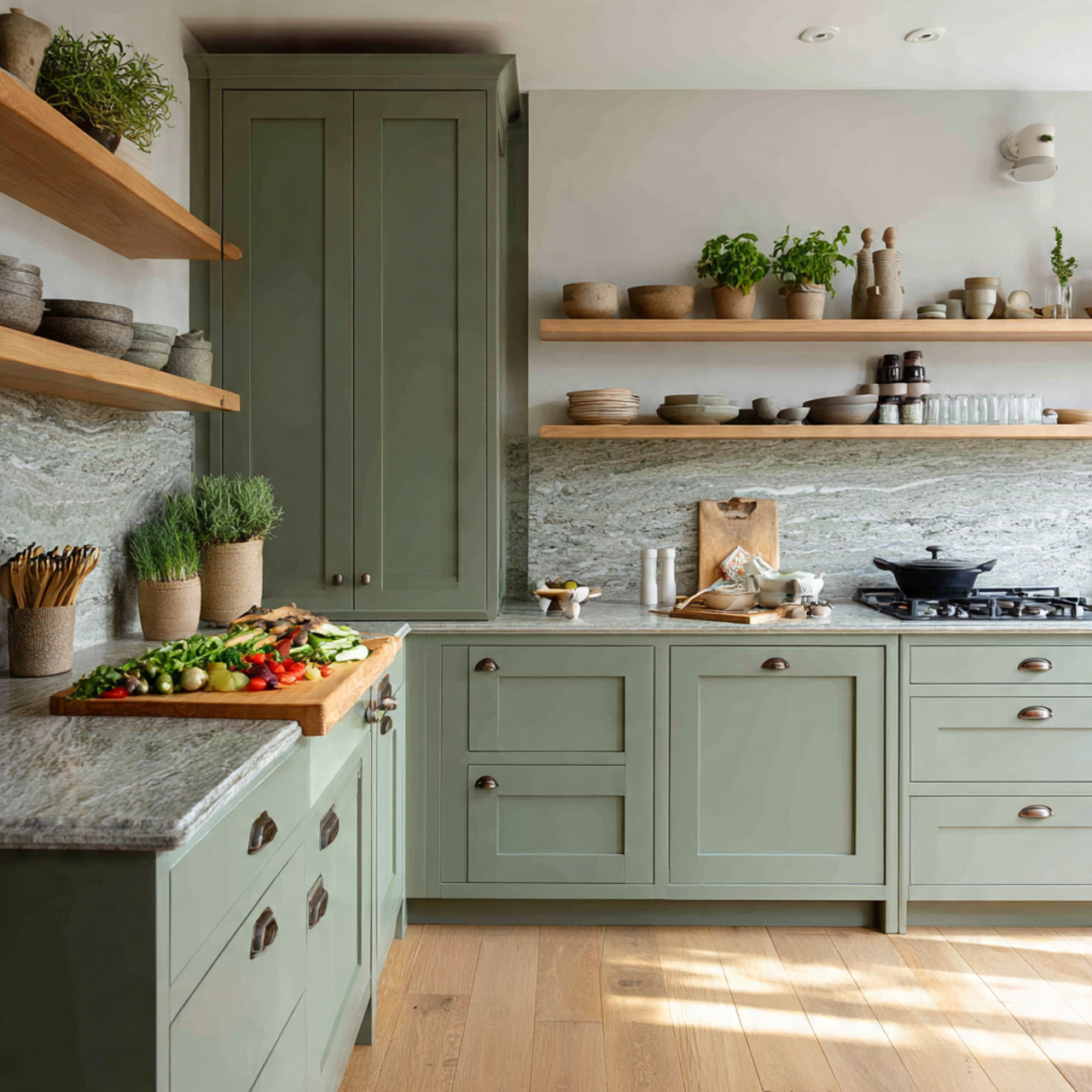
Sage green has moved well past trend status into the category of considered classic. Its muted, silvery undertones make it highly compatible with a wide range of countertop and flooring materials, from honed black granite to bleached white oak, which is precisely why it continues to earn repeat placement in high-end residential kitchens.
Best for: Those who want a calming, nature-forward kitchen that still feels polished and precise Product: Farrow and Ball Mizzle (No. 266), Sherwin-Williams Rosemary (SW 6187), or Benjamin Moore Dried Thyme (2143-40) Pro tip: Test sage green paint under your kitchen’s actual bulb temperature because the color reads dramatically cooler under daylight bulbs versus warm 2700K incandescents, and the wrong choice makes the cabinets look gray rather than green. Room Fit: Organic modern kitchens, Japandi-inspired spaces, family kitchens with natural material accents Designer language: “Muted green lacquer in a sage or tea-leaf family with warm gray undertones” Room size: Works beautifully at all sizes, especially grounding in large kitchens where a bolder color might feel too intense
Mirrored Surface Glamour Idea
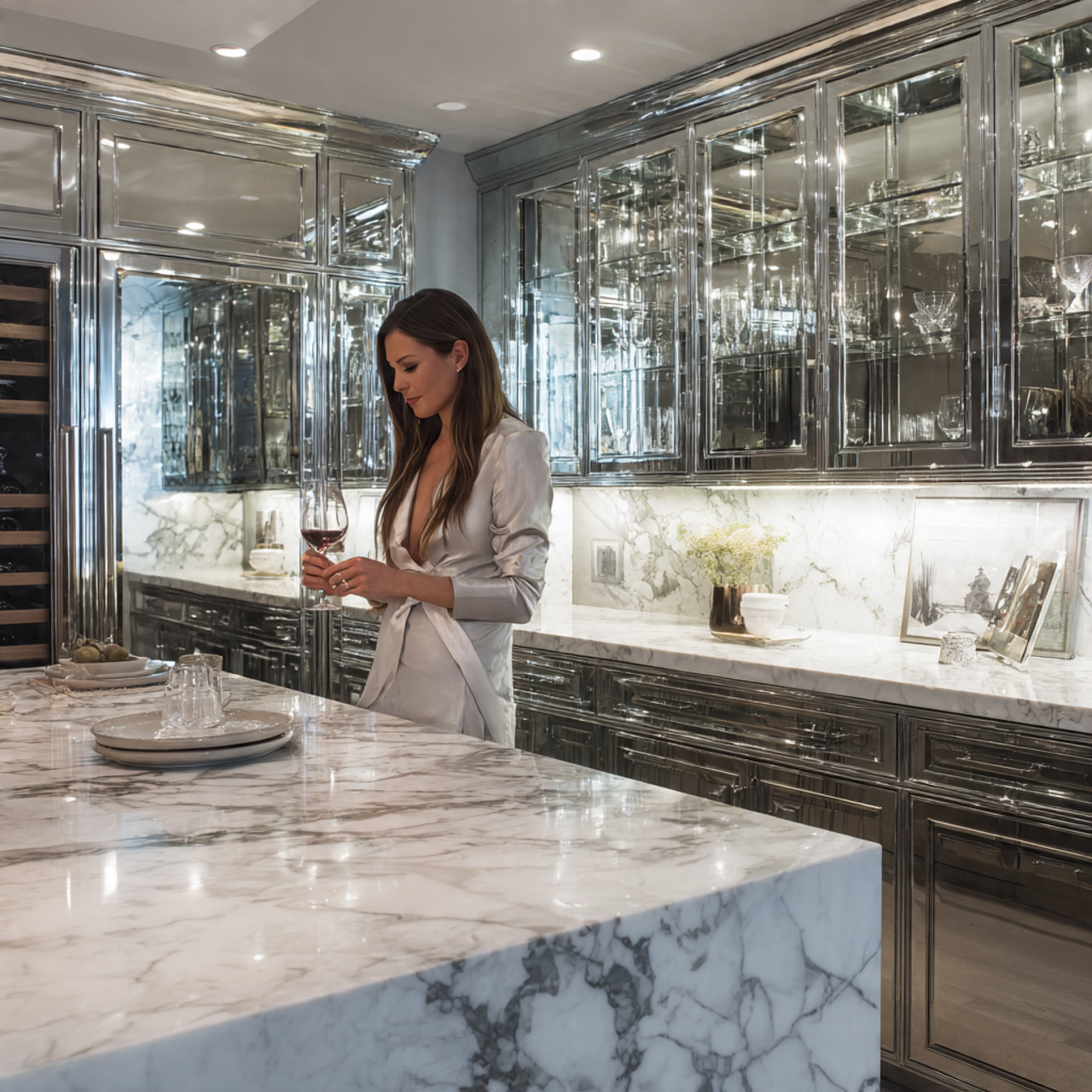
Mirrored cabinet panels land somewhere between high-gloss lacquer and a true statement design moment. The reflection doubles the apparent size of the room and adds a quality of light play that changes with the time of day in a way no paint or veneer finish can approach.
Best for: Those who want maximum drama and a Hollywood Regency or Art Deco-inspired kitchen presence Product: Custom mirrored cabinet panels through CB2’s custom cabinet line or specialty mirror suppliers like S&S Glass Pro tip: Specify antiqued mirror panels rather than clear contemporary mirror so the reflection reads as warm and slightly aged rather than clinical and stark. Room Fit: Formal kitchens, entertaining-focused kitchen dining spaces, compact urban kitchens Designer language: “Antique mirror panel door in a beveled or frameless profile with warm tinting” Room size: Particularly transformative in small to medium kitchens where the reflection creates a convincing sense of expanded depth
Slatted Wood Texture Design
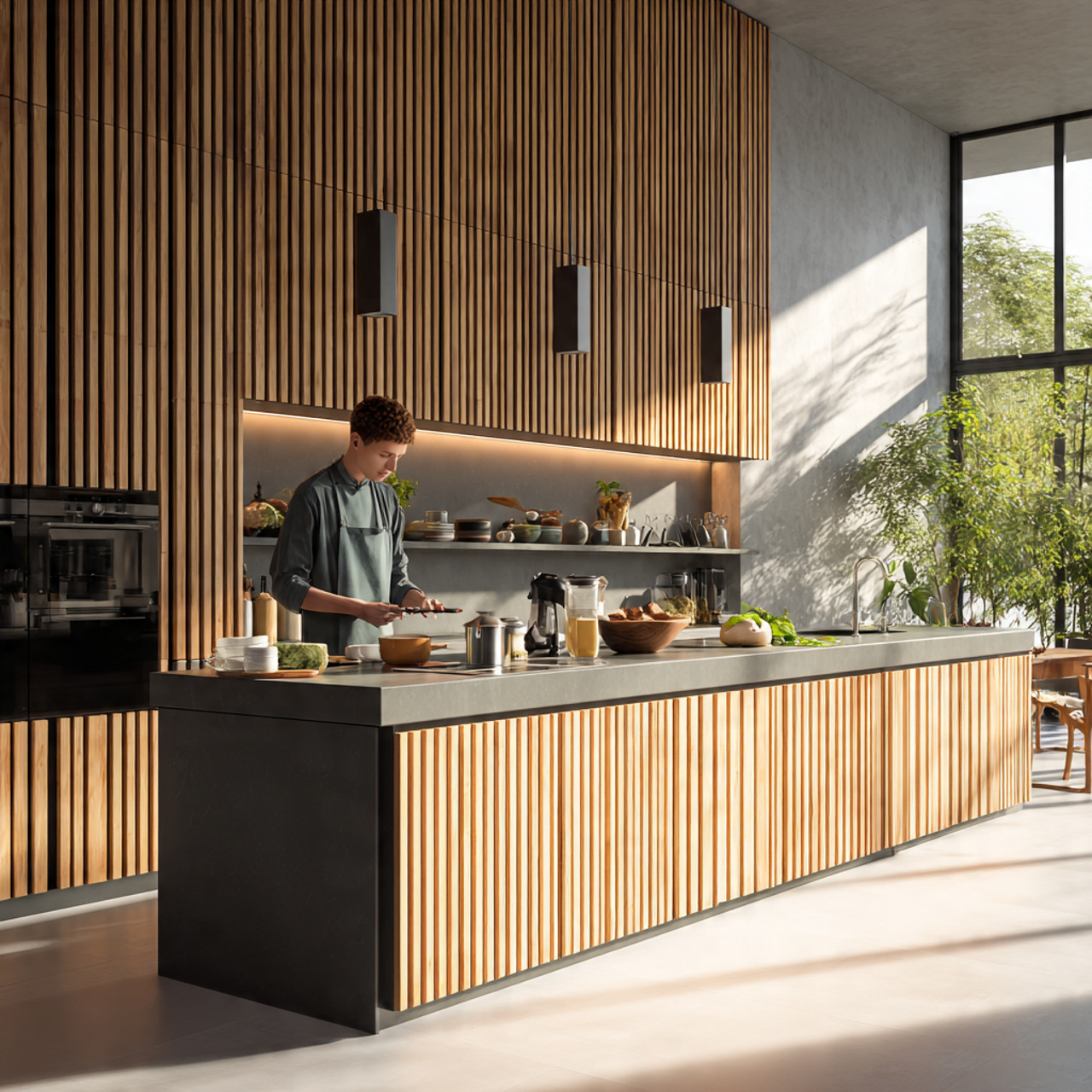
Fluted or slatted wood cabinetry has become one of the defining visual signatures of the current design moment. The thin vertical ribs cast micro-shadows that shift as the light changes throughout the day, making the cabinet face a dynamic and textural element rather than a static background plane.
Best for: Design-forward homeowners who want a contemporary texture that photographs well and lives beautifully day to day Product: Fluted oak or walnut cabinet fronts from Semihandmade or custom-routed MDF panels from The Cabinet Face Pro tip: Use slatted panels only on the kitchen island or a single run of lower cabinets rather than throughout the entire kitchen so the texture reads as a focal element rather than becoming visually exhausting. Room Fit: Contemporary kitchens, open-plan spaces, kitchens with statement islands Designer language: “Vertical-reed or fluted panel profile in a natural timber or painted finish” Room size: Works best in medium to large kitchens where the island or feature wall has enough volume to carry the texture
High Contrast White and Gold Style
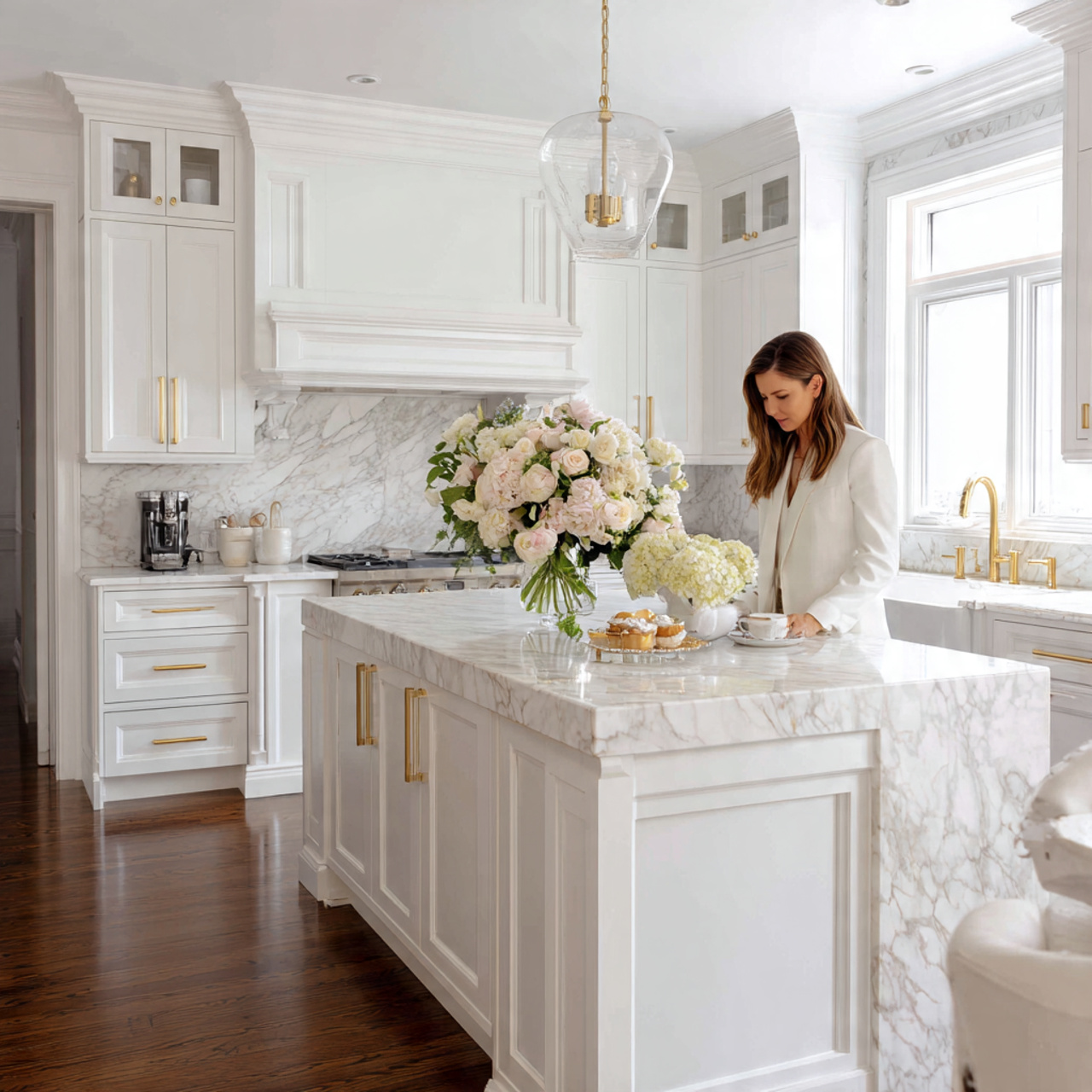
White cabinetry with gold hardware remains the most reliably popular combination in the market, and understanding why helps you execute it far better than average. The white surface reflects all available light while the gold acts as a warm focal point that draws the eye to every door and drawer without requiring anything else in the room to compete for attention.
The critical variable in this pairing is the undertone of the white and the tone of the gold. A stark, blue-white like Benjamin Moore Simply White (OC-17) reads best with bright polished brass like Top Knobs’ Polished Brass collection because both carry a clear, high-contrast quality. A creamier off-white like Sherwin-Williams Alabaster (SW 7008) pairs far more beautifully with unlacquered or aged brass carrying depth and warmth, available through Rejuvenation or Schoolhouse Electric. Mixing a cool white with warm antique brass creates a subtle visual discord that most people cannot name but can feel the moment they stand in the kitchen, and correcting it after installation is both expensive and disruptive.
Best for: Those who want a timeless, endlessly stylish kitchen that works as well in fifteen years as it does today Product: Benjamin Moore Simply White (OC-17) with Top Knobs Polished Brass hardware or Sherwin-Williams Alabaster (SW 7008) with Rejuvenation unlacquered brass pulls Pro tip: Specify full-extension soft-close drawer hardware inside the boxes even in a white-and-gold kitchen because the sound and feel of opening a drawer is part of the daily experience. Room Fit: Classic kitchens, transitional homes, bright open-plan kitchens Designer language: “Crisp painted millwork in a white or cream family with solid brass or polished brass hardware” Room size: Works at all sizes, most impactful in large kitchens where white amplifies natural light across an expansive wall
Quick Comparison Table
| Cabinet Style | Room Type | Style | Budget Level | Wow Factor |
|---|---|---|---|---|
| Shaker Style Cabinetry | All kitchens | Transitional | $$ | ★★★☆☆ |
| Handleless Modern | Compact or contemporary | Minimalist | $$$ | ★★★★☆ |
| Open Shelving Integration | Galley or open-plan | Eclectic | $ | ★★★☆☆ |
| Moody Charcoal Paint | Medium to large | Modern | $$ | ★★★★☆ |
| Natural Oak Wood Grain | All sizes | Scandinavian | $$$ | ★★★★☆ |
| High Gloss Minimalist | Small or dark kitchens | Contemporary | $$$ | ★★★★☆ |
| Vintage Glass Front | Traditional or formal | Classic | $$ | ★★★☆☆ |
| Two Tone Color Contrast | L-shaped or island | Transitional | $$ | ★★★★☆ |
| Distressed Farmhouse | Large family kitchens | Rustic | $$ | ★★★☆☆ |
| Matte Black Contemporary | Modern or chef spaces | Bold modern | $$$ | ★★★★★ |
| Floor to Ceiling Storage | Galley or loft | Architectural | $$$ | ★★★★☆ |
| Pastel Mint Green | Cottage or beach | Playful | $$ | ★★★☆☆ |
| Exposed Reclaimed Wood | Rustic or lodge | Organic | $$$ | ★★★★☆ |
| Inset Cabinetry | Traditional or formal | Bespoke | $$$$ | ★★★★★ |
| Bold Navy Blue | All sizes | Statement | $$ | ★★★★★ |
| Industrial Metal Frame | Loft or studio | Industrial | $$$$ | ★★★★☆ |
| Floating Cabinetry | Minimalist or large | Contemporary | $$$$ | ★★★★☆ |
| Beadboard Panel | Cottage or coastal | Classic | $$ | ★★★☆☆ |
| Warm Walnut Mid Century | Open-plan or architect | Mid-century | $$$ | ★★★★☆ |
| Hidden Walk In Pantry | Large family kitchens | Luxury | $$$$ | ★★★★★ |
| Arched Glass Door | Traditional or European | Elegant | $$$ | ★★★★☆ |
| Soft Sage Green | All sizes | Organic modern | $$ | ★★★★☆ |
| Mirrored Surface Glamour | Formal or compact | Glamorous | $$$ | ★★★★★ |
| Slatted Wood Texture | Contemporary or island | Design-forward | $$$ | ★★★★☆ |
| High Contrast White and Gold | All sizes | Timeless | $$ | ★★★★★ |
Frequently Asked Questions
What are the best Kitchen Cabinets Ideas for a small kitchen in 2026? High-gloss finishes, handleless doors, and floor-to-ceiling storage are the three most effective Kitchen Cabinets Ideas for maximizing a small kitchen. Lighter tones like soft white or pale sage paired with open shelving on one wall maintain airiness while dramatically increasing usable storage.
How do I choose between painted and natural wood cabinets? Painted cabinets give you color flexibility and are easier to refresh when preferences change, while natural wood adds warmth and organic character that paint cannot replicate. Consider how much natural light your kitchen receives, since dark wood in a north-facing kitchen can feel heavy without careful light compensation.
What hardware finish works with the most cabinet colors? Unlacquered brass is the most versatile hardware finish because it develops a natural patina that warms over time and reads well against both light and dark cabinetry. Matte black is the second most flexible option, providing sharp contrast on pale cabinets and a tonal effect on darker ones.
Can I mix cabinet styles in one kitchen? Mixing styles works when you maintain one consistent element across all the cabinetry, such as the same door profile or the same paint color. Using open shelving alongside closed cabinetry is the most common and forgiving version of this approach and rarely looks unintentional.
How long does it take to install new kitchen cabinets? A standard kitchen cabinet installation typically takes between three and seven days depending on the size of the kitchen and whether the project includes custom millwork. Lead times for custom or semi-custom cabinet orders typically run eight to twelve weeks from order to delivery.
Final Thoughts
The kitchen you live in every day deserves more than a hasty cabinetry decision made under showroom fluorescent lights. These twenty-five Kitchen Cabinets Ideas exist to show you the full range of what is possible, from the whisper-quiet sophistication of natural oak to the bold confidence of matte black.
Start with the feeling you want the room to generate before you choose a finish. Warm and organic, crisp and architectural, moody and dramatic. Each direction in this list is a complete design world, and the right one for your home is the one that makes you want to be in the kitchen every single morning.
Give yourself permission to be specific. Tell your designer or contractor the exact shade name, the exact hardware finish, and the exact wood species. Vague direction produces average results, and average results disappoint at every price point.
The most important insider truth in cabinetry selection is this: the door profile is permanent and the color is not. Choose the construction quality and door style you can live with for twenty years, then repaint when the world moves on. Great cabinetry is a structural investment first and a style statement second.