25 Covered Patio Ideas That Will Transform Your Backyard Into a Stunning Retreat
Your backyard has potential you can feel every time you walk past the sliding door, but something keeps stopping you from actually spending time out there. The harsh afternoon sun drives you indoors before you finish a cup of coffee, and that bare concrete slab offers nothing to make you want to stay. Covered patio ideas exist precisely for this problem, and the right one turns a frustrating outdoor space into your most-used room.
This struggle is more common than most homeowners realize, and it has nothing to do with your taste or budget. Most new construction allocates a basic slab and nothing else, leaving every aesthetic and functional decision entirely to the people who move in.
The real reason most outdoor spaces fail to become livable is the absence of a ceiling. Interior designers have understood for decades that a ceiling is what transforms a floor plan from a set of walls into a series of rooms. Without one overhead, no amount of furniture or planting solves the fundamental discomfort of sitting in an exposed, unprotected space.
After years of studying what separates an extraordinary outdoor living room from a concrete pad with chairs, one pattern becomes undeniable. The most successful patios all started with a deliberate decision about the overhead structure, not the cushions, the plants, or the string lights. The cover sets the scale, the mood, and the seasonal usefulness of everything that follows.
This article works through 25 of the most inspiring and practical covered patio ideas available right now. Each one includes specific product recommendations, professional designer language you can use with a contractor, and a focused pro tip that captures what most installation guides leave out entirely.
By the time you finish reading, you will have a clear sense of which structure fits your home’s architecture, your climate, and the way you actually want to use the space. Whether you are looking for covered patio ideas for a tight urban courtyard or a sprawling suburban backyard, the right answer is somewhere on this list.
Choosing your overhead structure is not a finishing touch. It is the most consequential design decision you will make for your outdoor space, and the current wave of fully furnished outdoor rooms in interior design makes this the best moment to commit to doing it properly. Lock in the structure first and every other element falls into place around it.
Modern Pergola With Louvered Slats
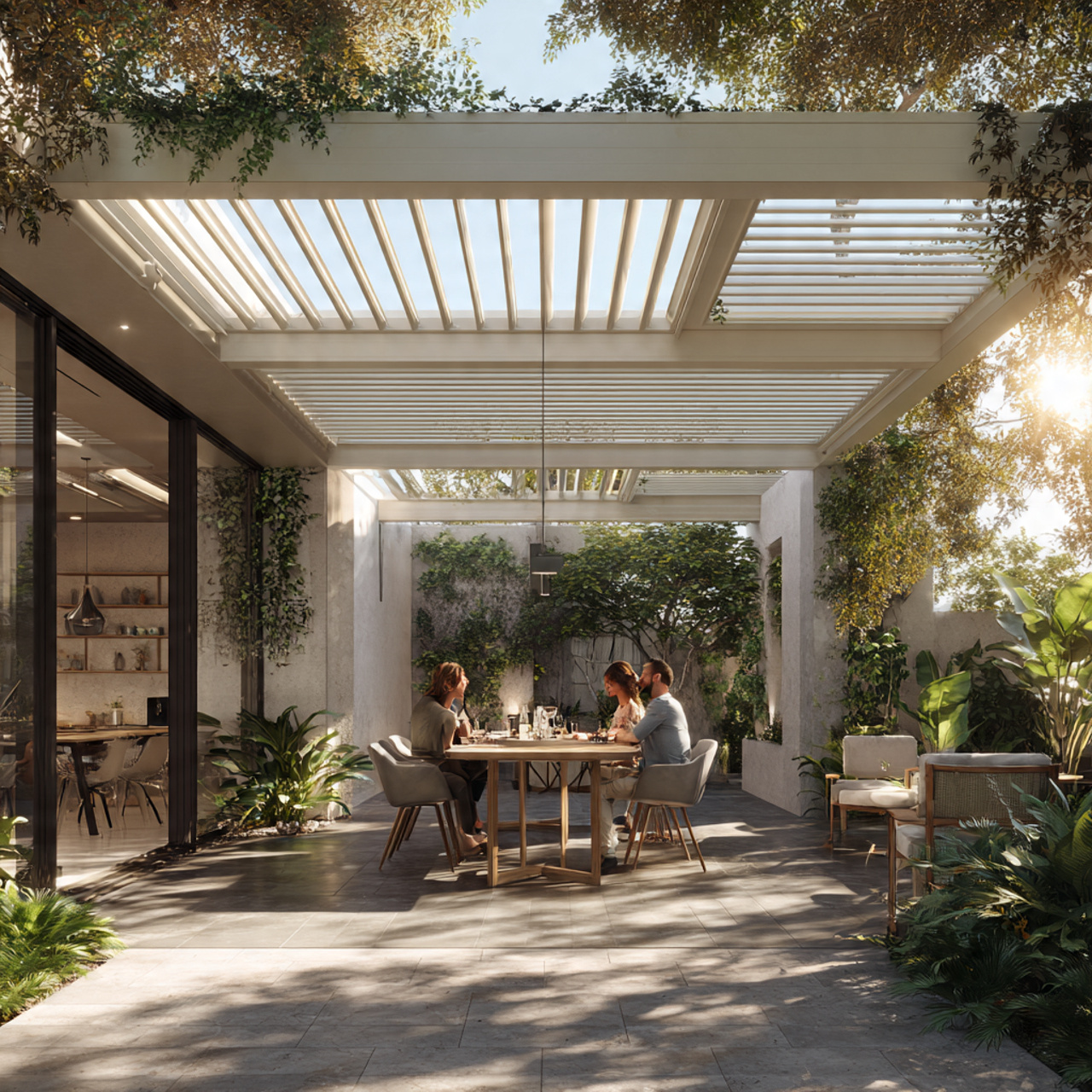
A motorized louvered pergola gives you something no fixed structure can match: complete environmental control without sacrificing style. The adjustable aluminum blades angle to filter morning glare, rotate to full shade during afternoon heat, or close entirely to block light rain. Brands like Azenco and Pergola Depot offer smartphone-connected louver kits that let you dial in the perfect setting without leaving your seat.
Best for: Homeowners who want active sun and shade control in one permanent structure Product: Azenco R-Blade motorized aluminum pergola in matte charcoal Pro tip: Orient the louver blades east to west so you block harsh afternoon western sun without losing your morning light. Room Fit: Mid-size to large patios, best on a level surface with at least 12 by 16 feet of floor space Designer language: “I want a motorized louvered pergola in matte charcoal with concealed drainage channels and integrated LED strip lighting in the blade frames.” Room size: Best for medium to large outdoor spaces of 12 by 16 feet or larger
Rustic Natural Wood Beam Overhang
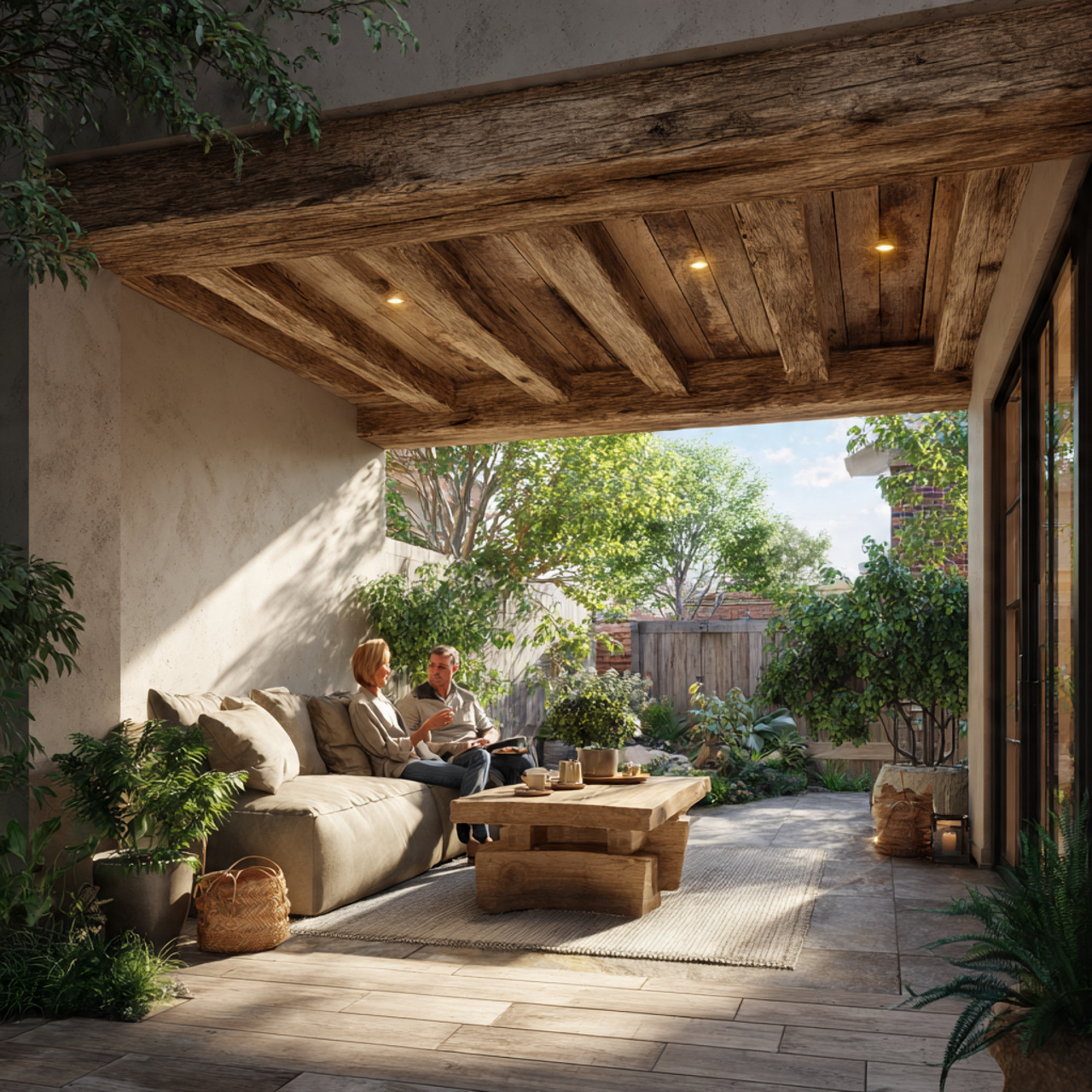
Thick timber overhead grounds a patio in a way no synthetic material fully replicates. A natural wood beam overhang in cedar or Douglas fir brings warmth and texture that immediately reads as handcrafted and intentional. Left unsealed, cedar silvers into a soft driftwood tone over time, while Cabot Australian Timber Oil deepens it to a rich amber that pulls out the grain.
Best for: Craftsman, farmhouse, and cottage-style homes seeking organic warmth Product: Cabot Australian Timber Oil in Natural for cedar and hardwood beams Pro tip: Specify 6-by-6 rough-sawn cedar beams instead of standard dimensional lumber for a bolder, more architectural look at nearly the same material cost. Room Fit: Wide suburban patios and side yards attached to the rear of the home Designer language: “I want a rough-sawn cedar beam overhang with a natural oil finish, traditional rafter tails cut at a 45-degree angle, and exposed black steel hardware.” Room size: Works on patios from 10 by 12 feet up to full wraparound configurations
Industrial Steel Frame Canopy
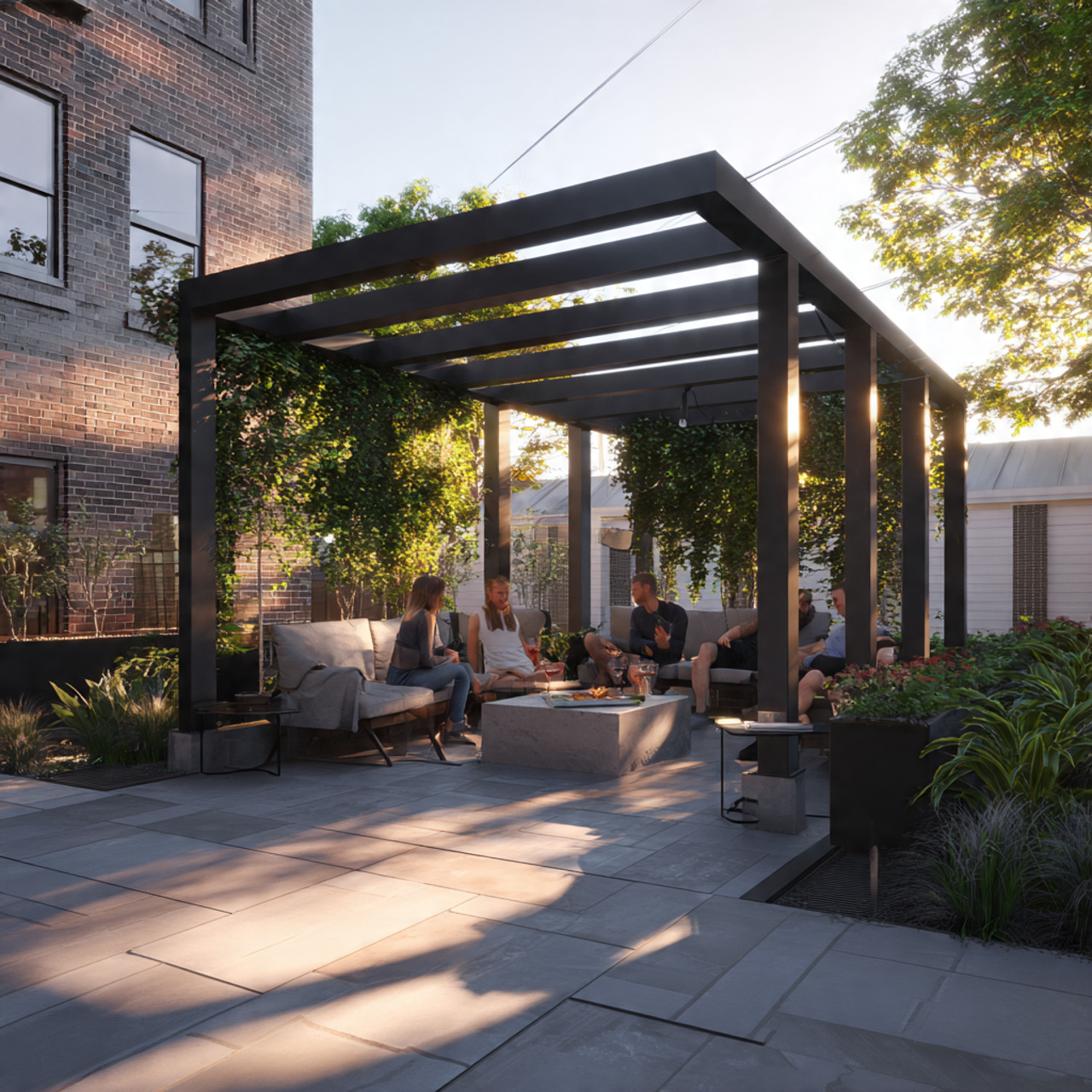
Steel frame canopies have made a decisive move from commercial buildings into high-end residential design. The material allows thinner profiles and longer spans than wood, producing an overhead plane that reads as floating rather than heavy. The contrast of a matte black frame against white stucco or light travertine is a combination that consistently delivers strong visual results. Struxure and Pergola Kits USA both offer modular steel systems that adapt to irregular lot shapes.
Best for: Urban townhomes, rooftop patios, and industrial-chic design enthusiasts Product: Struxure Pergola X modular steel frame system in flat black powder coat Pro tip: Weave cable wire lighting horizontally through the steel frame rather than hanging pendant fixtures to keep the industrial silhouette clean after dark. Room Fit: Narrow urban patios and rooftop terraces where column footprint is a real constraint Designer language: “I want a welded steel pergola frame in flat black powder coat with minimal column count, integrated wire management, and a stainless cable rail perimeter.” Room size: Ideal for compact to mid-size spaces under 200 square feet where column placement is critical
Mediterranean Style Arched Loggia

An arched loggia transforms the patio from a covered pad into a fully realized architectural feature that reads as original to the building. The repeated arch motif creates a visual rhythm that frames garden views the way a painting’s frame shapes a canvas. Smooth stucco in warm linen or terracotta paired with barrel tile and potted olive trees produces an atmosphere that feels pulled directly from the Amalfi Coast.
Best for: Mediterranean, Spanish Colonial, and Tuscan-style homes Product: Quikrete Commercial Grade stucco mix in Linen finish Pro tip: Use a barrel tile ridge cap at the roofline even if the interior uses flat concrete tile. That single detail reinforces the Mediterranean character of the entire structure. Room Fit: Wide rear patios that run along the full back or side elevation of the house Designer language: “I want a stucco arched loggia with barrel tile roofing, smooth column piers, a plaster ceiling in antique white, and a recessed tile border at the perimeter.” Room size: Best suited to homes with a rear yard setback of at least 15 feet in depth
Bohemian Inspired Bamboo Screen Cover
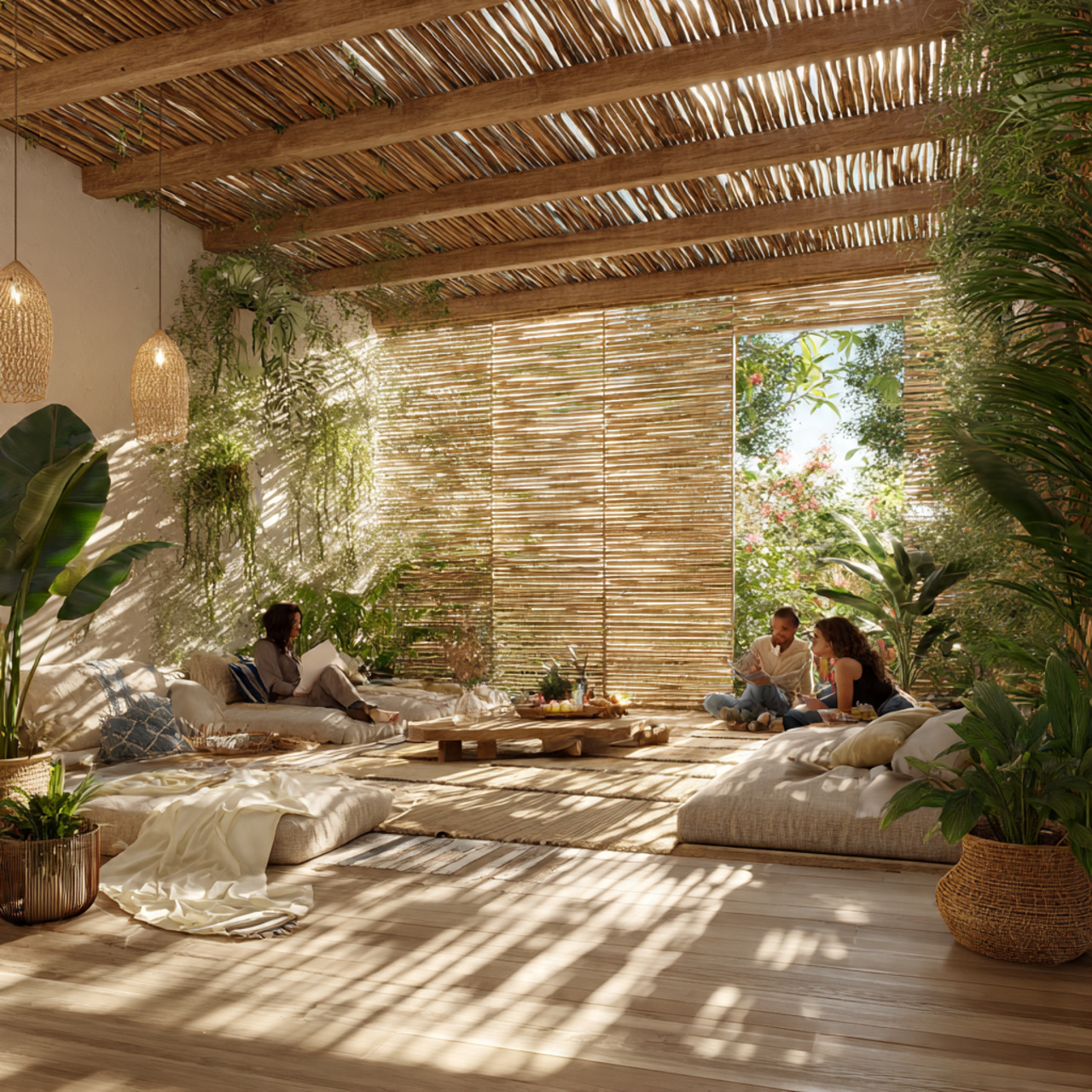
Bamboo is one of the most underestimated structural materials in outdoor design, and designers who work regularly with natural products know it is remarkably load-bearing for its weight. The dappled, layered shadow patterns bamboo projects onto the patio floor throughout the day are impossible to replicate with any synthetic canopy material, and the light quality underneath feels genuinely unique. The critical trade detail is sealing the material with a UV-blocking oil like Bamboo Guard to prevent cracking in the first season. IKEA’s SOLBLEKT bamboo shade panels offer a low-commitment entry point before investing in a permanent built structure.
Best for: Bohemian, eclectic, and biophilic design enthusiasts who prioritize texture Product: IKEA SOLBLEKT bamboo shade panels for a renter-friendly starting version Pro tip: Layer two bamboo panels at a perpendicular angle overhead to double shade density and create a more complex shadow pattern on the patio floor. Room Fit: Small to mid-size patios with an existing garden or tropical planting scheme nearby Designer language: “I want a bamboo overhead screen cover with natural-fiber lashing at the joints, layered for full shade, and paired with sisal and rattan textiles below.” Room size: Works best in spaces under 200 square feet where intimacy is the primary atmosphere goal
Traditional White Vinyl Pavilion
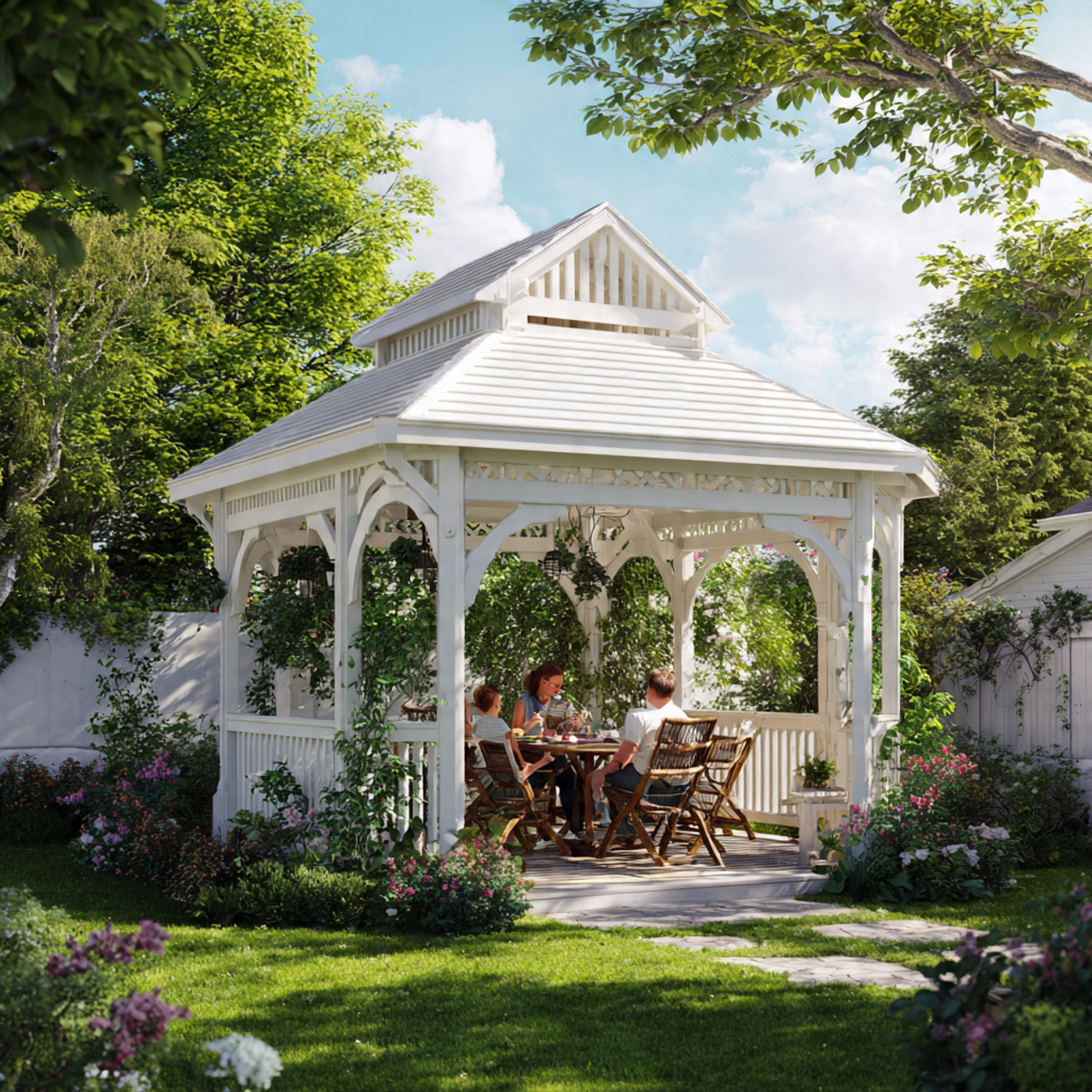
A white vinyl pavilion never needs painting, resists mold reliably, and holds its bright appearance through years of outdoor exposure without fading or chalking. For families who want a zero-maintenance outdoor room, vinyl is the clear practical winner. Backyard Discovery’s Montclair pavilion kit includes pre-cut components that most homeowners assemble in a single weekend, and the structured roof shelters indoor-quality furniture without concern for weather damage.
Best for: Colonial, traditional, and farmhouse exteriors seeking low-maintenance coverage Product: Backyard Discovery Montclair vinyl pavilion kit in white Pro tip: Add a beadboard vinyl ceiling panel kit inside the roof to hide raw rafters and create a polished interior ceiling that mirrors an indoor room. Room Fit: Freestanding in the yard or flush-mounted against the home’s rear exterior Designer language: “I want a white vinyl pavilion with a hip roof, decorative column wraps, a finished interior ceiling panel, and matching gutter and downspout trim.” Room size: Available in sizes from 10 by 12 feet to 16 by 20 feet to suit most suburban backyard footprints
Translucent Polycarbonate Roof Panels
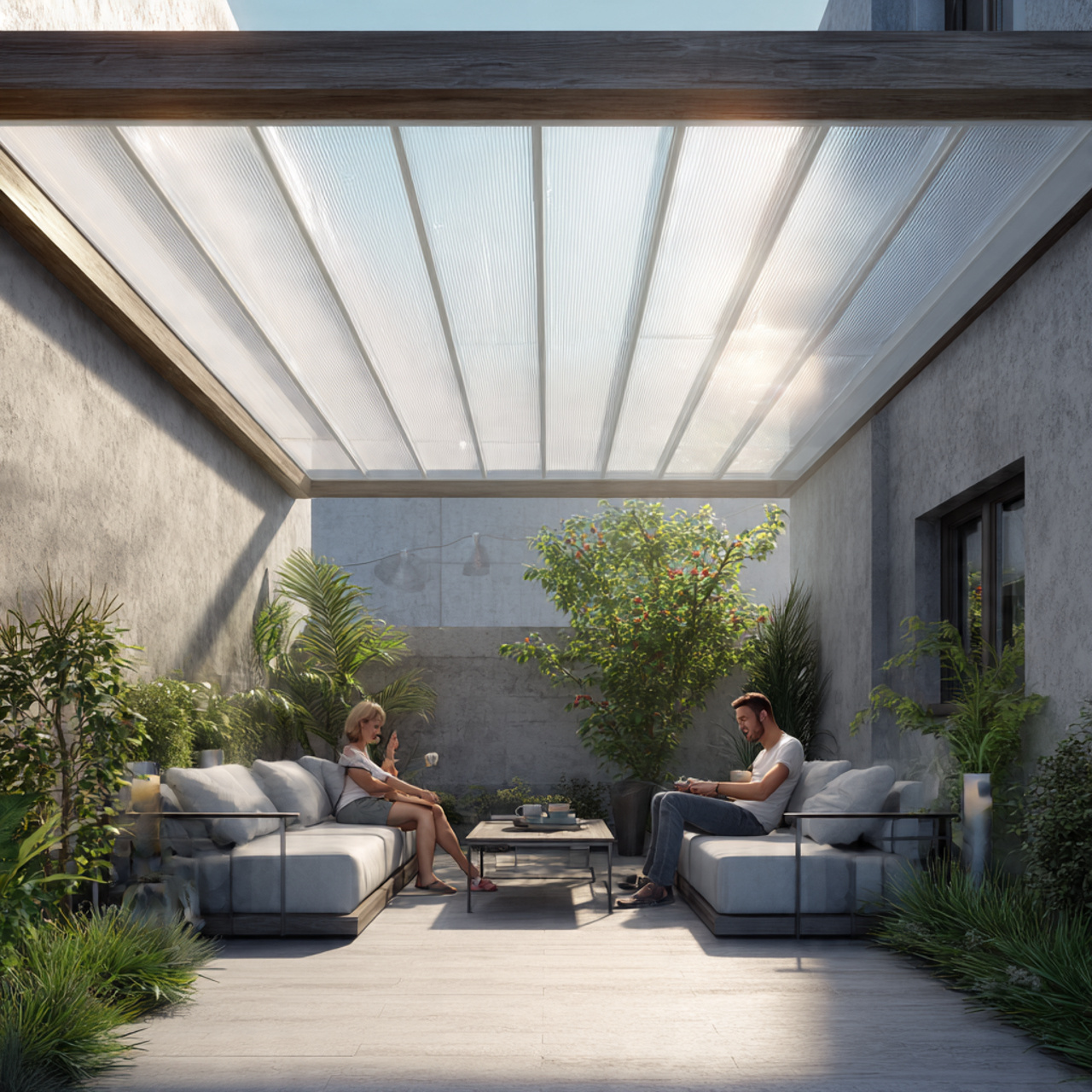
Polycarbonate panels solve the most persistent trade-off in patio cover design: the choice between full shelter and natural sunlight. These panels pass a high percentage of light through while blocking UV radiation and shedding water completely. Multi-wall polycarbonate from Palram Industries also traps an insulating air layer between surfaces, reducing heat transfer and preventing the condensation drip that single-skin panels produce in cooler mornings.
Best for: Lean-to patio covers, pergola additions, and covered walkways where sunlight is non-negotiable Product: Palram Multi-Wall Polycarbonate Sheets in Opal, 16-millimeter twin-wall profile Pro tip: Use clear polycarbonate over the primary seating zone and opal over any outdoor kitchen area to maximize dining light while diffusing cooking heat. Room Fit: Long narrow attached patios and side-of-house walkways connecting the home to a garage or garden Designer language: “I want a polycarbonate lean-to cover with twin-wall opal panels in an aluminum extrusion frame, attached to the fascia, with concealed internal gutters.” Room size: Scales from compact lean-tos under 100 square feet up to full carport-width structures exceeding 20 feet
Retractable Fabric Awning Concept
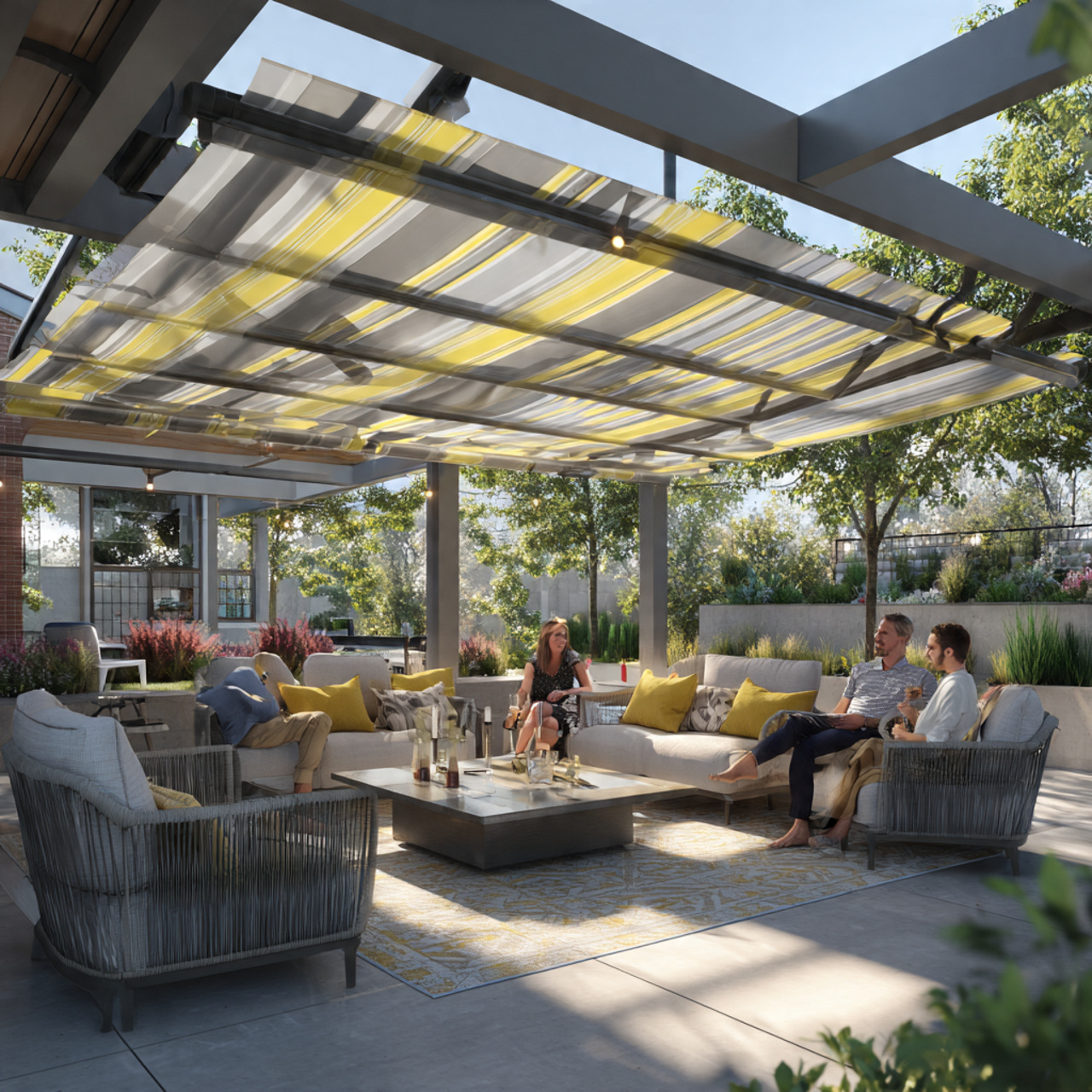
A retractable fabric awning provides a fully open sky when you want it and a solid shade canopy in under thirty seconds when you need it. Modern cassette-style systems from Sunesta and SunSetter include motorized arms with wireless remotes that deploy the full canopy without leaving your chair. Sunbrella brand acrylic fabric holds its color through prolonged UV exposure far better than standard polyester weaves, which is why it remains the professional standard for outdoor awning applications.
Best for: Flexible homeowners who want to control sun exposure at different times of day Product: Sunesta motorized retractable awning fitted with Sunbrella acrylic canvas Pro tip: Specify a heat-sensor add-on that automatically retracts the awning when temperatures exceed a set threshold to protect the motor and fabric on peak summer days. Room Fit: Attached patios directly off the kitchen or main living room where indoor-outdoor flow is the design priority Designer language: “I want a cassette-style motorized retractable awning in a wide-stripe Sunbrella pattern with a powder-coated aluminum cassette housing matched to the window trim color.” Room size: Works on patios from 8 feet wide up to fully custom widths exceeding 30 feet
Vaulted Ceiling Porch Extension
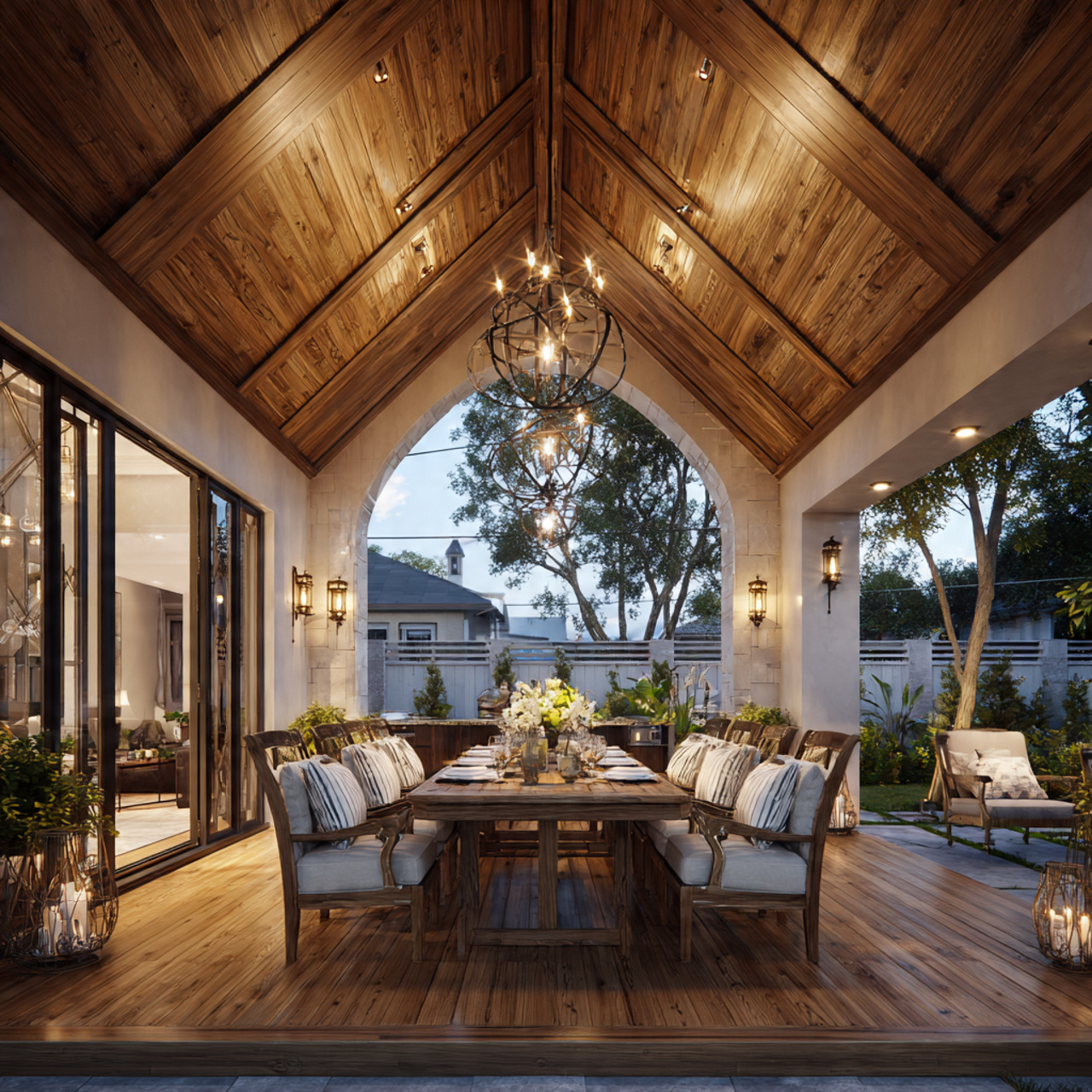
A vaulted ceiling porch extension converts a basic back porch into something that reads as genuinely architectural. By matching the pitch of the home’s existing roofline, the structure integrates so cleanly that it appears to be part of the original building rather than a later addition. Tongue-and-groove pine or cedar boards on the underside of the vault deliver a warmth that flat drywall cannot replicate outdoors, and painted in Sherwin-Williams Accessible Beige in exterior satin, the ceiling reads refined in every season.
Best for: Ranch, craftsman, and traditional homes where architectural integration is the primary goal Product: Sherwin-Williams Accessible Beige SW 7036 in exterior satin for the vaulted porch ceiling Pro tip: Install recessed can lights in a 3-2-3 grid pattern across the vault rather than a centered fixture so the lighting feels deliberate and hotel-grade after dark. Room Fit: Wide rear porches attached to the home, particularly those opening directly off the main living area or kitchen Designer language: “I want a vaulted porch extension with a tongue-and-groove wood ceiling, an exposed ridge beam, recessed lighting on a dimmer circuit, and painted fascia boards matching the home’s trim.” Room size: Best on porches with a minimum 14-foot width where the vault height is visually proportional and fully legible from the yard
Minimalist Glass Roof Veranda
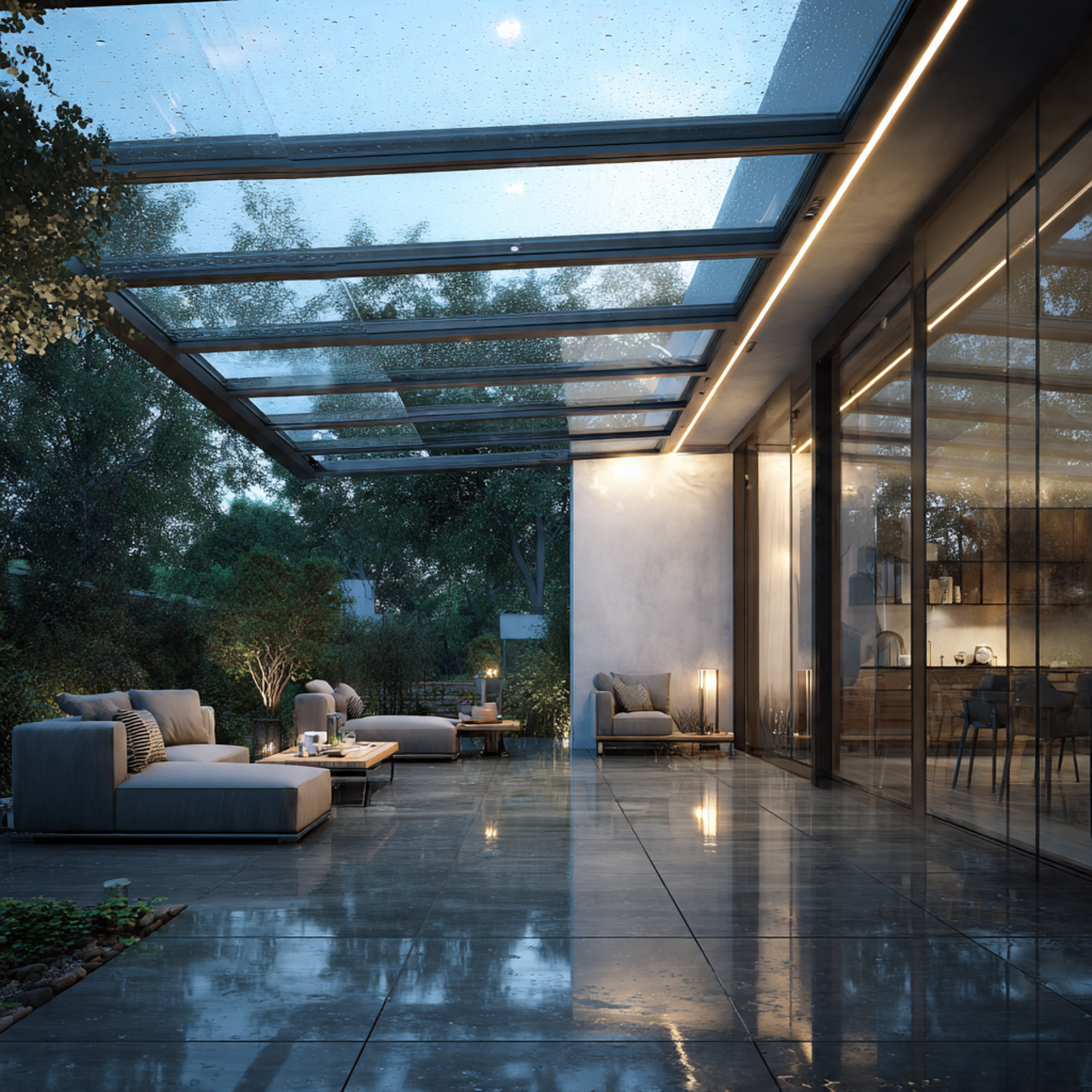
Professional landscape architects consistently recommend glass roof verandas to clients who want to dissolve the visual boundary between the garden and the interior of the home. The transparent overhead plane makes the sky a permanent part of the ceiling, and rain on glass creates a therapeutic sound environment that turns bad weather into an ambient feature rather than a reason to go inside. Slimline aluminum systems from Ultraframe and Alitex create near-invisible framing between panels, while heavier profiles shift the same structure toward an industrial or workshop character depending on the finish selected.
Best for: Contemporary and Scandinavian-style homes where garden-facing rooms need maximum light Product: Ultraframe slimline aluminum and glass veranda system with integrated gutter profile Pro tip: Specify a self-cleaning glass coating on roof panels at the time of order so rainfall automatically rinses away pollen and dust without leaving streaks or watermarks. Room Fit: Rear gardens where interior rooms face directly onto the outdoor space and preserving light is a structural requirement Designer language: “I want a slimline aluminum framed glass veranda with self-cleaning glazing, integrated gutters, LED perimeter lighting, and a frameless glass balustrade on the open sides.” Room size: Works from 10 by 12 feet on compact attached structures up to full garden-room scale exceeding 300 square feet
Reclaimed Barn Wood Gazebo
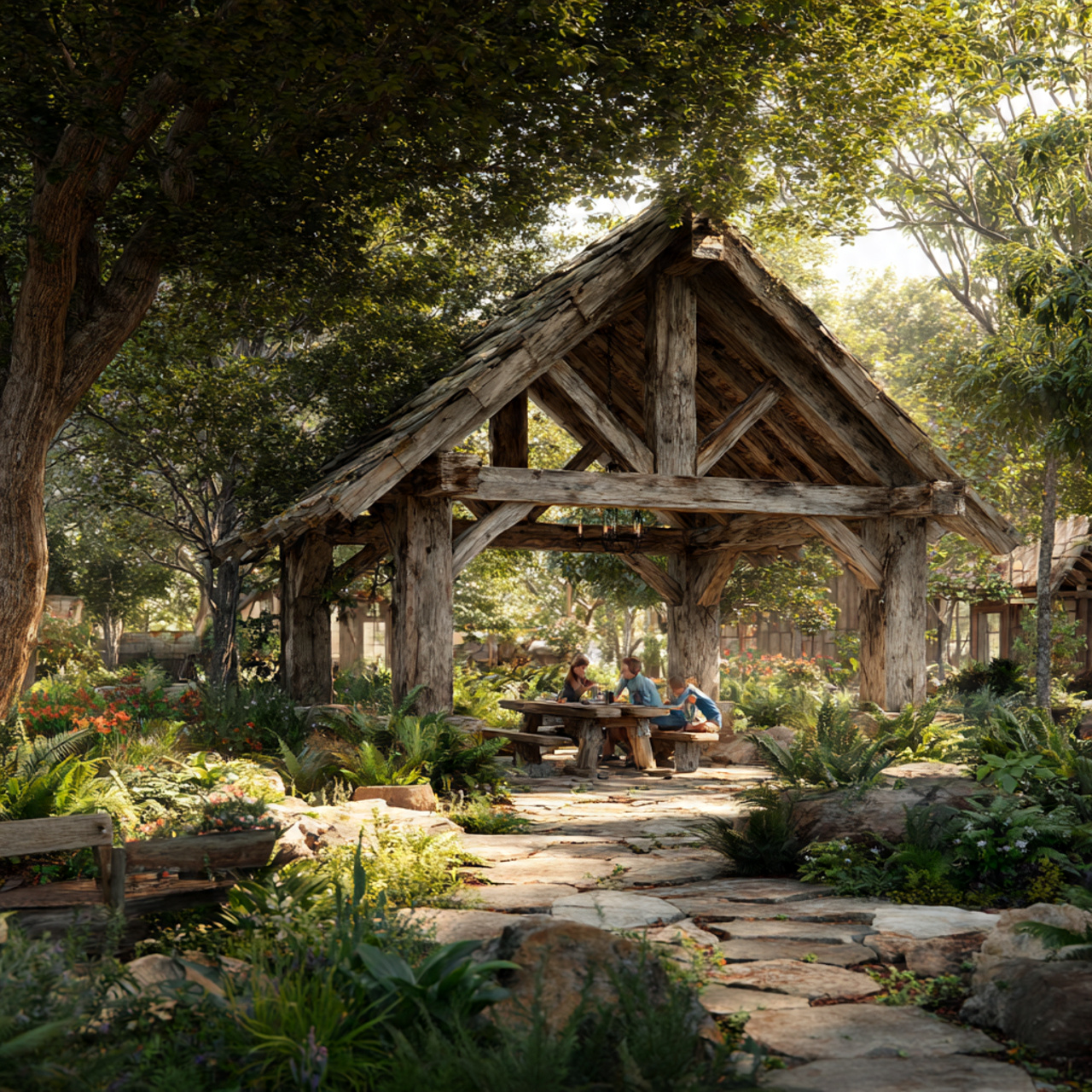
A reclaimed barn wood gazebo does something most patio structures cannot accomplish: it looks like it has always been there. The weathered grain, nail holes, and layered color variation in salvaged timber provide a sense of history that new lumber cannot replicate regardless of how much stain is applied. Sourcing from Elmwood Reclaimed Timber or TerraMai ensures the material is kiln-dried and structurally graded while retaining its aged character fully.
Best for: Country, farmhouse, and cottage properties with spacious rear yards Product: Elmwood Reclaimed Timber rough-sawn barn wood beams and planks Pro tip: Stain the interior ceiling surfaces one shade darker than the exterior beam faces to visually lower the ceiling plane and create a cozier atmosphere inside the gazebo. Room Fit: Freestanding destination structure placed at the far end of the yard to create a sense of arrival Designer language: “I want a freestanding reclaimed barn wood gazebo with open sides, exposed steel tie plates, and a standing-seam metal roof to complement the weathered timber.” Room size: Typically built in 10 by 10 to 12 by 12 foot configurations providing adequate seating for six to eight guests
Tropical Thatch Roof Tiki Hut

Nothing in residential outdoor design signals vacation mode as immediately as a tiki hut with a genuine thatch roof. The thick layering of dried palm fronds or African cape reed creates a highly effective natural insulating layer, keeping the temperature underneath measurably cooler than the surrounding air on a hot summer afternoon. For homeowners who want the look without organic maintenance demands, Forever Thatch produces synthetic panels from UV-resistant polyethylene that closely mimic the natural appearance with significantly longer service life.
Best for: Tropical, resort-inspired, and poolside outdoor designs Product: Forever Thatch synthetic palm thatch roofing panels with UV-resistant construction Pro tip: Weave outdoor-rated string lights through the underside of the thatch from pole to pole to create a warm, lantern-style glow that makes the tiki hut a genuine destination after sunset. Room Fit: Poolside or in a garden corner removed from the house where a standalone destination structure is the design goal Designer language: “I want a synthetic thatch roof tiki hut with round timber support poles, bamboo ceiling accent rails, and recessed LED lighting hidden within the thatch layer.” Room size: Standard configurations from 10 by 10 to 14 by 14 feet, suitable for a bar or dining table for four
Contemporary Cantilevered Roof Design
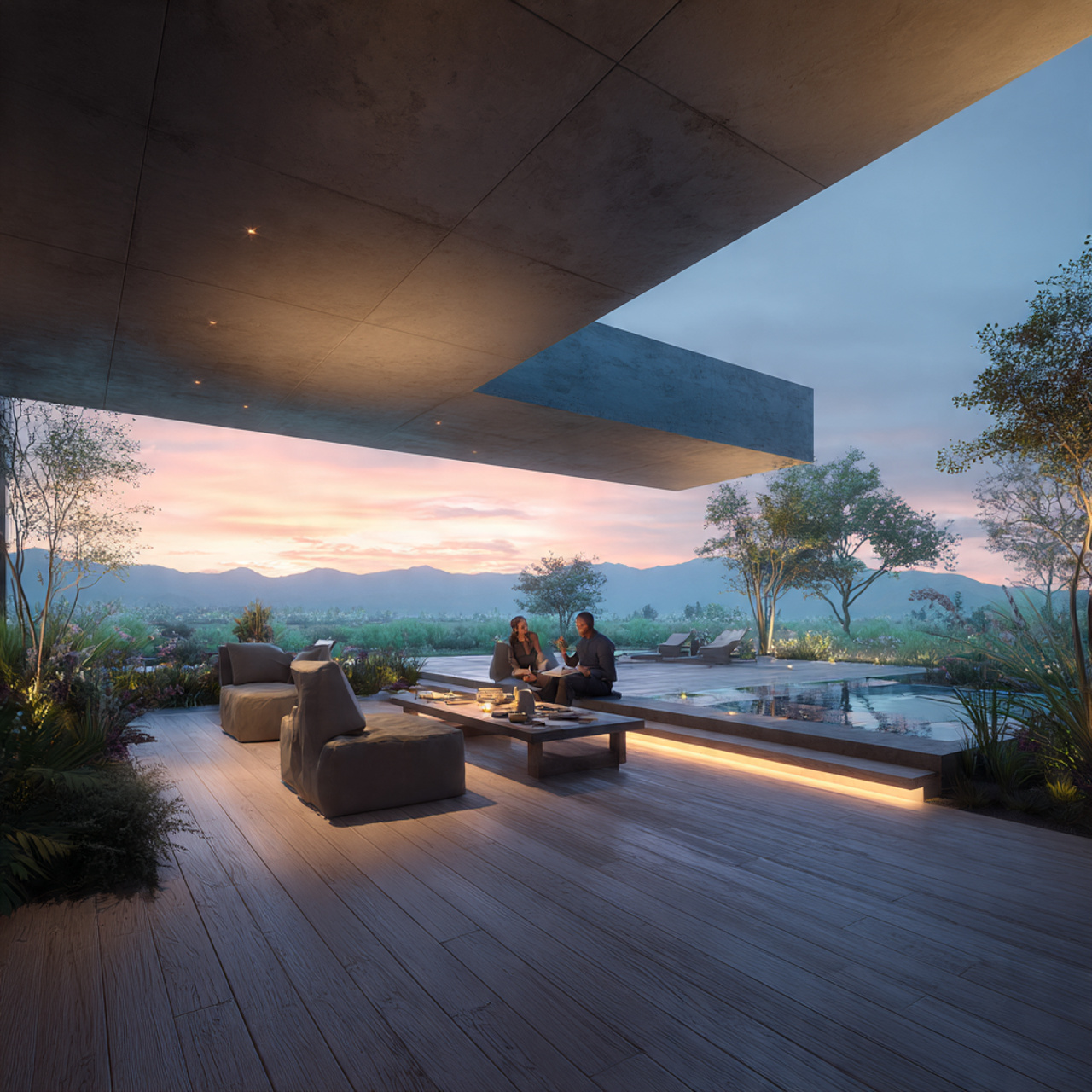
A cantilevered roof defies the visual expectation of traditional post-and-beam structures by projecting outward from a structural wall without visible columns. The entire patio floor stays completely free of obstructions, so furniture can be arranged anywhere without working around posts. This design requires a licensed structural engineer for load calculations, but the result is a level of custom architectural quality that no kit structure achieves. CB2’s outdoor collections pair particularly well here because their low-profile geometric forms complement the strong horizontal emphasis of a cantilevered canopy.
Best for: Modern and minimalist homes where column-free outdoor floor space is the priority Product: CB2 Dondra outdoor sectional in weathered grey for placement under a cantilevered cover Pro tip: Specify a fascia-mounted linear drain at the outer leading edge of the cantilevered roof so water runs silently into a recessed channel rather than dripping visibly along the eave. Room Fit: Rear or side patios on homes with a robust structural wall capable of carrying the cantilever load Designer language: “I want a structural cantilevered patio cover with a flat roof, fascia-mounted linear drainage, and a concealed beam connection flush with the house wall.” Room size: Typically engineered for projections of 8 to 14 feet from the wall, providing a generous seating area without a single exterior column
Classic Brick Pillar Porch
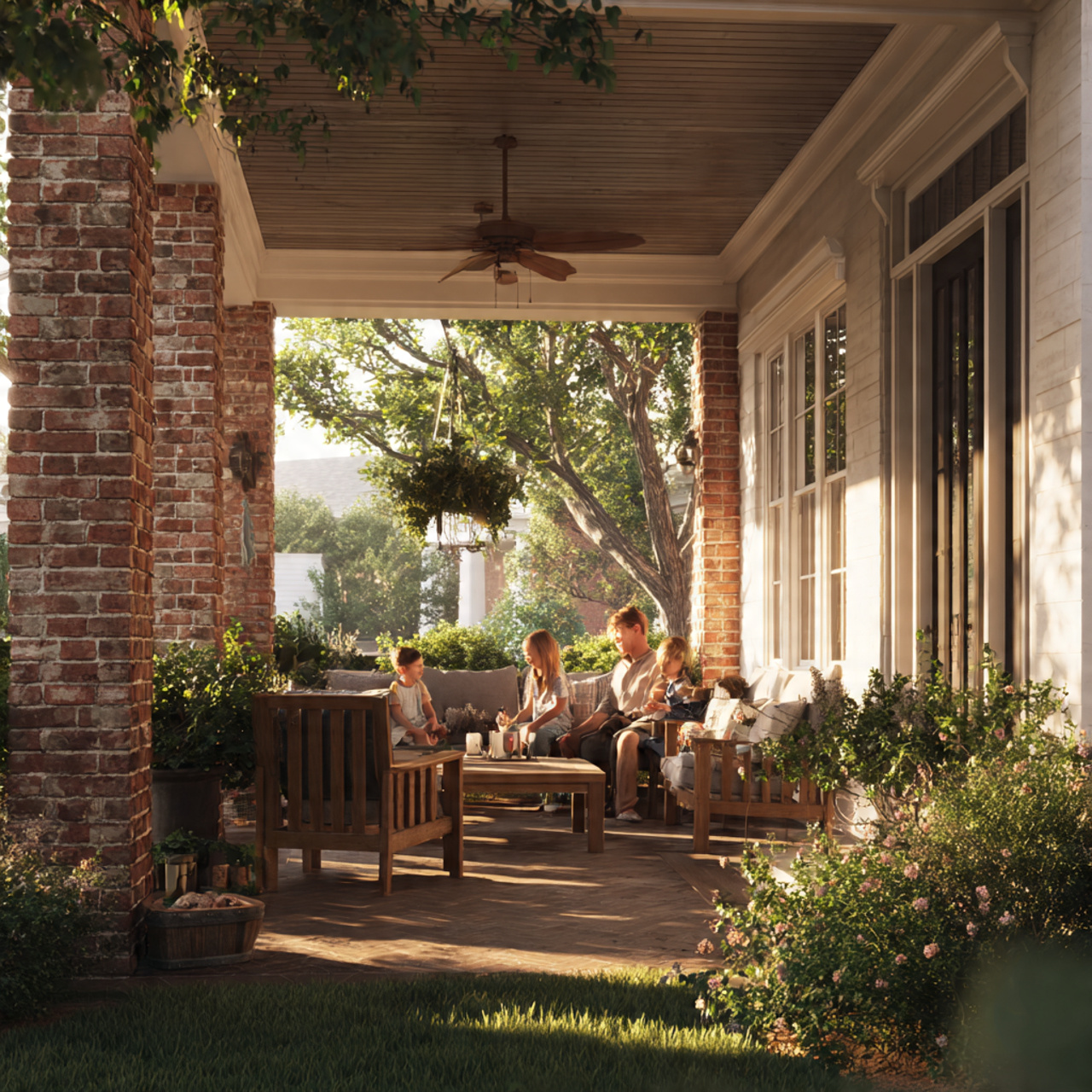
Brick pillar porches carry an architectural authority that synthetic materials have spent decades attempting to imitate. When the brickwork matches the home’s existing exterior, the porch becomes an undeniable part of the original structure rather than an obvious addition, and that sense of material continuity is one of the most reliable ways to add genuine resale value to a residential property. Restoration Hardware’s Aldgate teak collection looks proportionally appropriate here because its visual weight matches the density of the surrounding masonry.
Best for: Traditional brick homes, colonial residences, and properties focused on long-term resale value Product: Restoration Hardware Aldgate teak outdoor dining table and chairs Pro tip: Hire a mason to tuck-point the home’s existing brickwork at the same time the porch piers are laid so old and new mortar colors are matched and the transition is visually seamless. Room Fit: Front or rear porches on traditional residential lots with established streetscapes Designer language: “I want a brick pillar porch with matched mortar joints, a hip roof, a painted beadboard ceiling, and corbeled brick pillar caps at each column top.” Room size: Works on porches from 8 feet deep to full wraparound configurations on homes with sufficient lot setback
Trellis With Flowering Climbing Vines
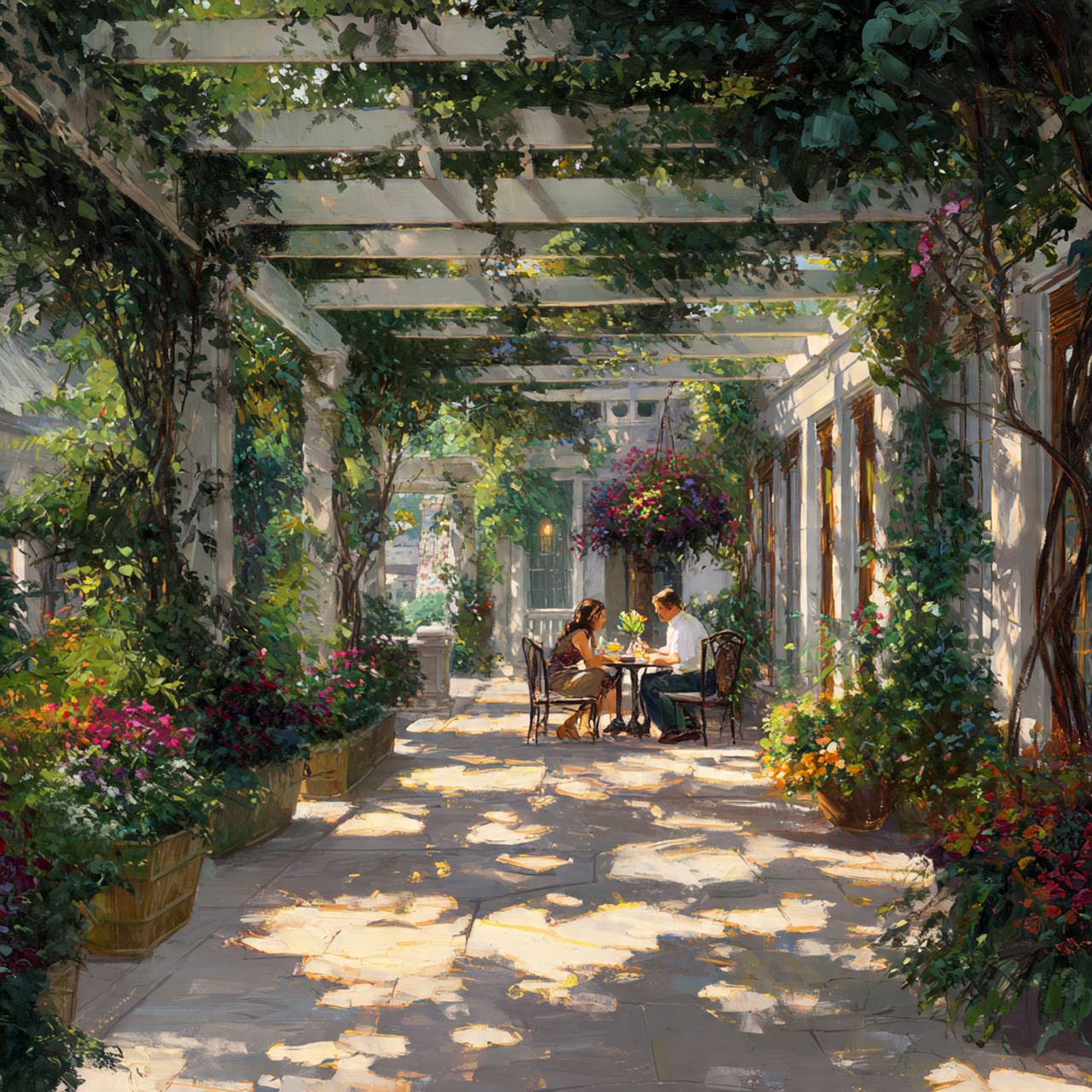
A trellis with climbing vines is the only covered patio option here where the roof is alive, and designers who work in horticultural-informed spaces know this living element changes the psychology of the space beneath it entirely. The filtered green light through wisteria or climbing roses is softer and more flattering than any artificial source, and the fragrance turns the whole yard into a sensory experience no inert material can replicate. The structural detail most homeowners miss is that wisteria at full maturity can exert hundreds of pounds of wet load on a frame, requiring galvanized or stainless steel structure rather than softwood lumber. Hooks and Lattice supply powder-coated steel trellis panels rated specifically for long-term vine load at exactly this scale.
Best for: Romantic, cottage garden, and naturalistic landscape styles Product: Hooks and Lattice powder-coated steel garden trellis panels in black or bronze Pro tip: Plant Wisteria sinensis at the base of two corner posts so the vine trains across the full trellis width within three to four growing seasons without annual replanting. Room Fit: Freestanding garden structures or attached pergola additions in established planting settings with deep soil for vine root systems Designer language: “I want a galvanized steel trellis cover rated for full wisteria load, with integrated base planters at each column and a decomposed granite floor below.” Room size: Best suited to garden spaces from 8 by 10 to 12 by 16 feet where vine coverage is achievable across the full span
Farmhouse Style Corrugated Metal Roof
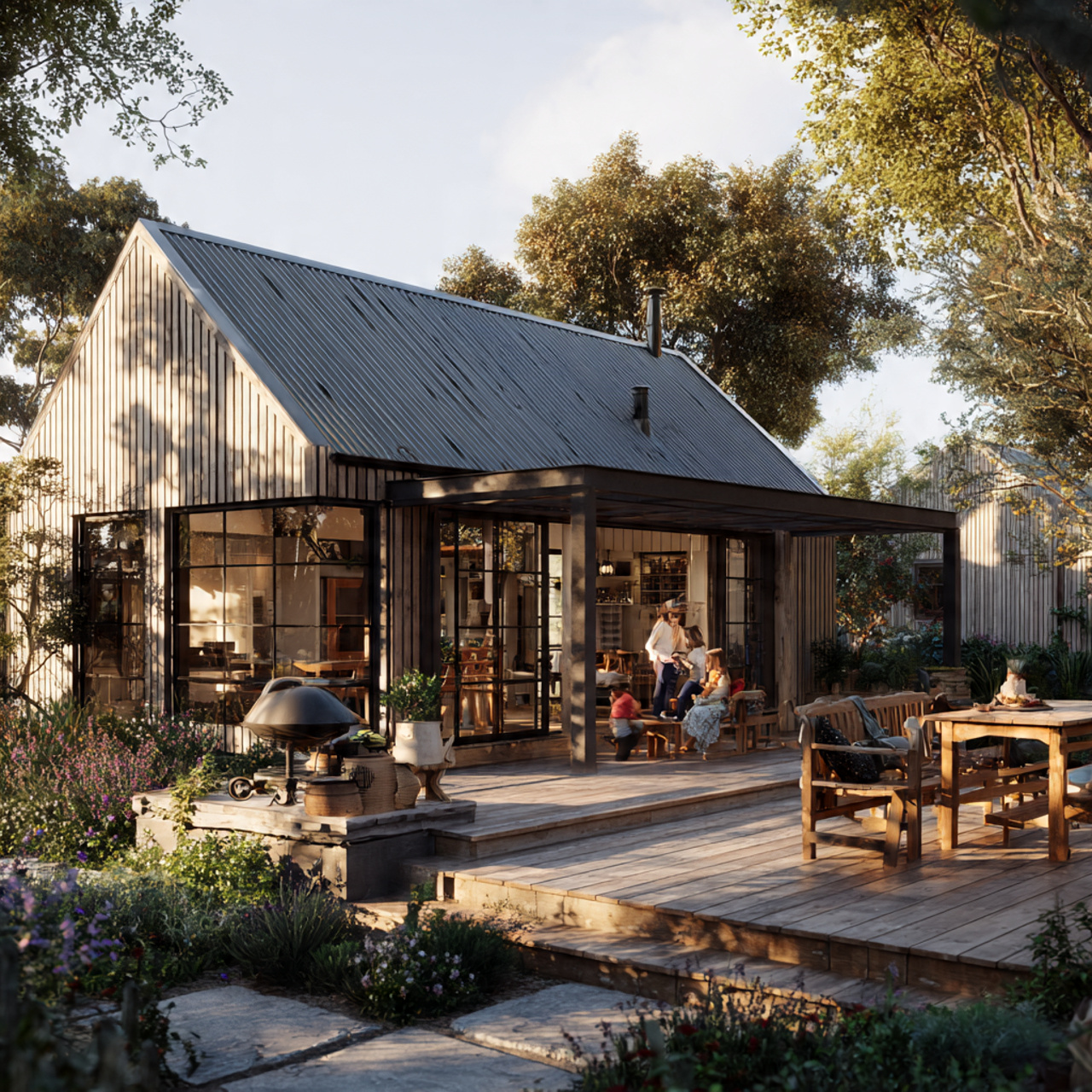
Corrugated metal has made a decisive move from agricultural buildings to high-end residential patios, driven largely by the modern farmhouse trend that continues to influence suburban design. The rhythmic ridges of the panel profile add a tactile texture that flat-roof materials cannot produce, and against white board-and-batten siding or black square-tube steel posts, a Galvalume panel looks simultaneously nostalgic and contemporary. McElroy Metal produces corrugated panel systems carrying 40-year warranties with documented resistance to fire, insects, and hail.
Best for: Modern farmhouse, rural, and transitional residential exterior styles Product: McElroy Metal corrugated Galvalume panel system in a 29-gauge profile Pro tip: Install closed-cell spray foam insulation on the underside of the metal panels to eliminate the hollow drumming sound during rainfall if a quieter patio atmosphere is the goal. Room Fit: Attached rear patios and covered driveways on larger suburban and rural properties Designer language: “I want a corrugated Galvalume metal roof patio cover on black powder-coated square tube steel posts with visible rafter tails and exposed hardware in a matching black finish.” Room size: Scales from 10 by 14 feet up to full RV-port or multi-car carport proportions without structural modification
Elegant Wraparound Covered Terrace
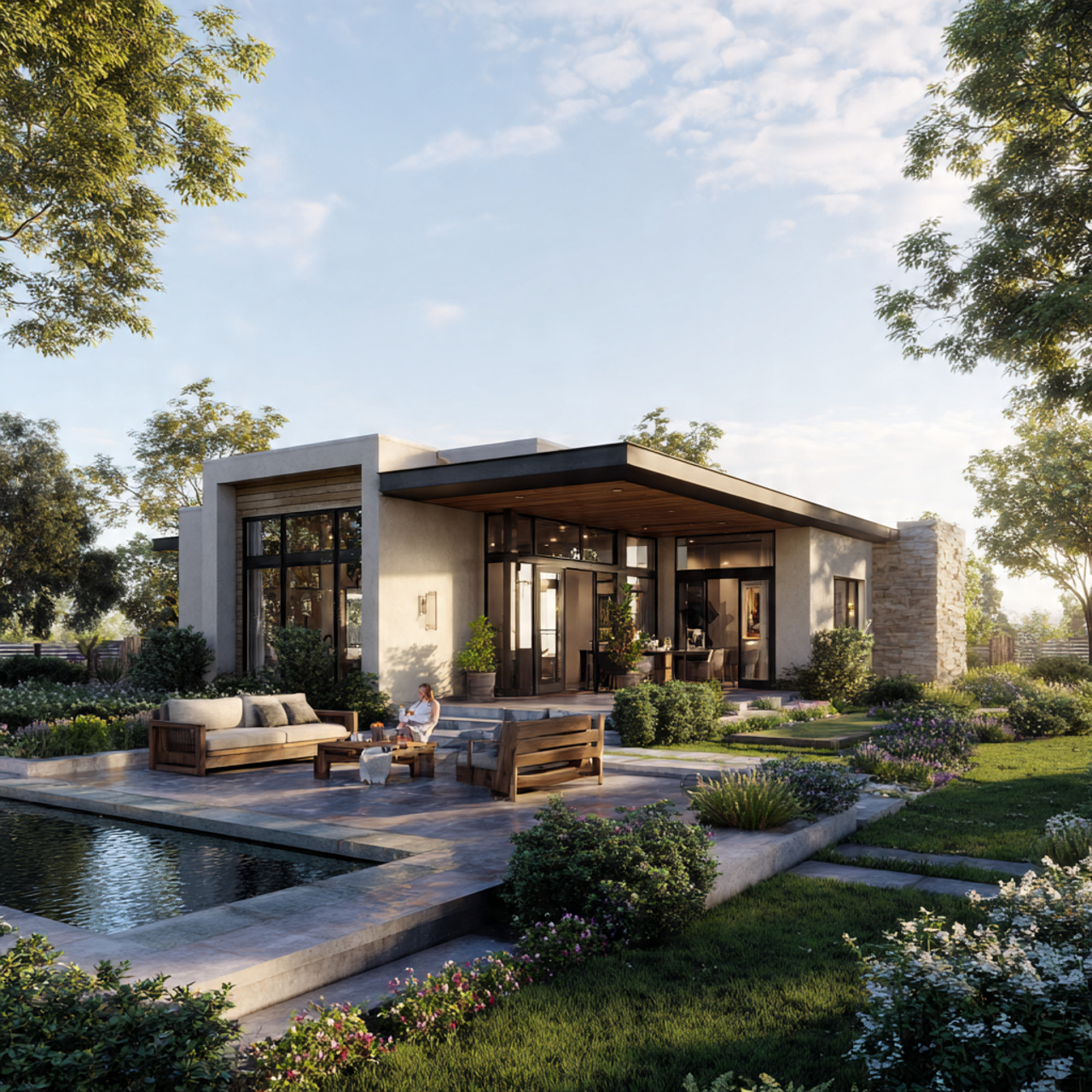
A wraparound covered terrace elevates a home from a house to a property. By following the perimeter on two or more exterior sides, the covered terrace creates distinct outdoor zones that serve different purposes throughout the day. A morning corner facing east captures the sunrise while an evening zone facing west holds the last warmth of late afternoon. Pottery Barn’s Torrey teak collection is designed for exactly this kind of multi-zone outdoor living and holds up to long-term exposure without seasonal storage.
Best for: Larger homes, rural properties, and high-end renovation projects focused on outdoor living Product: Pottery Barn Torrey teak outdoor sofa and sectional collection Pro tip: Specify a different ceiling color for each zone of the wraparound to subtly differentiate spaces, using soft sage for the garden-facing side and warm white for the dining section. Room Fit: Properties with at least 8 feet of lateral clearance on two or more exterior walls and a relatively level grade Designer language: “I want a continuous wraparound covered terrace with a consistent fascia height throughout, decorative column brackets, and zone-specific ceiling finishes on a shared structural plate.” Room size: Typically encompasses 300 to 800 square feet, best suited to larger homes on standard or oversized suburban lots
Integrated Skylight Patio Cover
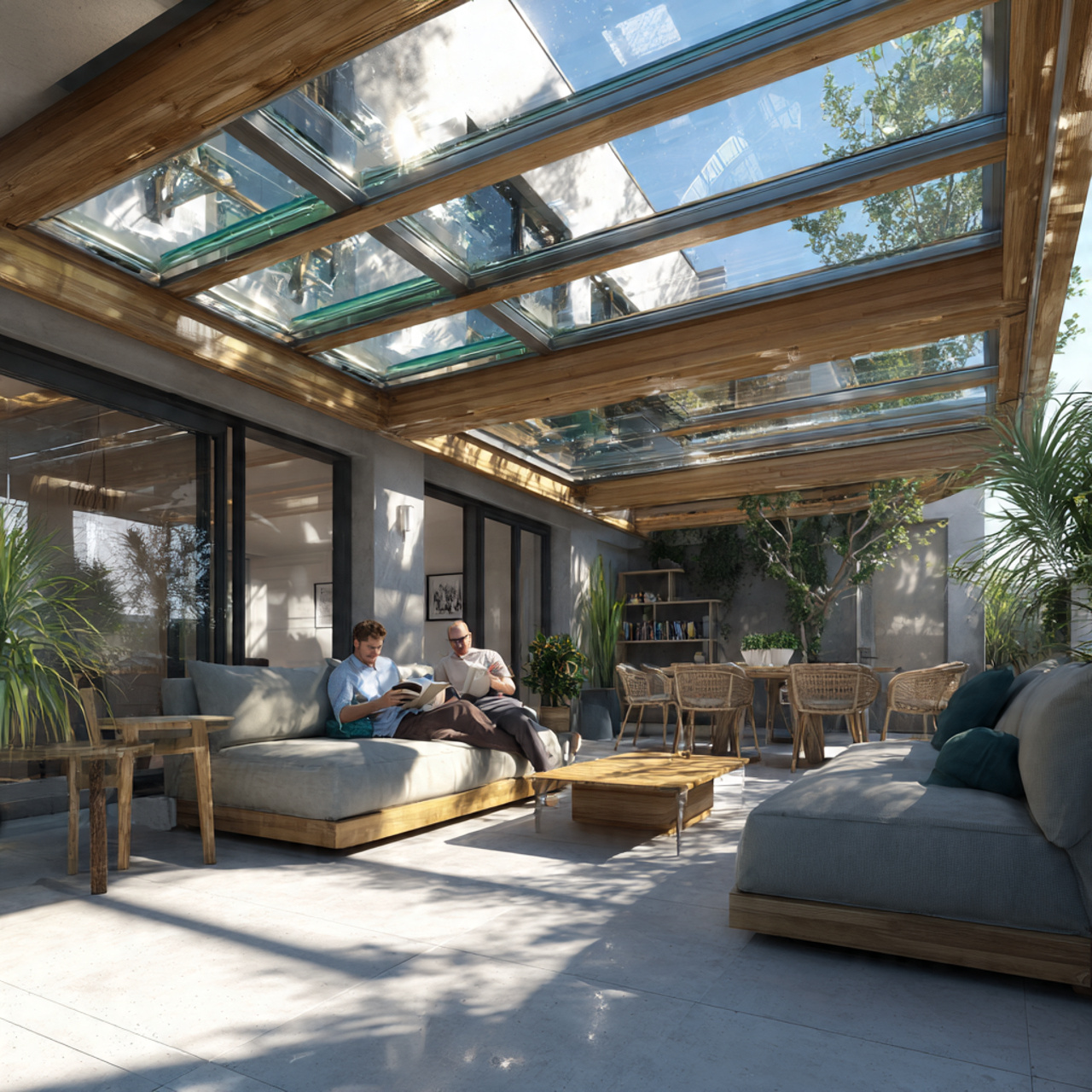
An integrated skylight patio cover answers the concern that a solid roof will darken the interior rooms sitting directly behind it. By recessing glass or acrylic skylight inserts into the patio roof at the point where it meets the house wall, natural light continues to flood both the patio and the windows behind it simultaneously. Velux fixed roof windows are the most trusted insert choice for this application because they carry waterproofing ratings appropriate for permanent outdoor installation and use laminated safety glass throughout.
Best for: Homeowners with enclosed patios adjacent to kitchens or main living rooms Product: Velux VFS fixed skylight panel for patio cover insert applications Pro tip: Maintain a slight roof pitch even on what appears to be a flat design so water always runs toward the exterior fascia edge and away from the skylight seals through every season. Room Fit: Attached rear patios where preserving natural light to interior windows is a structural and lifestyle priority Designer language: “I want a solid patio roof with integrated fixed skylight inserts in aluminum cladding frames and a painted plaster ceiling between the panels with recessed perimeter lighting.” Room size: Most effective on patios between 12 and 20 feet in depth where skylight inserts can serve specific functional zones
Geometric Laser Cut Metal Screens
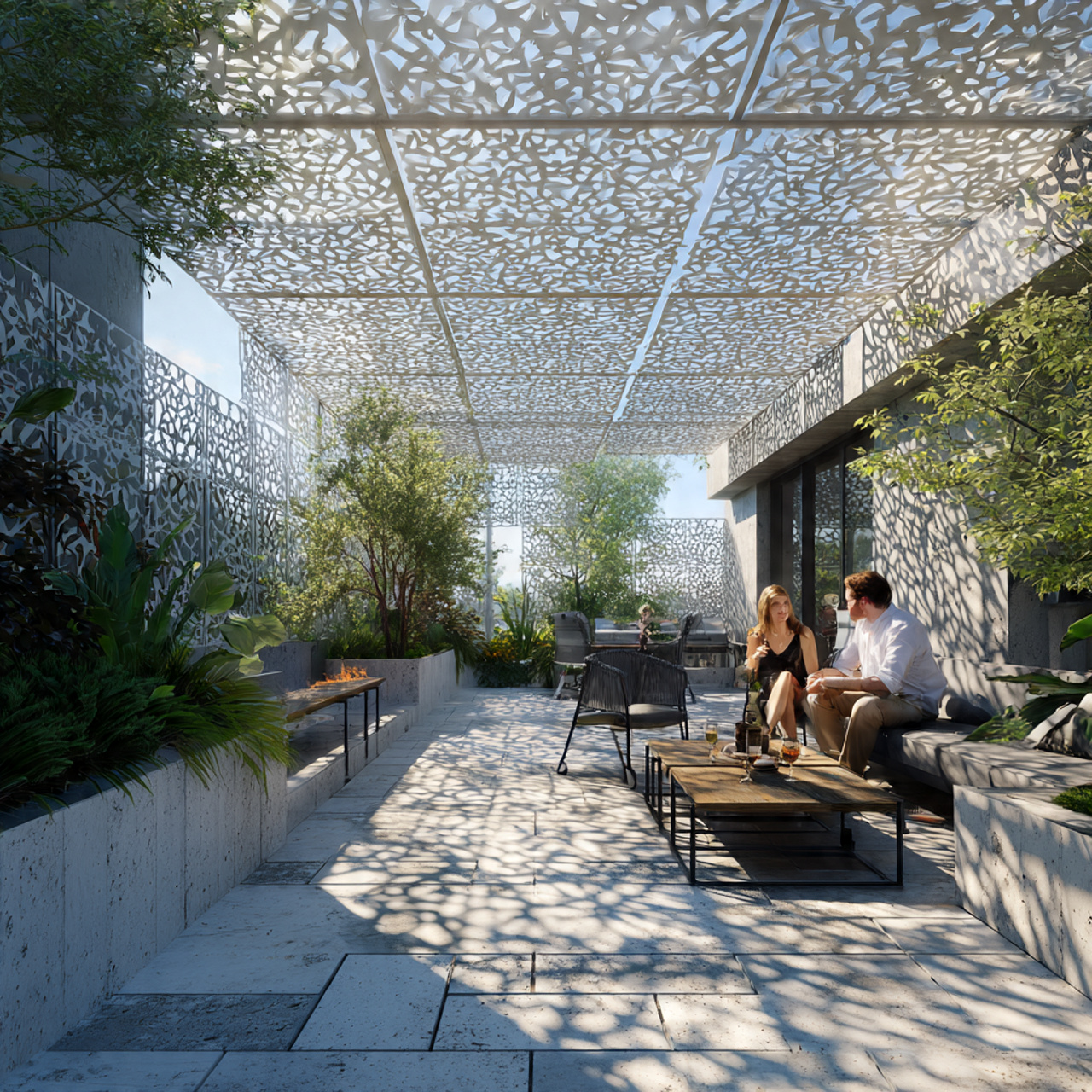
Geometric laser-cut metal screens project precise shadow patterns across the patio floor and walls that shift and elongate throughout the day as the sun moves, producing an effect closer to a living art installation than standard shade provision. Corten steel is the favored material because the warm orange-brown patina that develops naturally over time adds a second layer of visual interest that painted finishes cannot replicate. Moz Designs produces custom laser-cut panels in patterns ranging from strict geometric grids to organic botanical motifs.
Best for: Modern, artistic, and architecturally adventurous outdoor spaces prioritizing visual drama Product: Moz Designs custom laser-cut Corten steel patio canopy panels Pro tip: Mount a directional downlight above the laser-cut panel at night to project the shadow pattern onto the patio floor and extend the visual effect well into the evening hours. Room Fit: Feature patios and enclosed courtyard gardens where a strong design statement is the primary objective Designer language: “I want a laser-cut Corten steel overhead canopy in a custom geometric pattern mounted on a powder-coated aluminum subframe with concealed panel fixings.” Room size: Effective in compact courtyards from 8 by 8 feet and in larger feature installations up to 16 by 20 feet
Shiplap Ceiling Outdoor Living Room
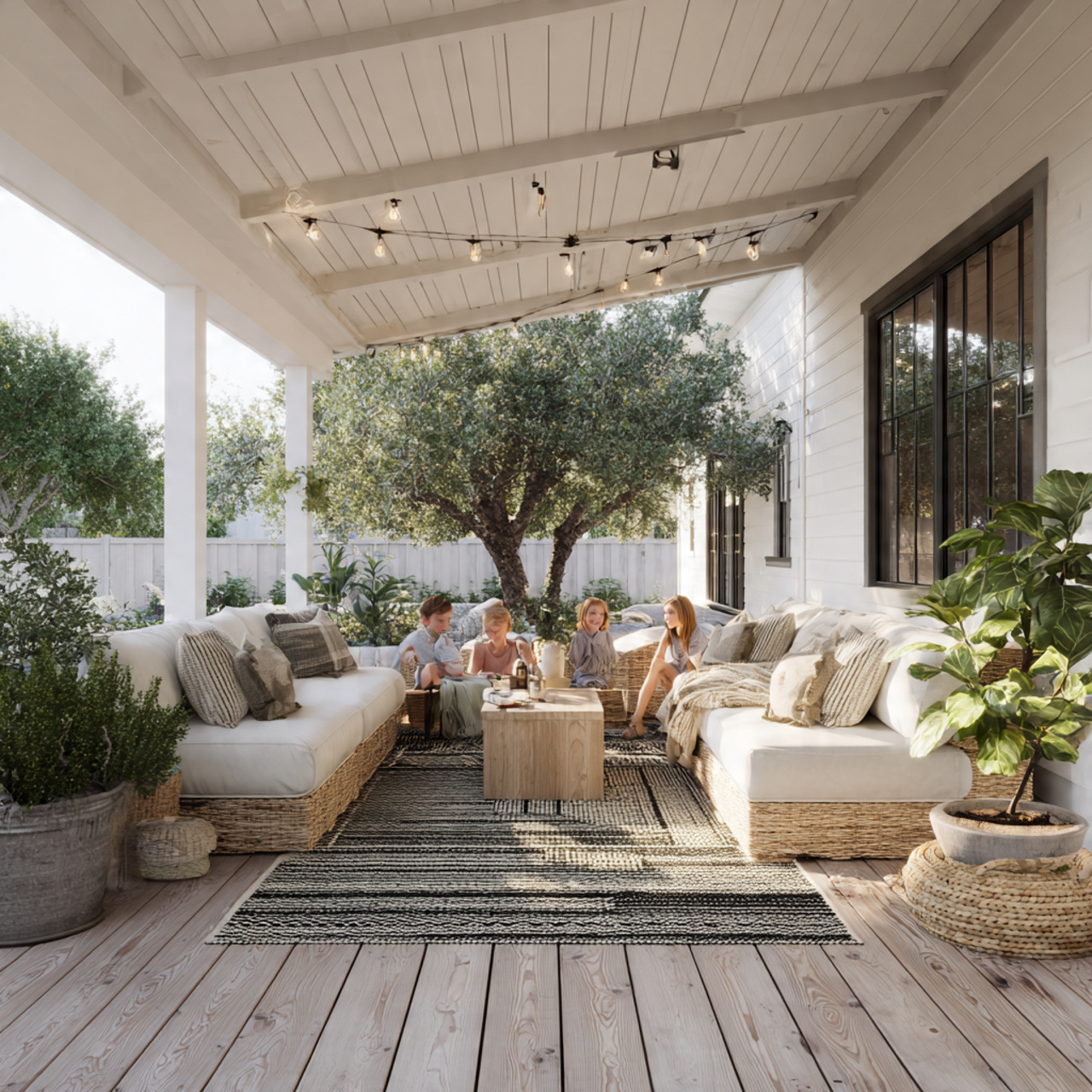
Taking shiplap from an interior ceiling to an exterior porch requires a material specification that most tutorial sources skip entirely, and getting this wrong is one of the most predictable covered patio mistakes a homeowner can make. Interior-grade wood shiplap absorbs moisture and begins to delaminate within a single winter in an exposed porch ceiling application. The correct product is a primed PVC shiplap panel from Versatex or exterior-rated cedar shiplap with a waterborne primer applied to all four surfaces before installation. Painted in Benjamin Moore White Dove in an exterior satin formula, a correctly specified shiplap ceiling holds up for decades and creates a finished quality that makes the patio feel like a true room rather than a transitional space.
Best for: Coastal, farmhouse, and transitional outdoor living rooms seeking a polished finished ceiling Product: Versatex PVC shiplap boards in a 6-inch reveal width, pre-primed for outdoor use Pro tip: Run shiplap boards perpendicular to the house wall so the horizontal lines draw the eye outward toward the yard and make the porch feel visually deeper than it is. Room Fit: Covered porches and attached patio structures with a minimum 8-foot ceiling height and solid overhead framing Designer language: “I want a PVC shiplap porch ceiling in a 6-inch reveal painted Benjamin Moore White Dove in exterior satin with recessed wafer lights on a dedicated dimmer circuit.” Room size: Best on porches from 10 by 14 feet upward where the ceiling plane is large enough for the shiplap pattern to read clearly
Visit Also: Sitting Room Ideas
Victorian Wrought Iron Solarium
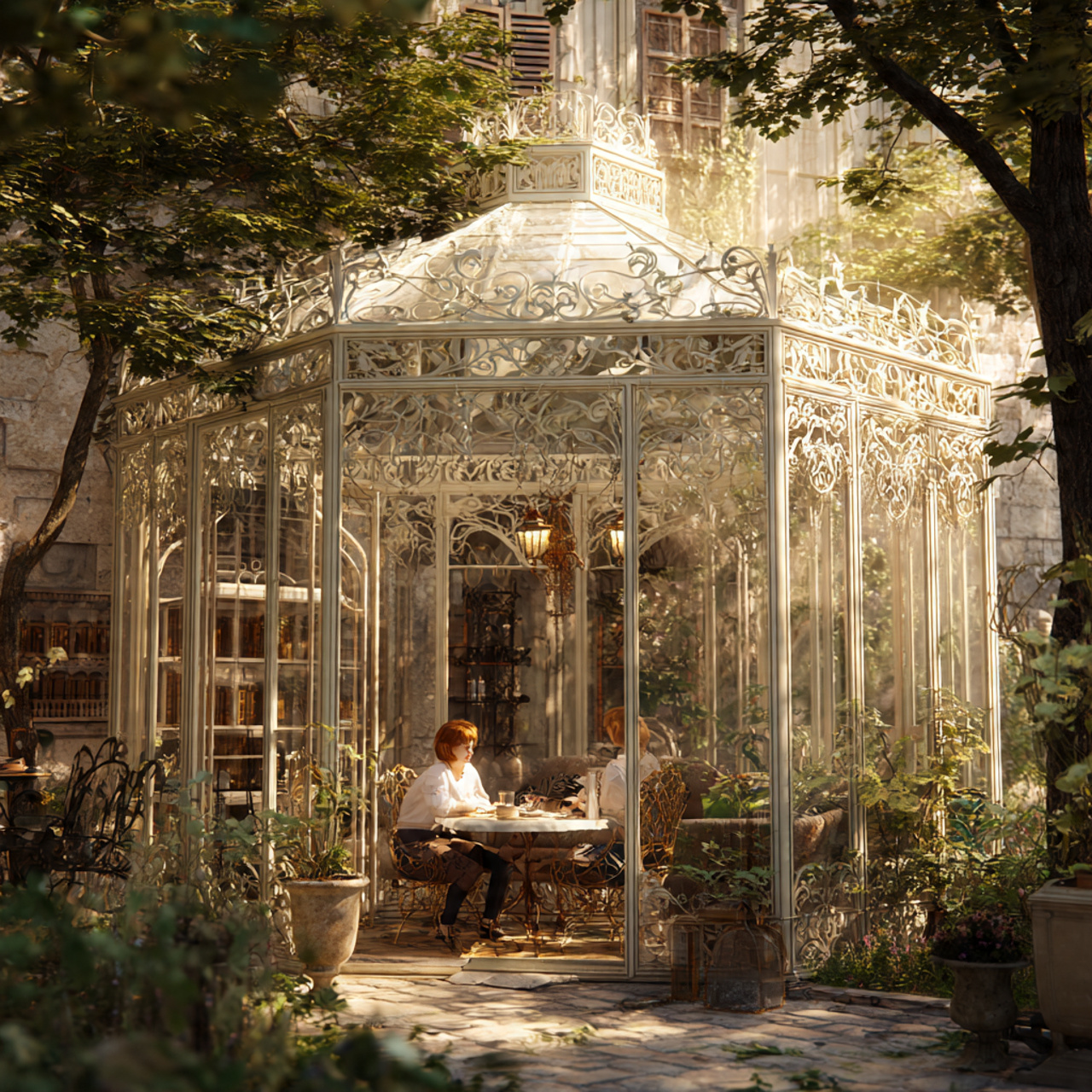
A Victorian wrought iron solarium draws its design language from the grand estate conservatories of the nineteenth century, and the ornate scrollwork, finials, and arched glazing panels create a visual richness that modern minimalist structures cannot approach. This is the covered patio option for homeowners who believe outdoor spaces deserve the same decorative investment as the finest interior rooms. Hartley Botanic produces custom Victorian-style iron and glass structures with historically accurate decorative castings in over thirty period-appropriate paint finishes.
Best for: Victorian, Edwardian, and classical revival-style homes with formal garden settings Product: Hartley Botanic Victorian lean-to glasshouse in Sage or Heritage Green finish Pro tip: Install radiant heated flooring under terracotta or encaustic cement tile inside the solarium so the space remains comfortable year-round and functions as a genuine room in every season. Room Fit: Formal rear gardens on period homes, particularly those with walled garden features or established topiary Designer language: “I want a Victorian cast iron solarium with ridge cresting, arched glazed panels, decorative hip end finials, and a painted antique green finish on all iron components.” Room size: Custom-built from 8 by 10 feet upward with most residential installations ranging from 120 to 250 square feet
Coastal Inspired Sail Cloth Shade
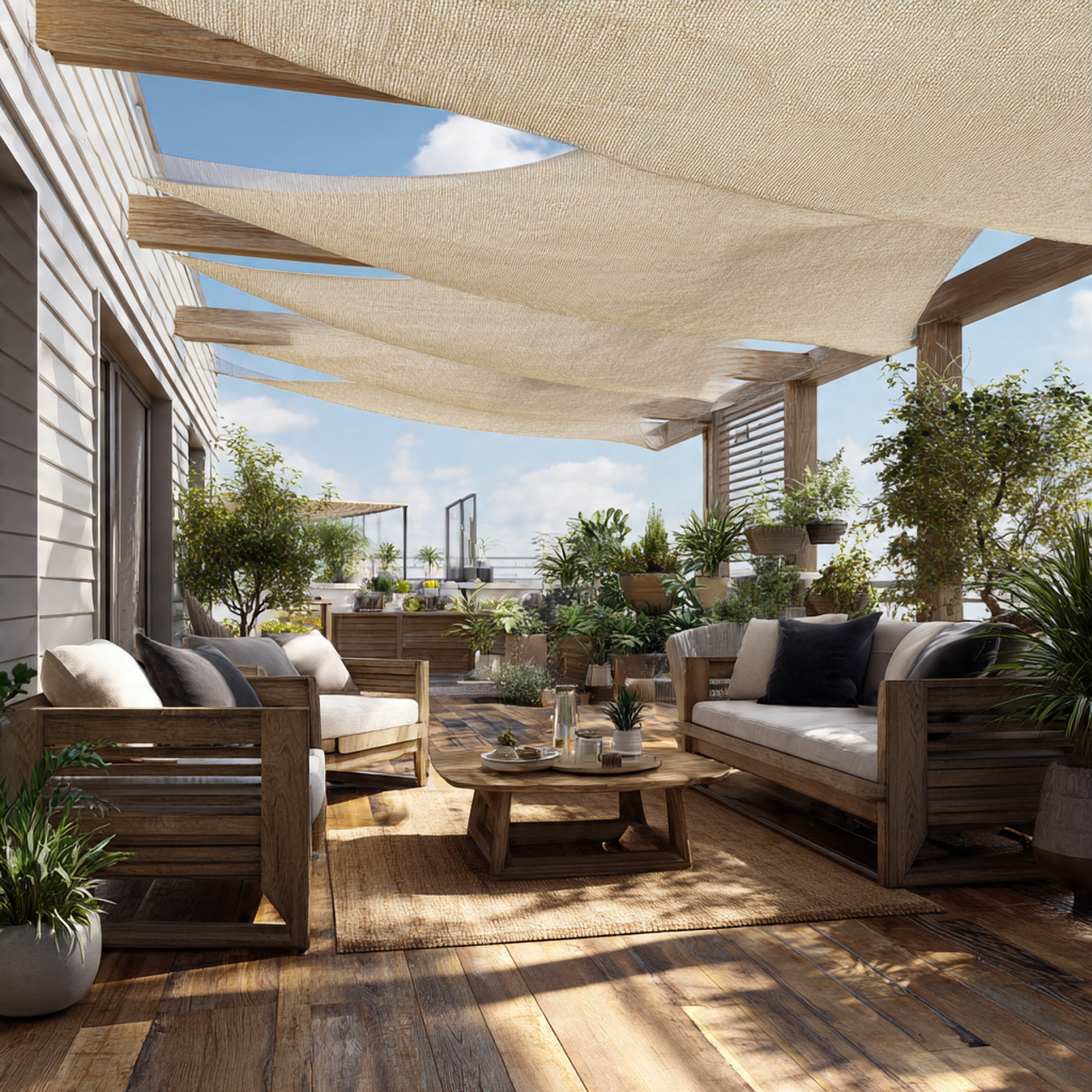
Sail shades are one of the most visually dynamic covered patio solutions because no two installations look identical. The tensioned fabric pulls at custom angles between anchor points, and the resulting geometry is unique to each yard’s dimensions, post heights, and the degree of overlap between individual panels. Coolaroo supplies heavy-duty HDPE shade sail fabrics rated for long-term outdoor exposure with UV-blocking performance reaching 95 percent. Choosing a neutral charcoal or slate tone grounds the installation and prevents the canopy from competing visually with the planting and furniture beneath.
Best for: Coastal, modern, and resort-inspired outdoor spaces requiring flexible shade coverage Product: Coolaroo heavy-duty HDPE shade sail in Charcoal, 340 GSM fabric weight Pro tip: Install turnbuckles at each mounting point so you can independently adjust tension on individual sails after installation and eliminate sagging during prolonged wet weather. Room Fit: Large open patios, pool decks, and rear garden lawns where multiple overlapping sails create a sculptural overhead shade layer Designer language: “I want a tensioned shade sail system in a 340 GSM HDPE fabric with a three-panel staggered height overlap configuration on powder-coated steel mounting posts set in concrete footings.” Room size: Effective from 12-foot triangle panels on tight patios to multi-sail configurations spanning 30 feet or more
Stone Pillar Mediterranean Portico
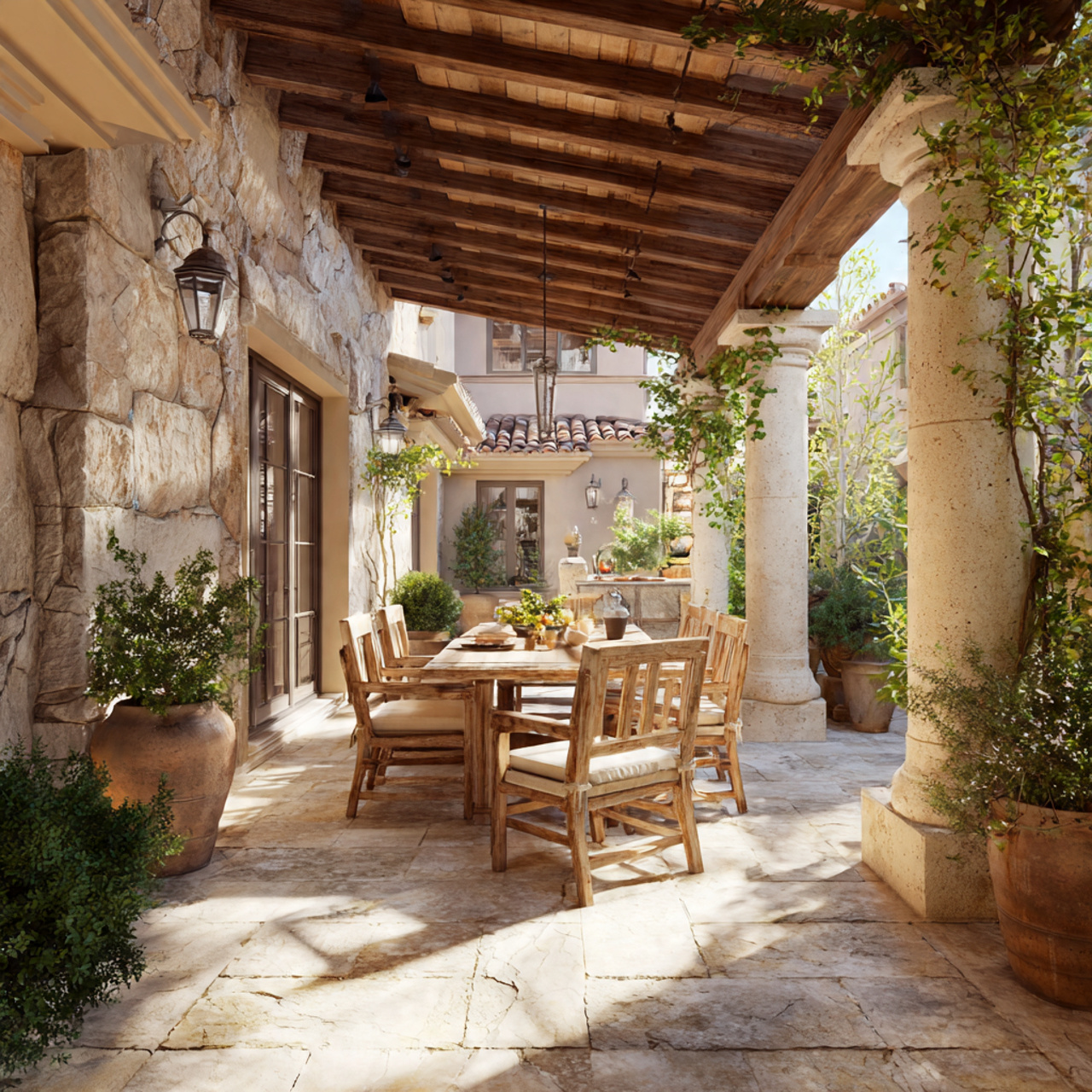
A stone pillar portico announces itself with a weight and permanence that no lightweight framed structure can approach. Whether the material is natural limestone, stacked fieldstone, or Eldorado Stone manufactured veneer, the visual density of stone columns makes every other element of the outdoor space feel anchored and resolved. In hot and arid climates, the thermal mass of stone columns and a clay tile roof actually moderates temperature after dark in ways that metal or timber cannot replicate, extending comfortable outdoor hours without mechanical cooling.
Best for: Mediterranean, Spanish Colonial, and Tuscan-style homes in warm, dry climates Product: Eldorado Stone stacked limestone veneer in Adobe colorway for column cladding Pro tip: Use a dark-toned grouting mortar between stone courses rather than standard light grey to make individual stones read more crisply and give the columns a richer, more hand-set character. Room Fit: Grand rear porticos and formal entertaining areas on estate-scale properties with significant lot depth Designer language: “I want a stone pillar portico with a clay barrel tile roof, hand-set limestone column cladding, a plaster ceiling between the rafters, and a recessed lighting grid above.” Room size: Most effective at a minimum of 12 by 20 feet to maintain the proportional relationship between column mass and the covered area they frame
A-Frame Exposed Rafter Pavilion
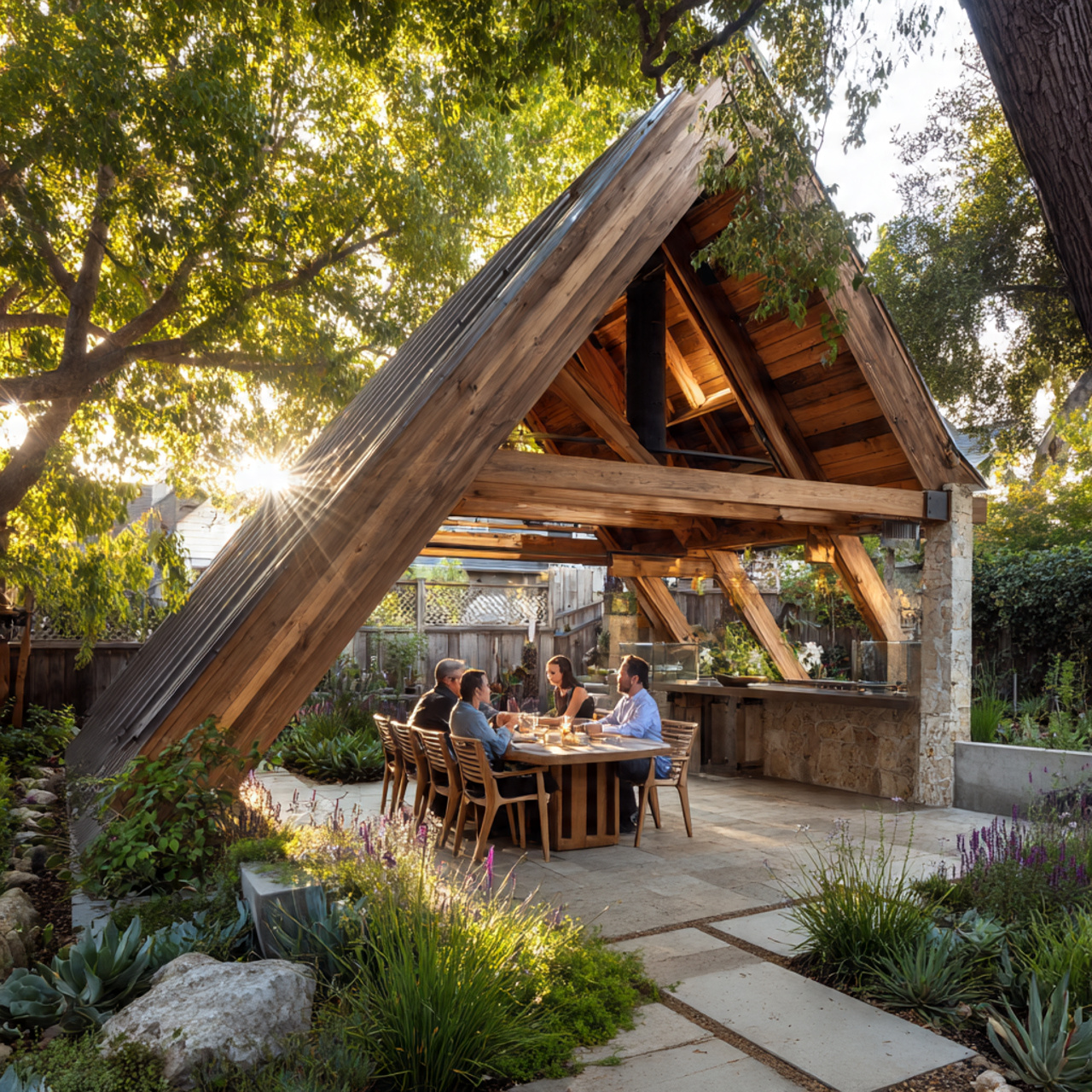
An A-frame pavilion generates a reaction from first-time visitors that few other outdoor structures can match. The steep pitch drives the ridge to an impressive height and leaves the full rafter structure visibly exposed, turning structural necessity into a defining aesthetic feature. This form also sheds rain and heavy snow more effectively than nearly any other covered patio configuration. California Redwood Association technical resources and TimberTech provide detailed specifications for the heavy timber sizing and connection hardware required to span safely at residential A-frame scale.
Best for: Mountain, woodland, and resort-style properties with large outdoor entertaining requirements Product: California Redwood Association Grade A clear heart redwood for structural ridge beam and rafters Pro tip: Hang a large outdoor chandelier at the apex of the A-frame on a long drop cord to fill the tall interior volume with warm light and give the peak a deliberate visual anchor. Room Fit: Freestanding pavilions in generous rear yards, particularly those set near a natural landscape feature or water element Designer language: “I want a clear heart redwood A-frame pavilion with an exposed ridge beam, structural knee braces, open sides, and a standing-seam metal roof in matte charcoal.” Room size: Most effective at widths of 16 feet or more where the height of the A-frame is visually proportional to the floor area below
Zen Inspired Slat Wood Teahouse
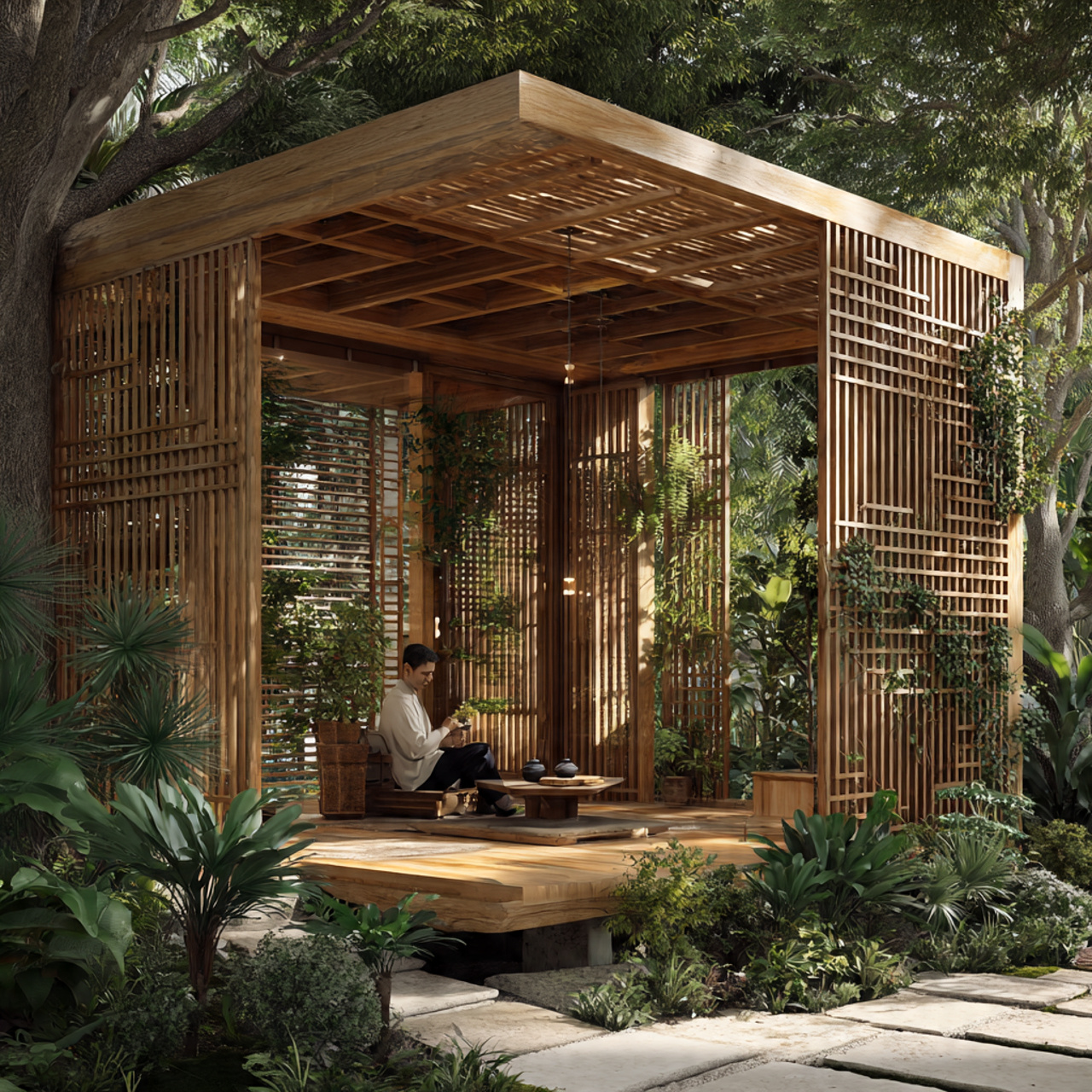
The Zen teahouse concept is one of the most disciplined approaches in outdoor architecture, and experienced designers working in this tradition know that restraint is the hardest quality to apply consistently. Every element that does not serve stillness and simplicity is removed until nothing remains that does not carry its own weight. Ipe and thermally modified ash are the two species most consistently recommended by landscape architects for this application because both remain dimensionally stable through repeated wet and dry cycles without cupping or checking. The 1.5-to-2-inch slat spacing creates a light rhythm that shifts gently across the floor throughout the day, providing a meditative visual quality fundamentally different from the organic randomness of bamboo or vine canopies.
Best for: Meditation gardens, Japanese-inspired landscapes, and minimalist outdoor design enthusiasts Product: Thermory USA thermally modified ash boards for slat cladding and overhead screen construction Pro tip: Leave the interior completely unfurnished on the day it is completed and sit in the space for one uninterrupted hour before deciding whether any furniture serves or undermines the atmosphere. Room Fit: A quiet corner of the garden removed from the main living area, placed near a water feature, gravel garden, or moss planting Designer language: “I want a Zen slat teahouse in thermally modified ash at a 1.5-inch spacing, with a pea gravel floor surround, no applied surface finishes, and no visible decorative hardware.” Room size: Most effective at 8 by 10 or 10 by 10 feet, where the intimate scale reinforces the contemplative purpose of the structure
Quick Comparison Table
$$$$$
| Patio Cover Style | Room Type | Style | Budget Level | Wow Factor |
|---|---|---|---|---|
| Modern Pergola With Louvered Slats | Large patio | Contemporary | $$$$ | ★★★★★ |
| Rustic Natural Wood Beam Overhang | Attached patio | Craftsman/Farmhouse | $$$ | ★★★★☆ |
| Industrial Steel Frame Canopy | Urban terrace | Industrial/Modern | $$$$ | ★★★★☆ |
| Mediterranean Style Arched Loggia | Wide rear patio | Mediterranean | $$$$ | ★★★★★ |
| Bohemian Inspired Bamboo Screen Cover | Small garden patio | Bohemian/Eclectic | $ | ★★★☆☆ |
| Traditional White Vinyl Pavilion | Freestanding yard | Traditional/Colonial | $$ | ★★★☆☆ |
| Translucent Polycarbonate Roof Panels | Narrow lean-to | Modern/Minimal | $$ | ★★★☆☆ |
| Retractable Fabric Awning Concept | Attached patio | Transitional | $$$ | ★★★★☆ |
| Vaulted Ceiling Porch Extension | Rear porch | Craftsman/Ranch | $$$$ | ★★★★★ |
| Minimalist Glass Roof Veranda | Garden-facing patio | Contemporary/Scandinavian | ★★★★★ | |
| Reclaimed Barn Wood Gazebo | Freestanding yard | Farmhouse/Country | $$$ | ★★★★☆ |
| Tropical Thatch Roof Tiki Hut | Poolside | Resort/Tropical | $$ | ★★★★☆ |
| Contemporary Cantilevered Roof Design | Rear patio | Modern/Minimal | ★★★★★ | |
| Classic Brick Pillar Porch | Front/rear porch | Traditional/Colonial | $$$$ | ★★★★☆ |
| Trellis With Flowering Climbing Vines | Garden pergola | Cottage/Romantic | $$ | ★★★★★ |
| Farmhouse Style Corrugated Metal Roof | Attached rear patio | Modern Farmhouse | $$ | ★★★☆☆ |
| Elegant Wraparound Covered Terrace | Multi-side porch | Traditional/Estate | ★★★★★ | |
| Integrated Skylight Patio Cover | Attached enclosed patio | Transitional | $$$ | ★★★★☆ |
| Geometric Laser Cut Metal Screens | Courtyard | Contemporary/Artistic | $$$$ | ★★★★★ |
| Shiplap Ceiling Outdoor Living Room | Covered rear porch | Coastal/Farmhouse | $$ | ★★★★☆ |
| Victorian Wrought Iron Solarium | Formal rear garden | Victorian/Classical | ★★★★★ | |
| Coastal Inspired Sail Cloth Shade | Pool deck/open patio | Coastal/Resort | $$ | ★★★★☆ |
| Stone Pillar Mediterranean Portico | Grand rear patio | Mediterranean/Estate | ★★★★★ | |
| A-Frame Exposed Rafter Pavilion | Freestanding yard | Mountain/Lodge | $$$$ | ★★★★★ |
| Zen Inspired Slat Wood Teahouse | Garden corner | Japanese/Minimalist | $$$ | ★★★★☆ |
Frequently Asked Questions
What are the most durable materials for covered patio ideas? Powder-coated aluminum, steel, and high-grade vinyl consistently outperform other materials in long-term outdoor exposure because they resist rot, insects, and UV degradation without annual sealing or painting. For a warmer natural look with comparable longevity, thermally modified wood and pressure-treated cedar are the trade-level recommendations over standard pine or untreated softwood.
Which covered patio ideas offer the best natural lighting? Translucent polycarbonate panels and slimline glass veranda systems allow the highest percentage of natural light through while still providing a fully weatherproof barrier overhead. Louvered pergola systems and retractable awnings offer the most real-time flexibility because the amount of light can be adjusted throughout the day based on sun angle.
How does an overhead patio cover affect airflow in the space below? Open-profile structures like louvered pergolas, bamboo screens, and sail shades allow rising heat to escape and cross breezes to move freely through the space. Solid roof structures can trap warm air at low ceiling heights, but this is effectively managed with outdoor ceiling fans or by specifying a vaulted ceiling profile that allows convective heat to rise away from the seated zone.
What permits are typically required for covered patio ideas? Most permanent covered patio structures including pavilions, pergolas, and attached porch extensions require a building permit because they constitute a permanent structural addition to the property. Freestanding temporary structures like shade sails and retractable awnings are typically exempt, but zoning setback rules still apply in most municipalities regardless of permit status.
How can covered patio ideas be adapted for compact outdoor spaces? Cantilevered roof designs and wall-mounted retractable awnings are the most space-efficient options for small patios because they eliminate the column footprint from the usable floor area entirely. Using light-colored covers in white vinyl or translucent polycarbonate on a compact space also prevents the overhead structure from making a small area feel darker or more enclosed than it already is.
Final Thoughts
The right covered patio idea does not just protect you from the weather. It gives you a genuine reason to be outside more often, to entertain with ease, and to feel connected to the outdoor space your home sits within every single day. These structures change how a home feels from the inside out, and the difference between a bare backyard and a fully realized outdoor room is something you notice whether you are using it or simply looking at it through the window.
These covered patio ideas span every budget, every architectural style, and every climate consideration a homeowner is likely to face. The most important step is committing to one and taking the project from inspiration to installation, because a structure that is nearly perfect and actually built will always outperform a perfect plan that lives on a mood board indefinitely.
Start by matching the cover style to the architectural character of your home before considering anything else. A glass veranda on a Victorian brick row house and a steel cantilever on a 1960s ranch are both beautiful choices in the right context, but both will fight the existing architecture if the structural relationship between old and new is ignored from the start.
The detail that separates a covered patio that feels designed from one that feels added is always the ceiling: how it is finished, how it is lit, and how it speaks to the material language of the home that stands behind it.