25 Closet Organization Ideas That Will Finally Transform Your Space
If closet organization ideas are on your mind right now, you already know the specific frustration of opening your closet door every morning and facing tangled hangers, buried shoes, and garments you forgot you owned. That moment of dread before the day even starts chips away at your mood and your time before you have done anything else.
You are not disorganized by nature. Most closets are designed as an afterthought, assigned a single rod and a single shelf, and left to serve a wardrobe that outgrew that setup years ago. When the structure fails you, no amount of personal effort holds the space together for long.
The root cause of closet chaos is almost always a mismatch between storage type and wardrobe volume. Most people have far more folded items than one shelf can handle and far more small accessories than any single rod was designed to manage. A closet built around the wrong assumptions defeats you every time.
After studying how professional organizers and interior designers approach wardrobe storage across dozens of builds, the patterns that separate functional closets from chaotic ones become unmistakable. It almost never comes down to square footage. It comes down to system design and the decisions made before a single item goes back inside.
This article walks you through 25 specific strategies addressing every part of the closet, from the top shelf to the floor. Every idea includes a real product recommendation, designer language, a room size reference, and a pro tip you can act on immediately.
You will leave with a clear picture of what needs to change and how to change it. Whether you are working with a cramped reach-in or a generous walk-in, these closet organization ideas deliver a space that is easier to maintain, more enjoyable to use, and genuinely beautiful every single morning.
The most important rule in home decor closet design is that organization and aesthetics are not competing goals. The most beautiful closets look that way precisely because they are well-organized. In 2026, the biggest shift in home organization has moved toward curated, visible storage that functions as intentional decor rather than hiding everything behind closed cabinet doors.
Vertical Storage Maximization Ideas
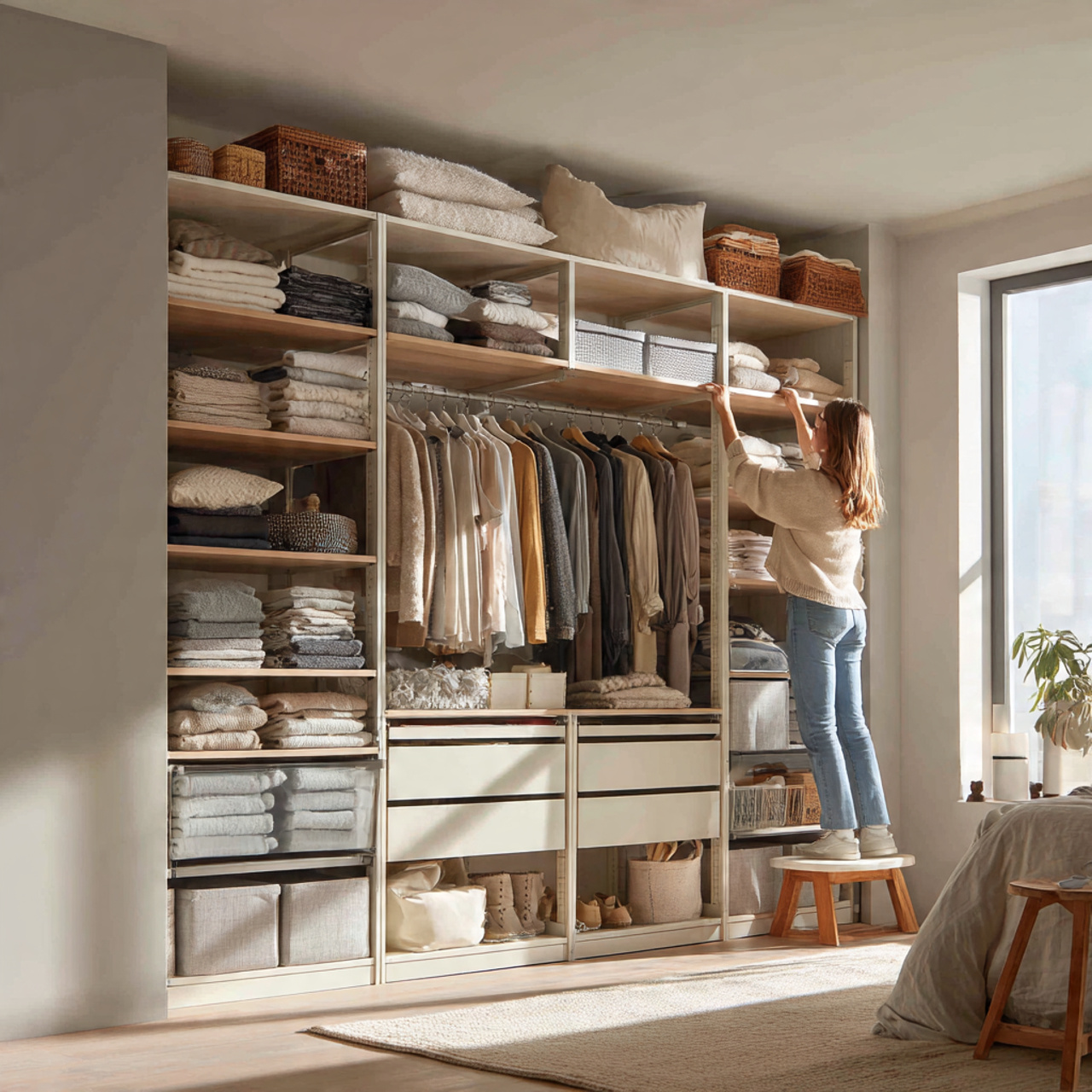
When floor space is limited, the wall above your head is the most underused asset in the closet. Installing modular shelving or adjustable uprights running floor to ceiling captures the vertical zone a standard single-rod setup leaves completely empty. The IKEA PAX system is the most widely used solution, with stackable components fitting nearly any ceiling height.
Most closets leave two to three feet of wall above the top shelf completely unused. Reclaiming that zone for off-season bins or spare linens immediately changes capacity without touching a wall.
Best for: Anyone working with a shallow or narrow closet footprint Product: IKEA PAX wardrobe system with stacked add-on shelving units Pro tip: Reserve everything above eye level for items used fewer than four times a year so prime hanging space stays dedicated to daily use. Room Fit: Small to medium bedroom closets with ceilings of 8 feet or taller Designer language: Ask for a floor-to-ceiling modular shelving configuration with adjustable shelf heights. Room size: Works best in closets with at least 8-foot ceilings and any width
Seasonal Clothing Rotation Ideas

Rotating seasonal clothing is one of the highest-return habits you can build because it immediately reclaims prime space for garments you actually reach for now. Off-season pieces compressed in SpaceSaver vacuum storage bags take up a fraction of their original volume and store easily under a bed. The visual result is a closet that feels lighter and more manageable almost instantly.
The transition between seasons is also the ideal moment to check for items that need repair or no longer fit your wardrobe. A disciplined rotation keeps the closet accessible and visually calm throughout the year.
Best for: Wardrobes with significant variation between warm and cold-weather months Product: SpaceSaver Premium Vacuum Storage Bags for off-season compression Pro tip: Label every bag with the season name and item count so restocking the closet takes minutes rather than guesswork the following season. Room Fit: Any bedroom with a primary closet regardless of size Designer language: Specify a seasonal rotation strategy with clearly labeled auxiliary storage outside the primary closet zone. Room size: Most impactful in small closets where two full seasons cannot coexist without crowding the rod
Color-Coded Wardrobe Display Ideas

Color-coding your wardrobe sounds almost too simple until you actually do it and realize it completely changes how your closet feels. Arranging garments by color within each category creates a visual rhythm that makes outfit building faster and more enjoyable. The effect is most powerful when paired with a uniform hanger profile like the Amazon Basics Velvet Suit Hanger set in one consistent color.
Interior stylists use chromatic arrangement as a finishing detail in high-end builds because it makes the space read as intentional from the doorway. Even a modest closet takes on an editorial quality when colors move cleanly from light to dark.
Best for: Anyone who builds outfits around a defined color palette Product: Amazon Basics Velvet Suit Hangers in one uniform color throughout the entire closet Pro tip: Pull all white and cream pieces to the far left so the gradient reads cleanly from the moment the door opens. Room Fit: Bedroom closets with open hanging sections and adequate lighting Designer language: Reference this as a chromatic wardrobe arrangement with uniform hanger profiles. Room size: Works in any size closet where the primary storage format is hanging rather than folded
Hidden Shoe Storage Ideas
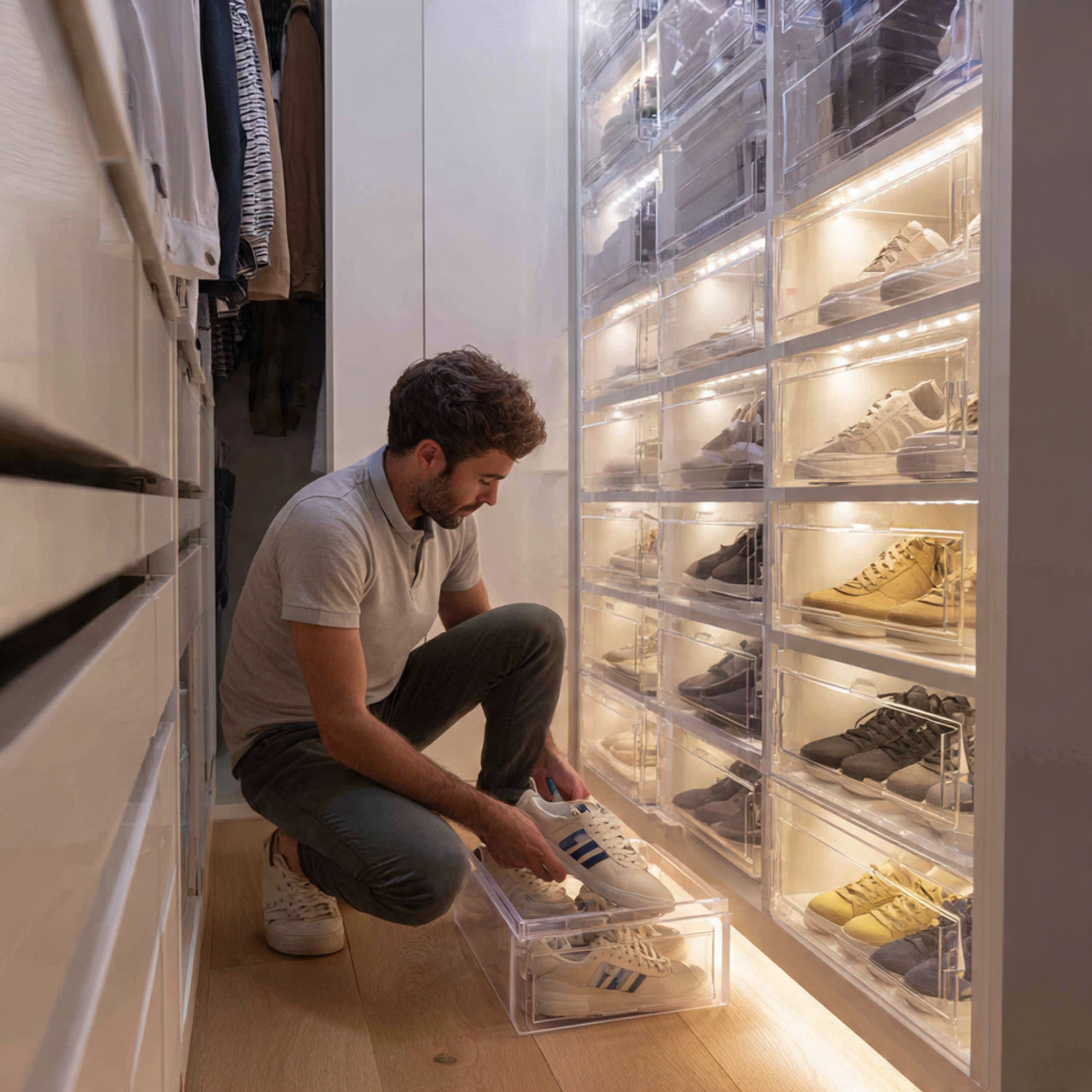
Shoes on the floor create visual noise and cause damage through scuffing, dust, and shape loss over time. Pull-out trays, base cabinetry, or clear drop-front boxes solve both problems at once. The IKEA KOMPLEMENT pull-out shoe shelf stores pairs at an angle for efficiency and slides smoothly without disturbing surrounding items.
For formal footwear, clear lidded boxes from The Container Store offer dust protection while keeping every style identifiable at a glance. Both approaches result in a cleaner floor and better-preserved shoes.
Best for: Shoe collections of 15 or more pairs currently living on the floor Product: IKEA KOMPLEMENT pull-out shoe shelf or The Container Store clear drop-front shoe boxes Pro tip: Store heels with the toe facing outward so each style is identifiable without pulling any box down from the shelf. Room Fit: Walk-in closets and deep reach-in configurations with available base cabinetry sections Designer language: Specify integrated shoe cabinetry with pull-out trays and toe-forward display orientation. Room size: Best in medium to large closets with dedicated base storage sections
Sliding Drawer System Ideas
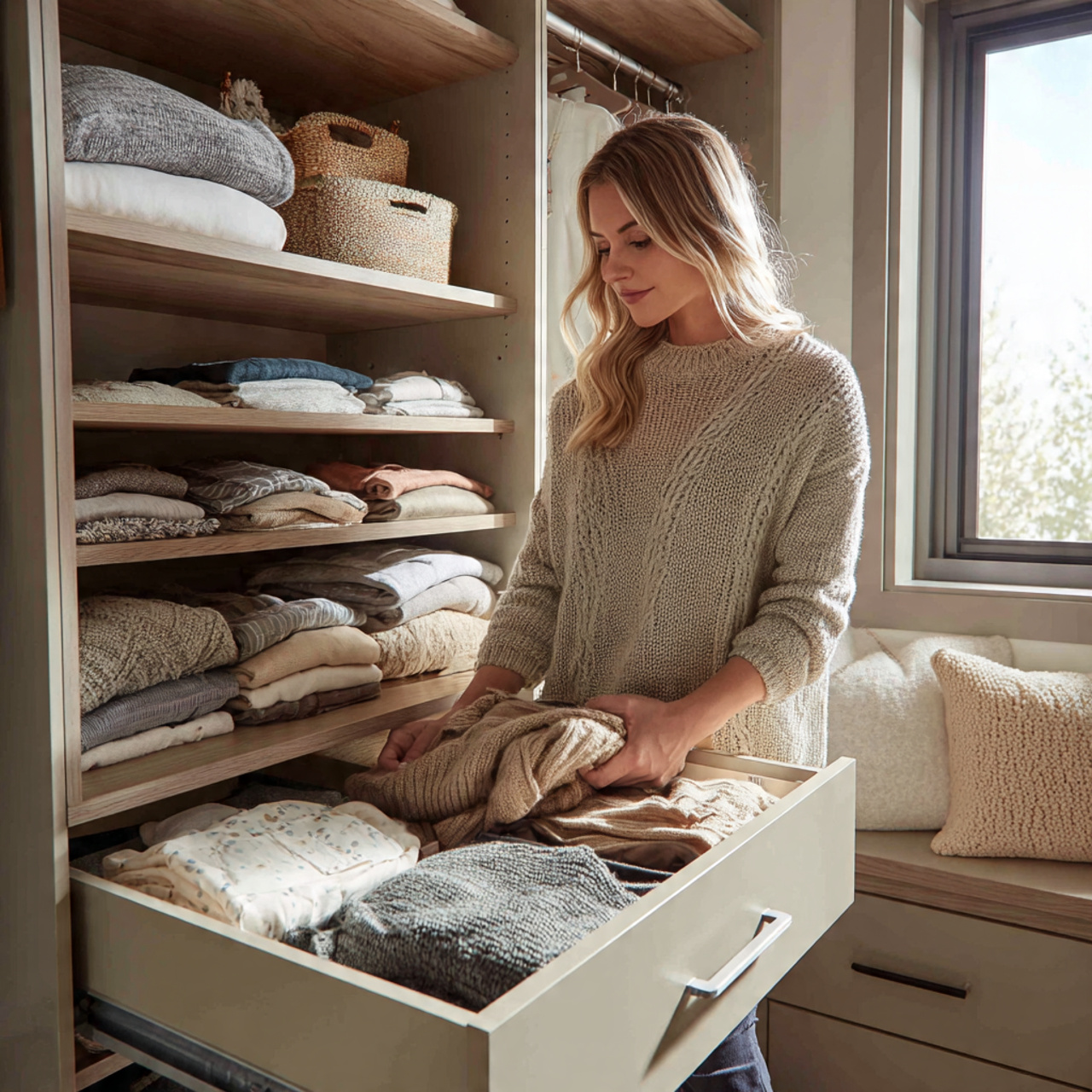
Sliding drawers inside a closet bring dresser function into the wardrobe zone, eliminating the need for a separate bedroom chest. They are especially valuable for knitwear, loungewear, and athletic gear that presents better folded than hung. California Closets drawer towers and IKEA PAX drawer inserts both work well depending on whether you want a custom or modular build.
Soft-close mechanisms protect garments from slamming and keep the system feeling polished through years of daily use. Adjustable internal dividers prevent category mixing and make every drawer instantly readable from above.
Best for: Anyone who folds more than they hang, particularly knitwear and casualwear Product: California Closets custom drawer tower or IKEA PAX internal soft-close drawer unit Pro tip: Position the garments you reach for most in the second drawer from the top so you never crouch or stretch for everyday pieces. Room Fit: Master bedroom closets and larger walk-in configurations Designer language: Specify a soft-close drawer tower with adjustable interior dividers for categorized folded garment storage. Room size: Works best in closets at least 24 inches deep to allow full drawer pull clearance
The standard drawer depth for folded garment storage in professional closet design is 14 to 16 inches. Anything shallower forces awkward folding and makes drawer contents nearly impossible to read at a glance. That single measurement separates a custom-quality result from a generic shelf installation.
Jewelry and Accessory Integration Ideas

Keeping jewelry and accessories inside the closet brings the entire dressing routine into one room, which is something professional wardrobe stylists design for specifically. Shallow velvet-lined drawers at eye level prevent the tangling and scratches that pile-style storage inevitably causes. Pottery Barn’s velvet jewelry drawer inserts fit most standard systems and provide the compartment depth delicate pieces require.
For scarves, belts, and statement necklaces, a hook rail on the inside of the closet door provides immediate visibility. When accessories live beside the clothing they complete, you wear them far more consistently.
Best for: Anyone whose jewelry regularly goes unworn because it is out of sight Product: Pottery Barn velvet jewelry drawer inserts or The Container Store over-door accessory organizer panel Pro tip: Mount small Command hooks inside a cabinet door for necklaces so chains never tangle without requiring permanent wall hardware. Room Fit: Walk-in closets and large reach-in designs with available door panel real estate Designer language: Specify integrated accessory storage with velvet-lined compartmentalized drawers at the primary dressing zone height. Room size: Best in medium to large closets; compact insert versions work in small reach-ins as well
Small Reach-In Closet Design Ideas
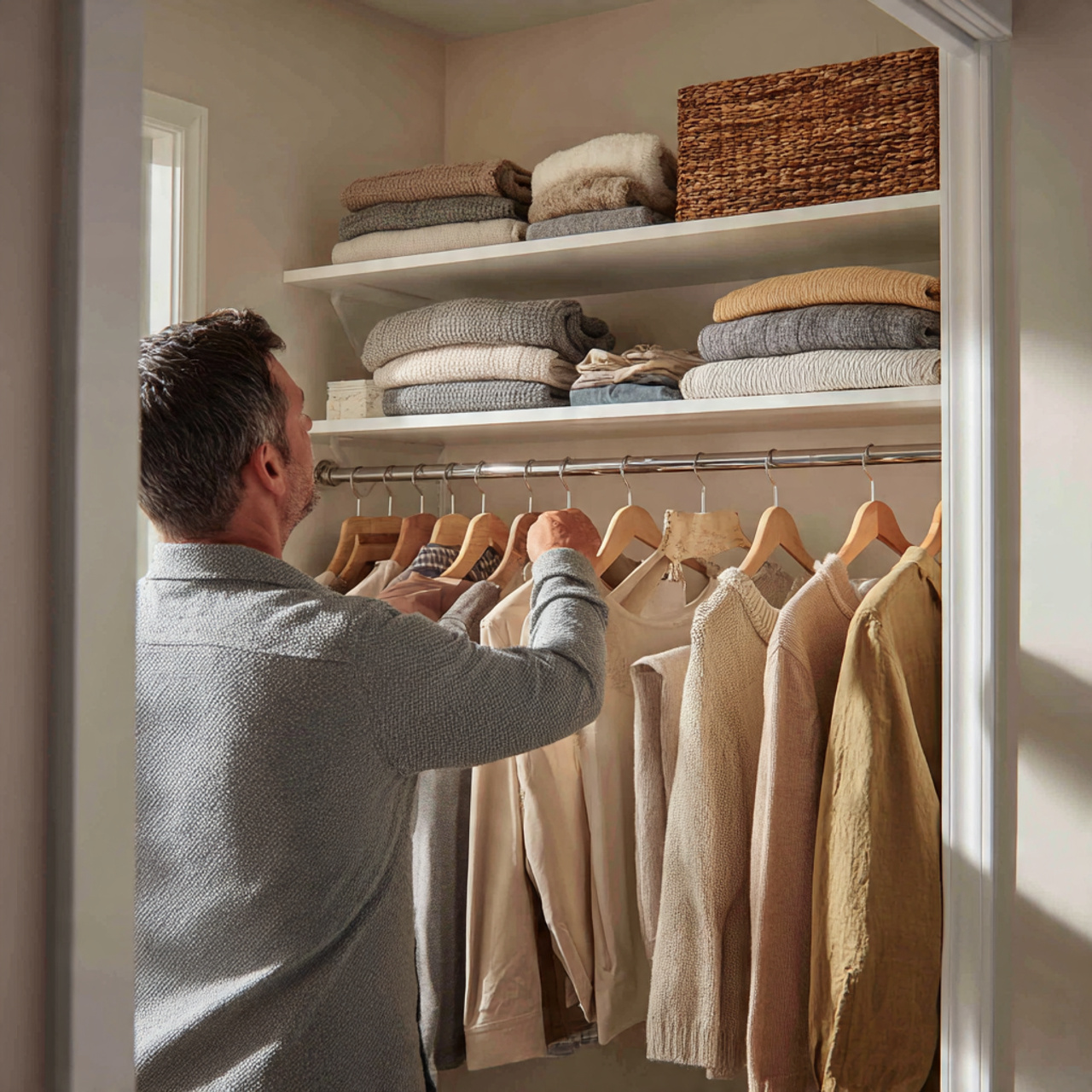
A reach-in closet requires different design logic than a walk-in because every component must be thin, multifunctional, and precisely placed with no margin for redundancy. Switching to Huggable Hangers by Joy Mangano alone recovers up to six inches of rod length compared to standard plastic versions. That recovered space is one of the most impactful single changes a small closet can receive.
The back wall above the rod is almost always underused. Shallow bins fitted precisely to that depth become functional storage for bags, folded jeans, or spare linens without overwhelming the space.
Best for: Studio apartments, guest rooms, and smaller master bedrooms Product: Huggable Hangers by Joy Mangano and ClosetMaid ShelfTrack adjustable wall shelving Pro tip: Use both inside side walls with slim hook rails to capture vertical real estate that a standard kit ignores entirely. Room Fit: Any bedroom with a single reach-in closet under 6 feet wide Designer language: Reference this as a high-density reach-in build with wall-to-wall adjustable shelving and slim-profile hanger hardware. Room size: Designed for closets under 6 feet wide and under 24 inches deep
Walk-In Closet Island Installation Ideas
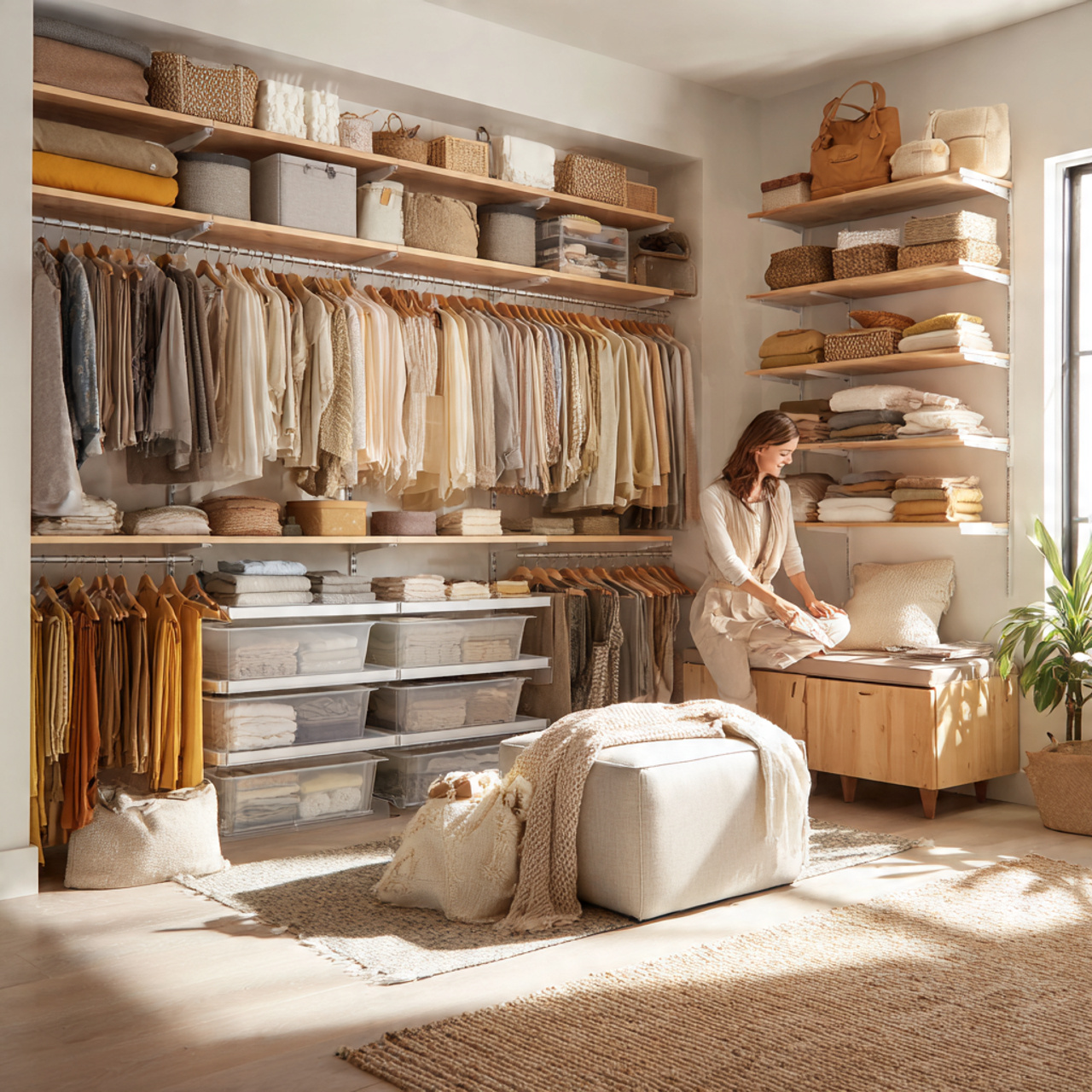
A closet island turns the center floor of a walk-in into a multifunctional styling and storage hub that wall-mounted systems cannot replicate. The surface gives you space to lay out outfits, fold fresh laundry, or manage seasonal transitions without taking over the bedroom. California Closets and RH both offer island units with quartz or marble countertop finishes for different budgets.
Drawers below the surface suit jewelry, lingerie, and accessories that benefit from an enclosed environment. Always confirm at least 36 inches of circulation clearance on all sides before committing, which is the professional design minimum.
Best for: Walk-in closets being designed or renovated with a luxury brief Product: California Closets custom island or RH closet island with stone countertop option Pro tip: Choose an island with shallow top drawers and deeper base cabinets combined so a single unit handles both fine accessories and bulkier folded garments. Room Fit: Walk-in closets of at least 100 square feet with usable central floor space Designer language: Specify a freestanding or built-in closet island with stone countertop and mixed-depth drawer configuration. Room size: Requires a walk-in footprint of at least 8 by 10 feet to maintain 36-inch clearance on all sides
Open Shelving for Folding Ideas
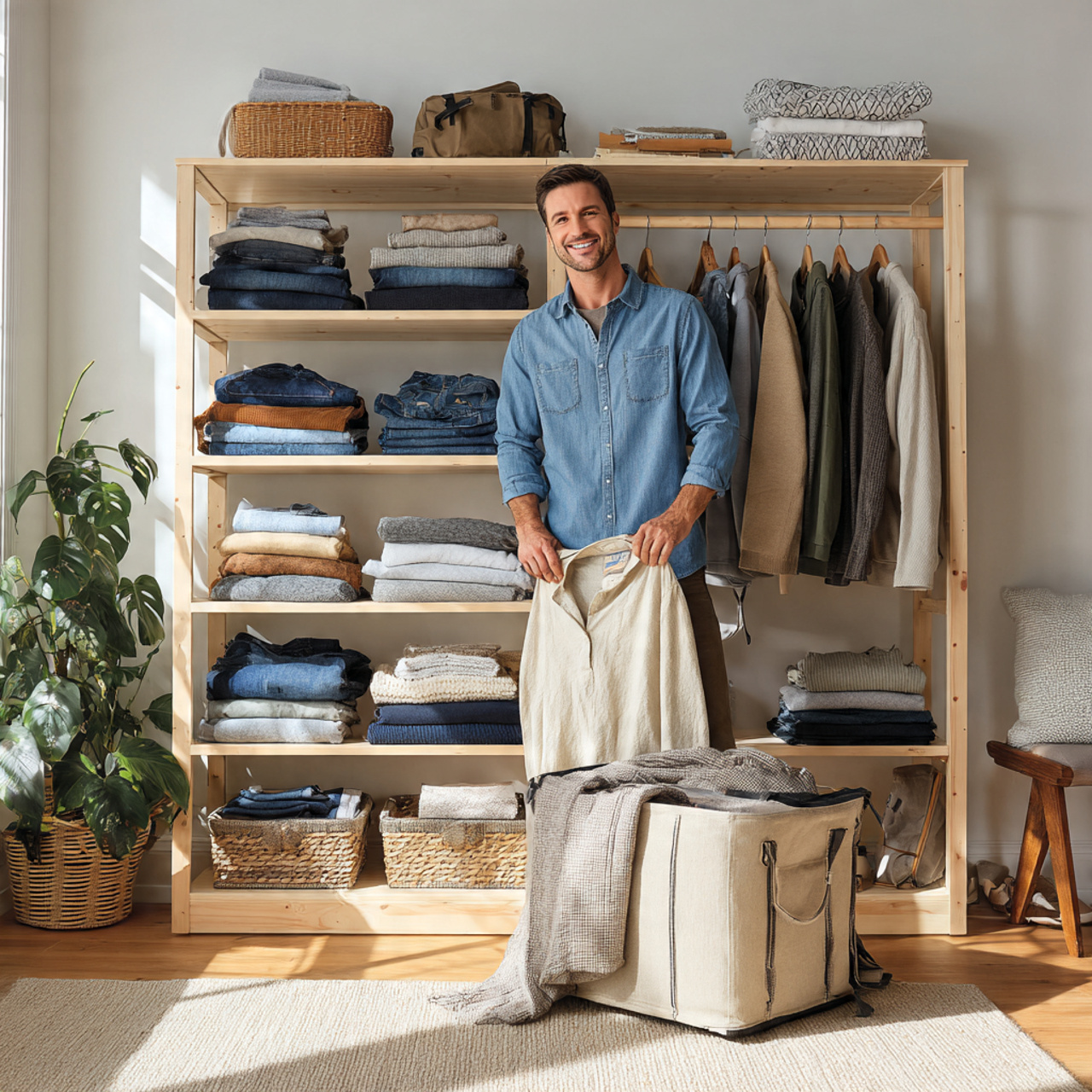
Open shelving has one advantage over drawers that matters enormously in a wardrobe context: everything is visible at once. Garments folded using the KonMari technique stand upright and allow an entire shelf to be read at a glance without pulling anything out. IKEA KALLAX units repurposed inside a closet are a popular and budget-accessible approach to this format.
Shelf dividers prevent stacks from spreading into neighboring categories, especially on shelves wider than 12 inches. Maintaining a consistent fold height is the key discipline that keeps the display clean over time.
Best for: Anyone with a large collection of knitwear, casualwear, or folded denim Product: IKEA KALLAX shelf unit or ClosetMaid adjustable wood closet shelving with bracket hardware Pro tip: Fold each item to the exact width of its shelf section so every stack aligns edge to edge and the display reads as deliberate. Room Fit: Master bedroom and guest room closets with a dedicated folding zone Designer language: Reference this as an open-format folded display shelf with vertical dividers and consistent uniform stack heights. Room size: Works well in closets at least 18 inches deep per individual shelf section
Custom DIY Drawer Divider Ideas
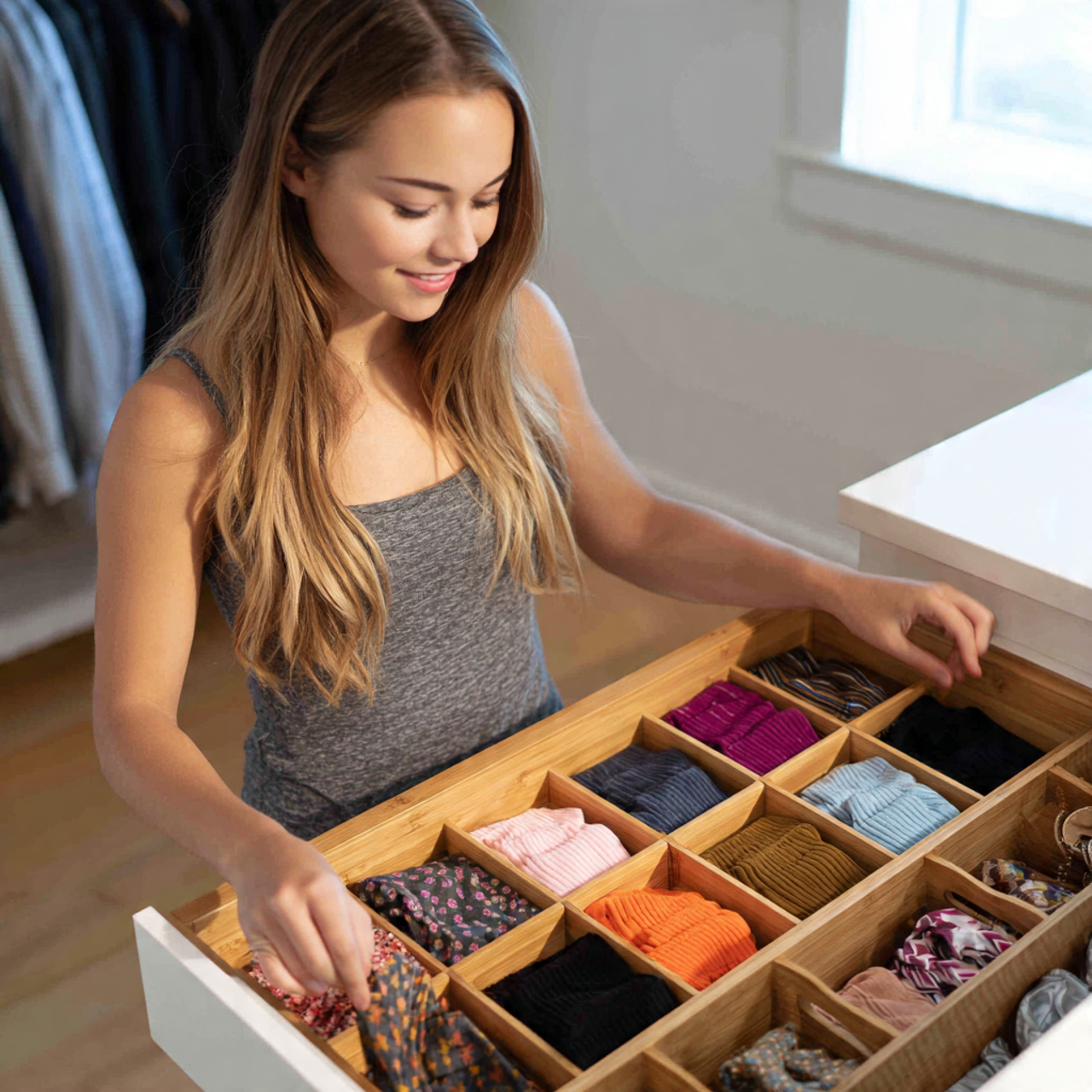
Off-the-shelf drawer inserts rarely match the exact dimensions of the drawer or the items going inside, which is why custom dividers outperform pre-made products in practice. Modular interlocking organizers from mDesign or bamboo sets from The Container Store give full control over compartment size and count. Socks, undergarments, and accessories all require different slot widths to stay organized rather than just contained.
Building your own divider system costs far less than custom cabinetry and takes under an hour. The result is a drawer where nothing migrates and nothing disappears to the back.
Best for: Anyone frustrated by generic inserts that waste half their drawer space Product: mDesign bamboo drawer organizer set or The Container Store interlocking drawer dividers Pro tip: Measure the drawer you use most every single day before buying anything and design the compartment grid around those specific items first. Room Fit: Any bedroom closet with existing drawer storage at any scale Designer language: Specify custom-pitch drawer organization with compartment widths matched to garment folding dimensions. Room size: Suitable for all closet sizes with drawers of any standard depth
Shelf depth is the detail most people overlook and most closet kits get wrong. Professional designers specify a minimum of 12 inches for folded garments and 14 to 16 inches for bags and shoes. A shelf that is too shallow causes items to hang over the edge, which creates exactly the visual disorder you were trying to fix.
Belt and Tie Hanging Solutions Ideas
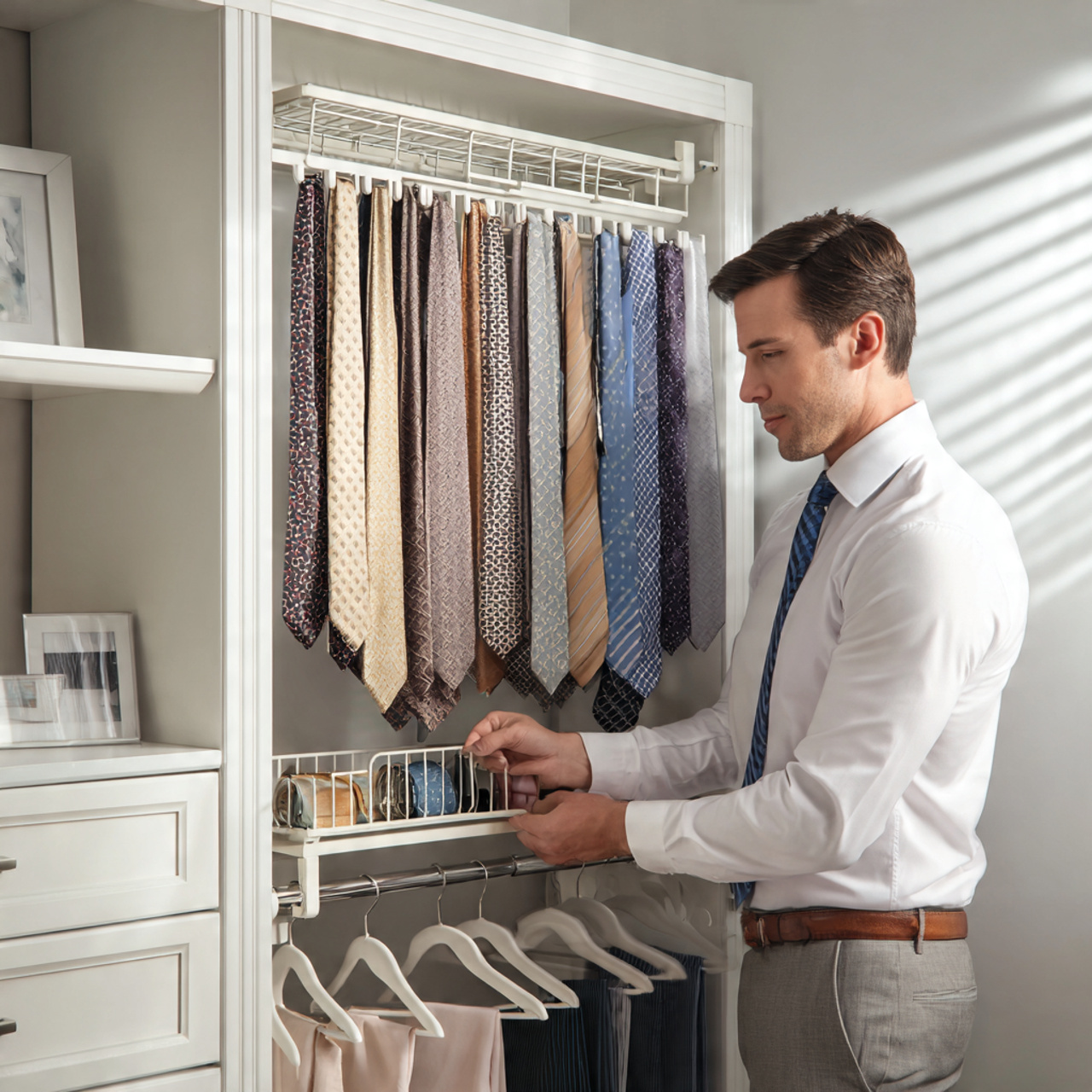
Belts rolled in a drawer lose their shape, and ties draped over a rod develop creases that dry cleaning cannot always remove. A pull-out rack dedicated to both solves years of wear damage in a single installation. The IKEA KOMPLEMENT pull-out pants hanger works well repurposed as a belt display, and The Container Store carries dedicated tie and belt organizers that mount to a side panel.
The pull-out format is superior to a fixed rail because it brings the entire collection forward so nothing overlaps. Visibility drives usage, and broader usage is exactly what a functional closet is designed to produce.
Best for: Anyone with five or more belts or a collected tie wardrobe Product: IKEA KOMPLEMENT pull-out hanger repurposed as a belt rack or The Container Store tie and belt pull-out organizer Pro tip: Hang ties with the narrow end up so the wide blade pattern faces forward and every tie is identifiable in two seconds. Room Fit: Walk-in closets and reach-in designs with a side wall panel available for mounting Designer language: Specify a wall-mounted full-extension pull-out tie and belt rack with side panel mounting hardware. Room size: Installs on panels as narrow as 20 inches in a side wall or door mount position
Smart Hanging Rod Doubling Ideas
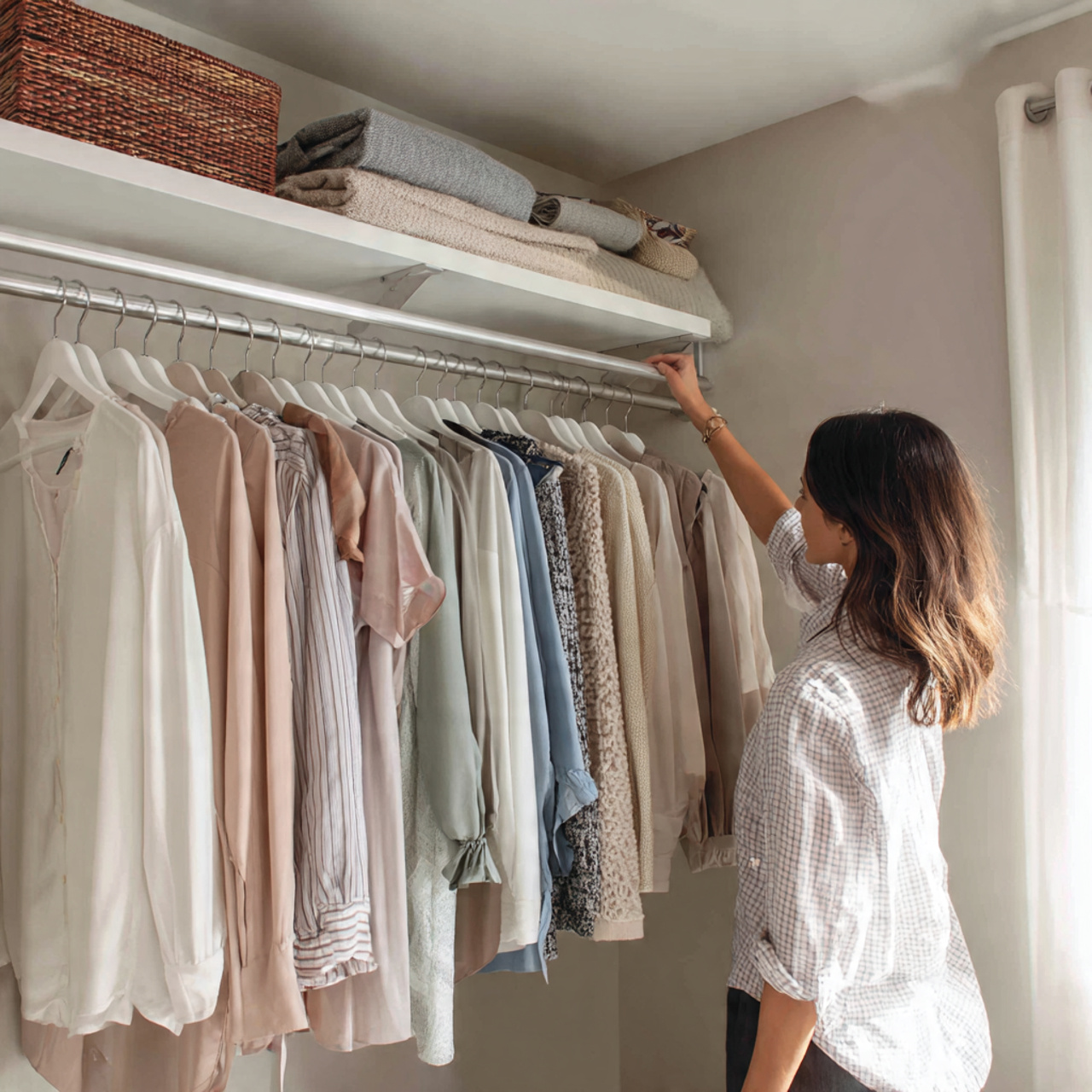
Doubling the hanging rod is the fastest high-impact upgrade available because it requires no structural renovation and doubles hanging capacity in under 30 minutes. A second rod installed below the first turns one hanging zone into two, and all short garments including shirts, blouses, and skirts fit comfortably on the lower section. The IKEA MULIG clothes bar or a chrome rod from Home Depot both install simply with basic tools.
Measure the drop length of your longest short garments first and position the lower rod to leave at least two inches of floor clearance. That gap keeps the lower zone fully functional and prevents hem dragging.
Best for: Anyone with mostly short garments and limited existing hanging space Product: IKEA MULIG clothes bar or a standard 1-inch chrome closet rod from Home Depot Pro tip: Reserve the upper rod exclusively for shirts and blouses and use the lower rod for folded trousers on clip hangers so both zones stay categorically clean. Room Fit: Bedroom and hallway closets with a single rod currently running the full width Designer language: Reference this as a double-hang configuration with dedicated upper and lower rod zoning by garment category. Room size: Works in any closet at least 72 inches tall with 18 or more inches of depth
The professional standard for a double-hang setup is 40 inches from the floor for the lower rod and 80 inches for the upper. These measurements preserve full garment clearance at the hem while fitting standard shirt and blouse lengths without bunching. Most DIY installations get this spacing wrong, which is why results can still feel crowded after the rod is in place.
Repurposed Furniture Storage Ideas
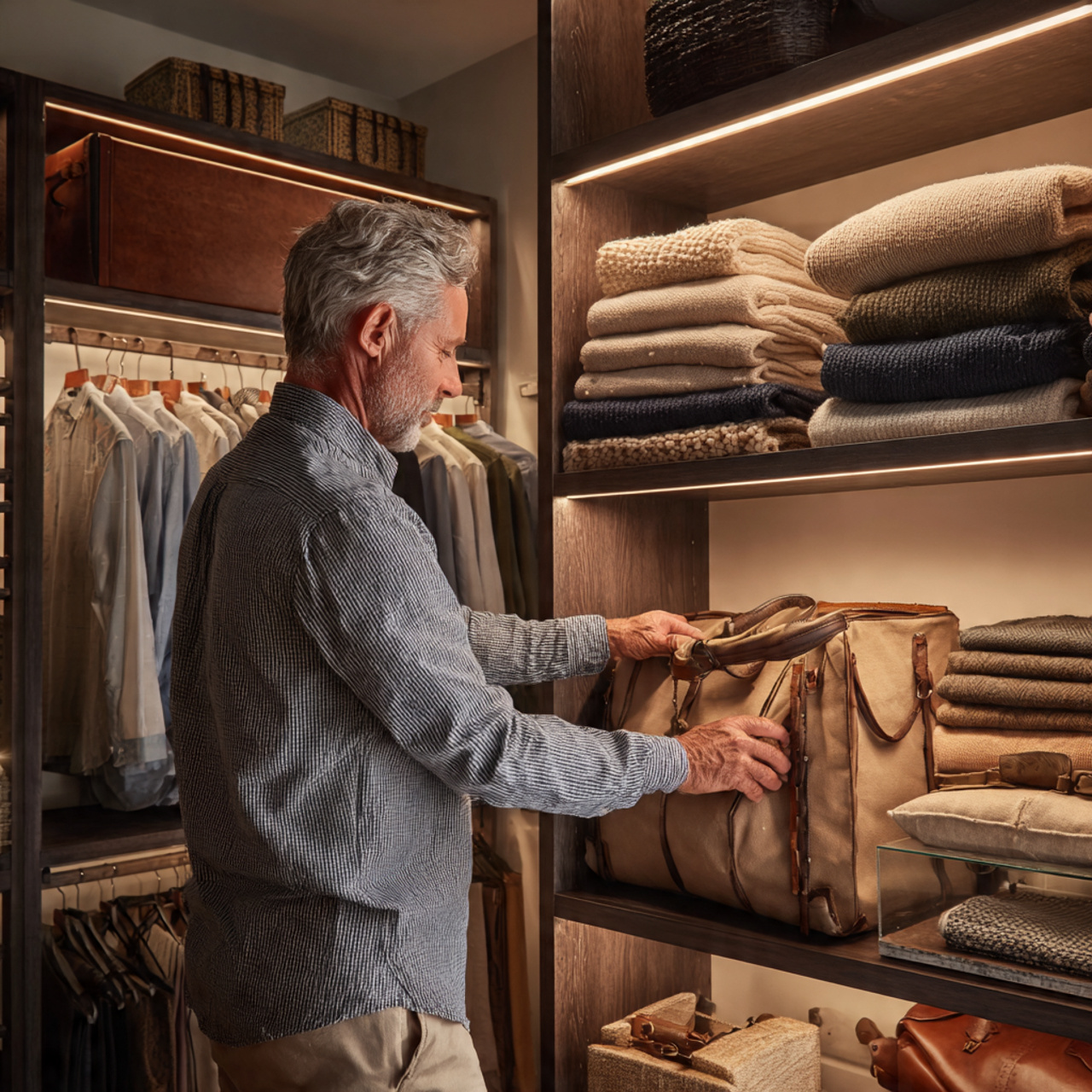
A vintage bookcase or narrow barrister cabinet brings personality to a walk-in closet that built-in units simply cannot replicate. The character of a repurposed piece makes the space feel like a curated boutique rather than a storage room. Antique bookshelves from Facebook Marketplace or HomeGoods work well for open sweater display or handbag presentation at a modest price.
The proportions must work within the closet’s circulation path and the finish should complement rather than compete with the surrounding system. A coat of chalk paint in a coordinating neutral unifies a mismatched find quickly.
Best for: Walk-in closets designed with a boutique or eclectic editorial aesthetic Product: Vintage bookcase from Facebook Marketplace or an open shelving unit from HomeGoods Pro tip: Fill the repurposed piece with a single category only, such as bags or folded denim, so it reads as a deliberate display rather than overflow. Room Fit: Large walk-in closets with at least one open wall or unused corner Designer language: Describe this as a freestanding accent storage unit serving a curated single-category boutique display function. Room size: Requires a walk-in with at least 12 square feet of open floor space beyond the primary shelving system
Back-of-the-Door Utilization Ideas
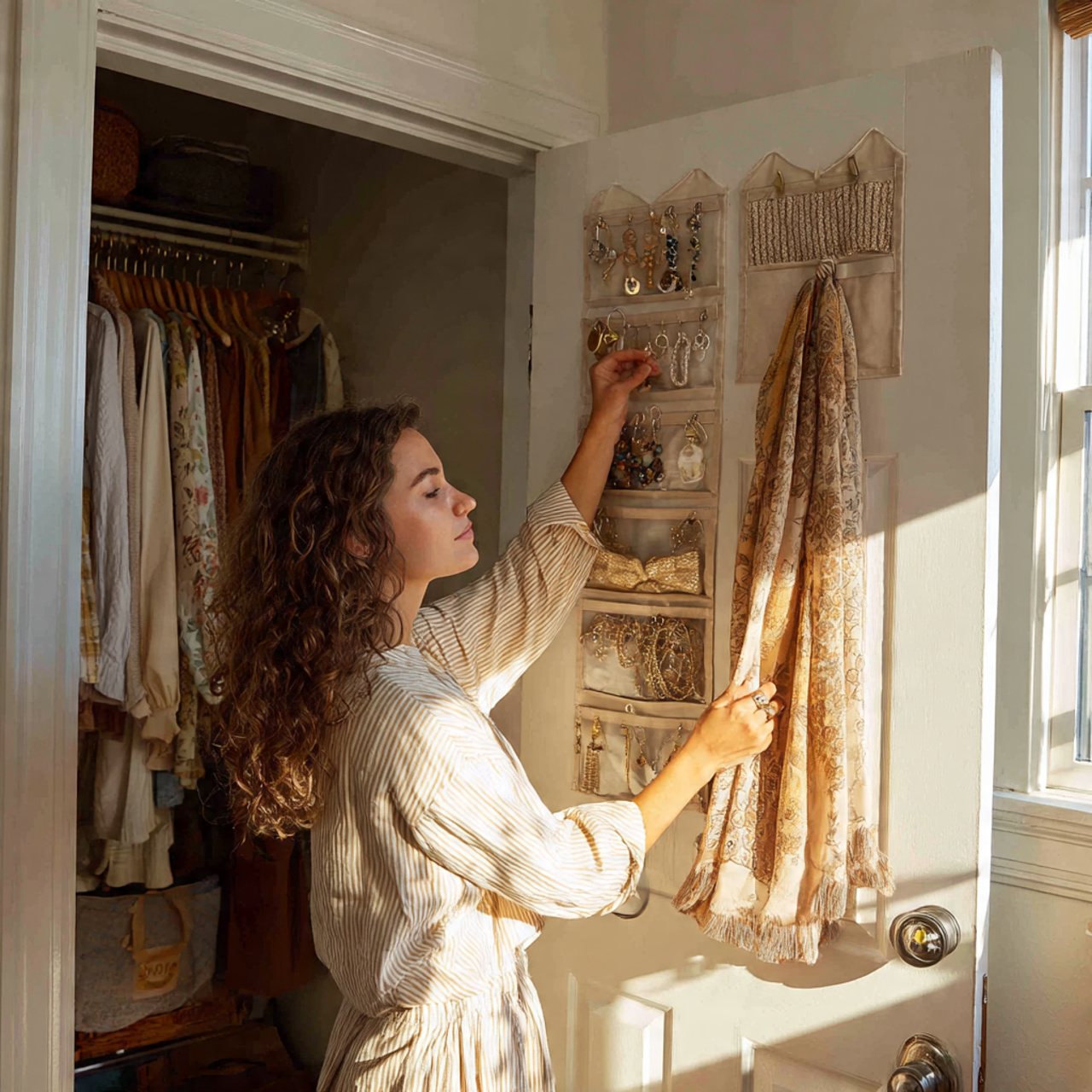
The back of a closet door is a flat, vertical, accessible surface that most people treat as dead space. Mounted organizers, hook rails, and slim storage panels turn it into a secondary storage zone without consuming any of the closet interior. The Container Store elfa door rack is one of the most adaptable over-door solutions, with components that mix and match for nearly any need.
For renters, options requiring no screws are especially practical. Tiered pocket panels and multi-hook bars hold robes, bags, and accessories in a way that makes everything visible the moment the door opens.
Best for: Closets with solid-panel doors and limited interior wall space Product: The Container Store elfa door and wall rack or a set of multi-bar Command hook strips Pro tip: Mount a slim full-length mirror on the back of the door to double its functional value and eliminate the need for a separate mirror elsewhere. Room Fit: Bedroom closets and hallway coat closets with hinged solid-panel doors Designer language: Reference this as behind-door vertical storage with modular hook and shelf components mounted without permanent wall damage. Room size: Works on any standard 24 to 36-inch wide closet door regardless of room size
Acrylic Bin and Container Ideas
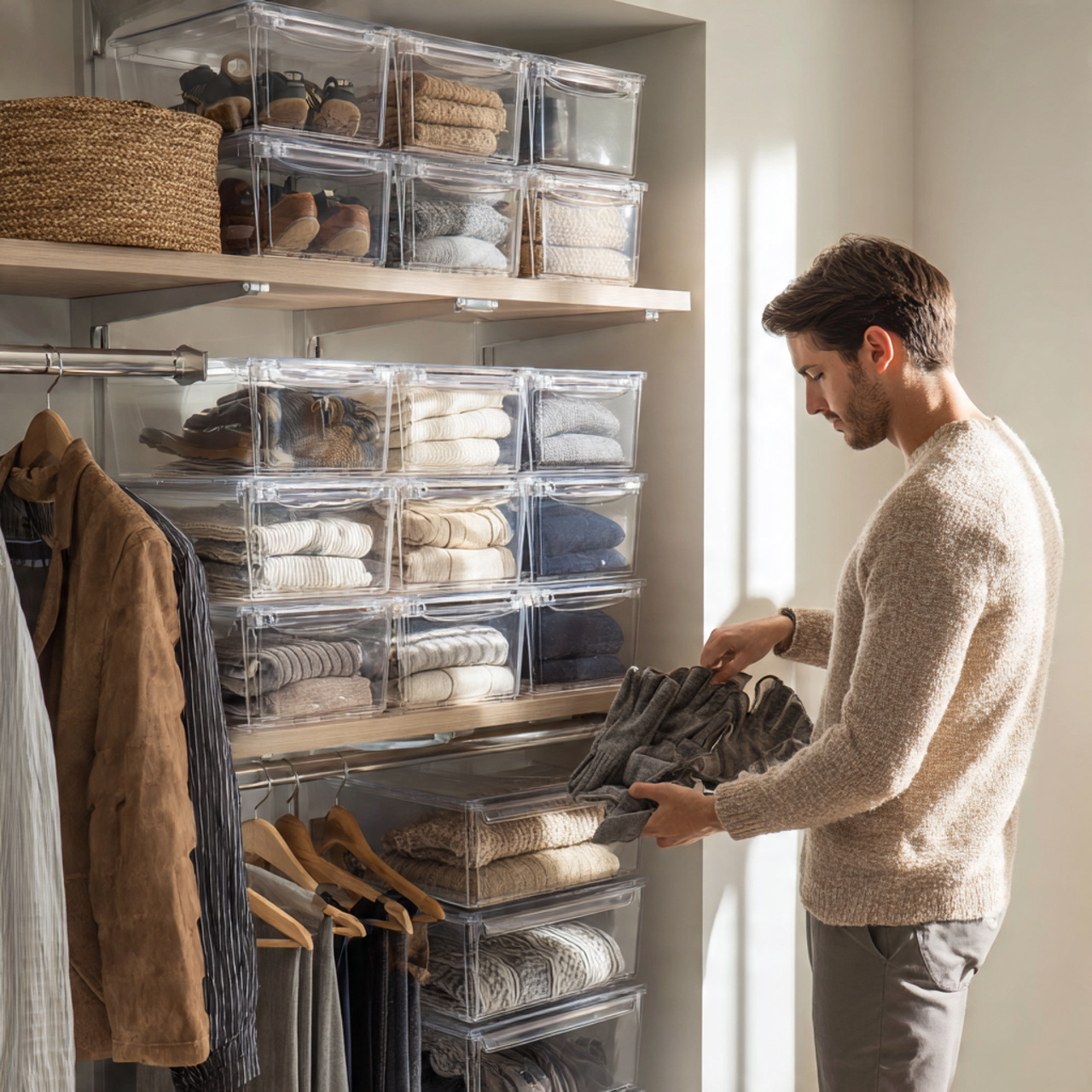
Acrylic containers create a polished look that immediately elevates a closet from functional to genuinely designed. The transparent material lets you identify every bin’s contents without opening anything, which makes retrieval fast and eliminates the rummaging that displaces everything nearby. MUJI and The Container Store both offer premium clear acrylic sets in matching profiles that stack cleanly on open shelves.
Consistent containers from a single brand read as intentional design rather than accumulated storage. A modest investment in matching bins transforms even a basic open-shelf zone into something that looks curated.
Best for: Open-shelf zones holding small loose items like socks, swimwear, or seasonal accessories Product: MUJI acrylic storage boxes or The Container Store Linus clear stackable bins Pro tip: Buy bins slightly larger than you think you need so items fold in without forcing the lid, keeping both the container and contents in better condition over time. Room Fit: Bedroom closets with open shelving and walk-in dressing rooms with visible storage zones Designer language: Specify uniform clear acrylic storage with consistent bin profiles for open-shelf categorization. Room size: Suitable for any closet with at least one open shelf section of standard 12-inch depth
Interior designers consistently recommend buying all storage containers from the same brand and product line rather than just the same color. Even small dimensional differences between brands create visual breaks in a shelf line. That subtle inconsistency is often what makes a freshly organized closet still feel slightly off even after significant effort.
Vanity/Dressing Area Integration Ideas
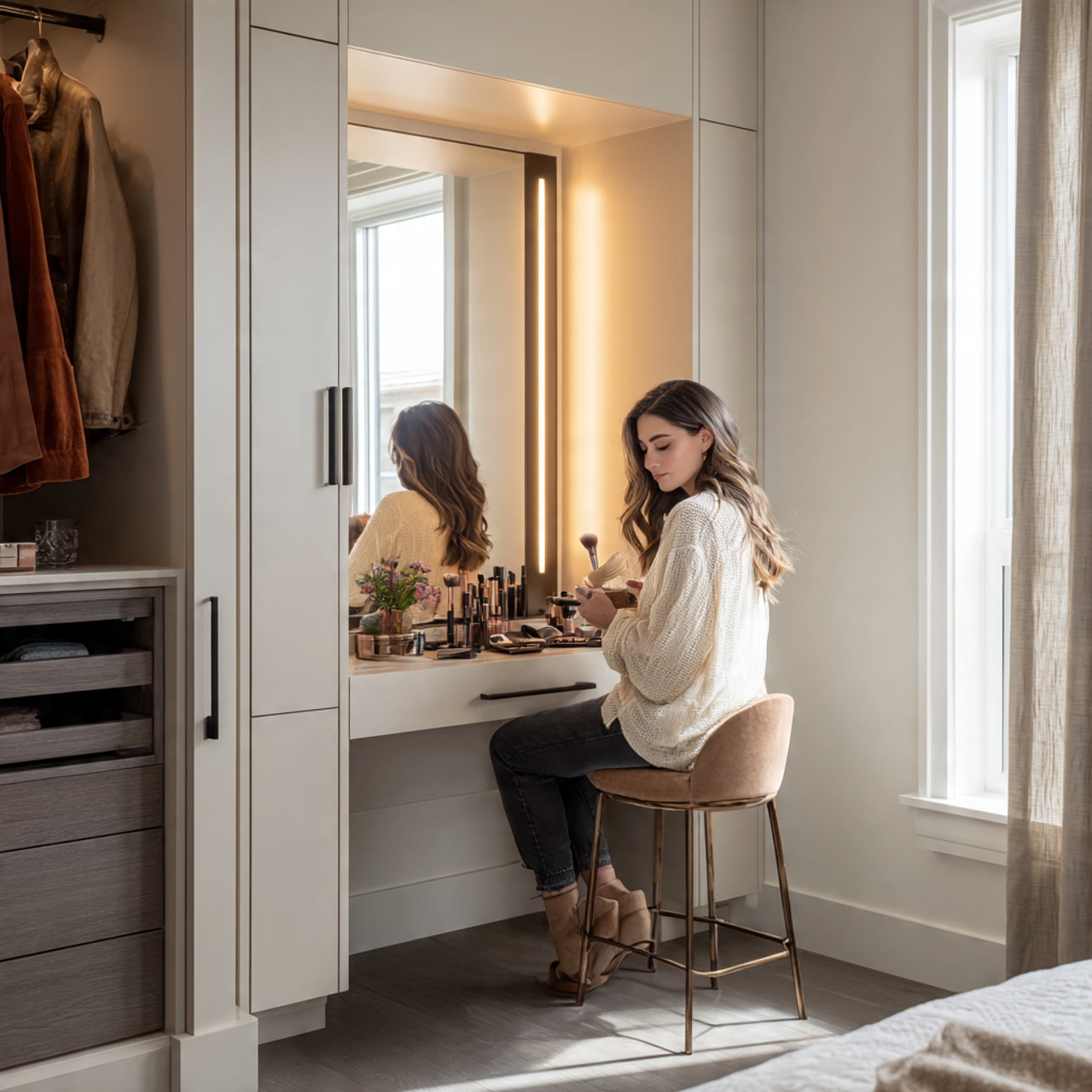
Adding a dressing vanity inside a walk-in closet collapses the morning routine into one room and eliminates the back-and-forth between the bathroom and the wardrobe. A floating shelf with a backlit mirror replaces a traditional vanity table and requires only about 18 inches of wall depth. West Elm and Pottery Barn both carry slim wall-mounted mirrors with integrated lighting designed for this specific closet application.
Drawers directly beneath the vanity surface should hold makeup, hair tools, and fragrance exclusively. This detail transforms a closet from storage space into a genuine lifestyle room, and that shift is felt every single morning.
Best for: Walk-in closet owners who currently complete their full grooming routine in the bathroom Product: West Elm floating shelf desk or Pottery Barn Mercer illuminated wall-mounted mirror Pro tip: Wire a dedicated outlet into the vanity wall during any renovation so hair tools plug in directly rather than running a cord across the floor. Room Fit: Walk-in closets and dressing rooms with a spare wall section at least 30 inches wide Designer language: Reference this as an integrated dressing station with dedicated task lighting and compact vanity storage below the mirror surface. Room size: Requires a wall section at least 30 inches wide and 18 inches deep within a medium to large walk-in
Under-Shelf Basket Storage Ideas
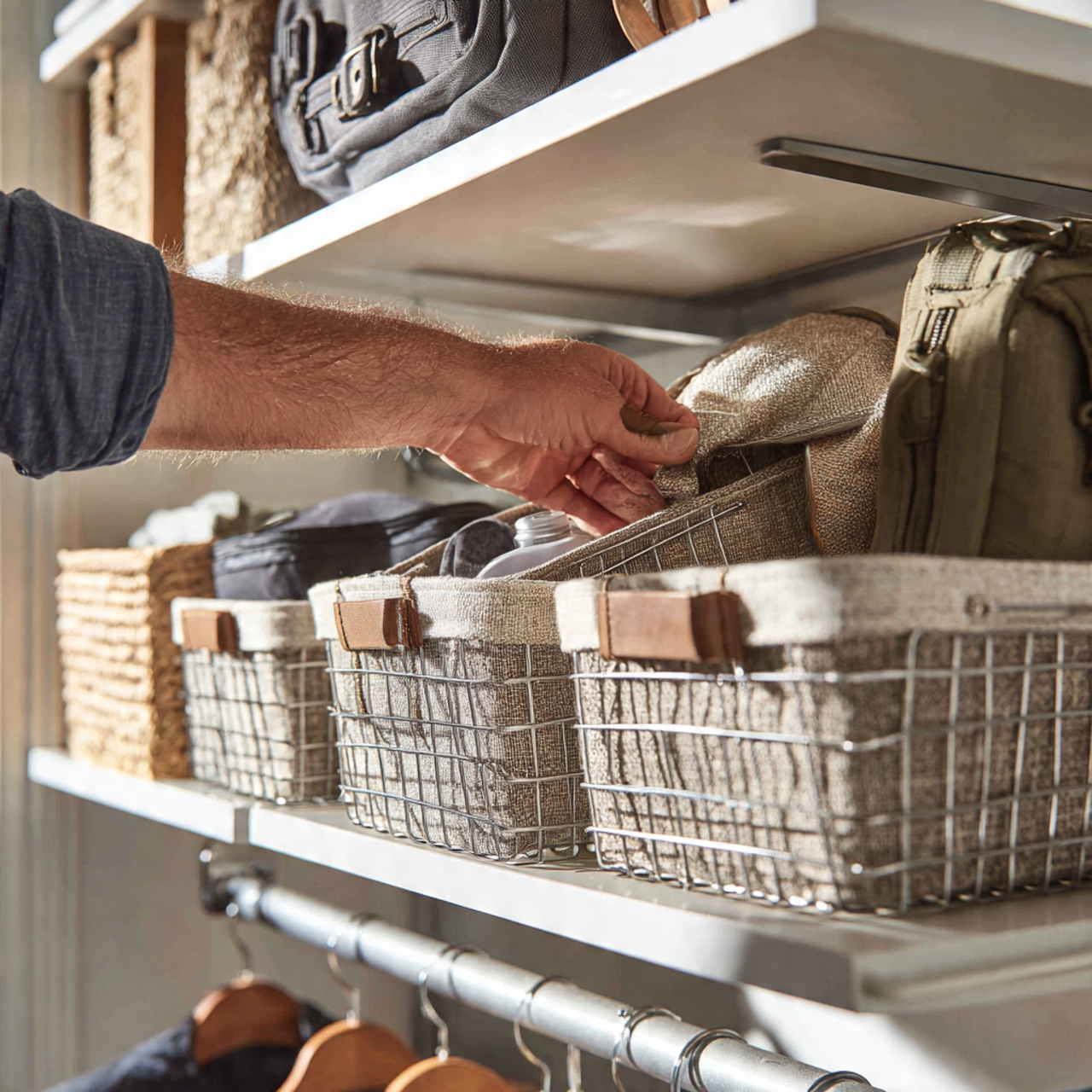
Under-shelf baskets clip to the underside of a fixed shelf and convert the empty vertical gap below it into immediate, accessible storage. Wire clip-on baskets from ClosetMaid and The Container Store install without tools in under a minute and cost very little relative to the storage they add. This ranks among the highest-value-per-dollar upgrades in the entire closet organization category.
The solution is especially useful in older closets with widely spaced fixed shelving where gaps are too tall for neat stacking but too short for a full-size bin. Small bags, travel accessories, and everyday items all fit well in the under-shelf position.
Best for: Closets with existing fixed shelving and unused vertical space between shelf levels Product: ClosetMaid clip-on under-shelf basket or The Container Store stainless steel under-shelf basket Pro tip: Place the most frequently reached small items in the under-shelf basket so they are always at hand without opening a drawer or digging through a bin. Room Fit: Bedroom and hallway closets with fixed shelving systems at any size Designer language: Reference this as under-shelf clip-on storage for interstitial vertical space capture between fixed shelf levels. Room size: Works in any closet where the gap between two fixed shelves measures at least 8 inches
Utilizing Awkward Corner Space Ideas
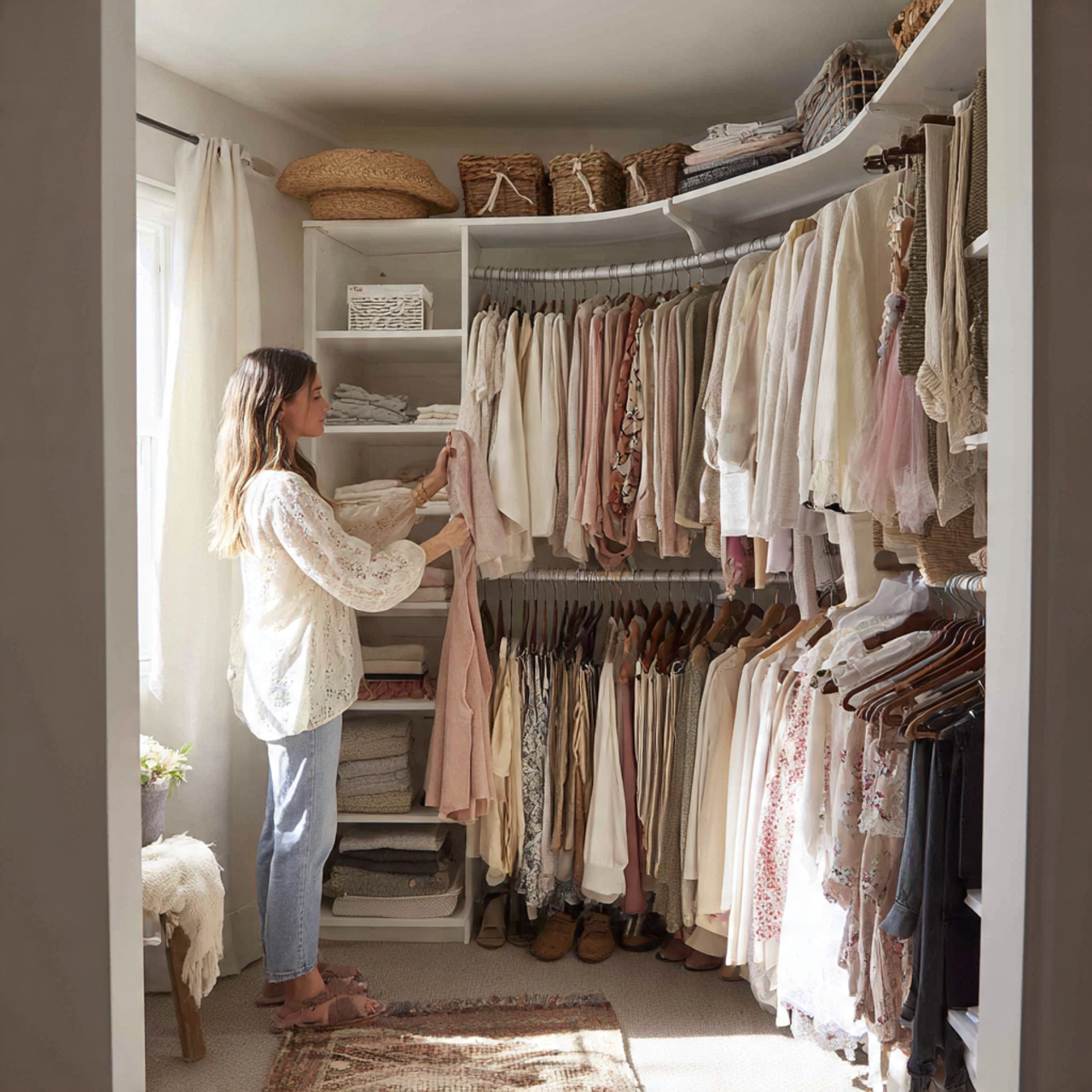
Corner space is the most wasted real estate in any walk-in closet and also one of the easiest problems to solve with the right components. Lazy Susan carousel units and pull-out systems from Rev-A-Shelf allow comfortable access to what would otherwise remain a dark, unreachable zone. Two rods meeting at 90 degrees transition a hanging section seamlessly across a corner without creating a gap or an unusable pocket.
The blind-corner pull-out, borrowed from custom kitchen cabinetry, works equally well in a wardrobe context. This is the detail a professional designer adds to prevent storage loss that a standard shelving kit completely ignores.
Best for: Walk-in closets with unused 90-degree interior corner zones Product: Rev-A-Shelf closet corner storage solution or a custom L-shaped shelf from California Closets Pro tip: Store your least-used seasonal items in the deepest corner sections so accessible corner-adjacent space stays open for daily use. Room Fit: Walk-in closets with two walls forming an interior right-angle corner Designer language: Specify a corner carousel or L-shaped shelf with a full-extension pull-out for blind-corner zone access. Room size: Requires a walk-in footprint with at least 24 inches of depth per wall on each side of the corner
Displaying Handbag Collection Ideas
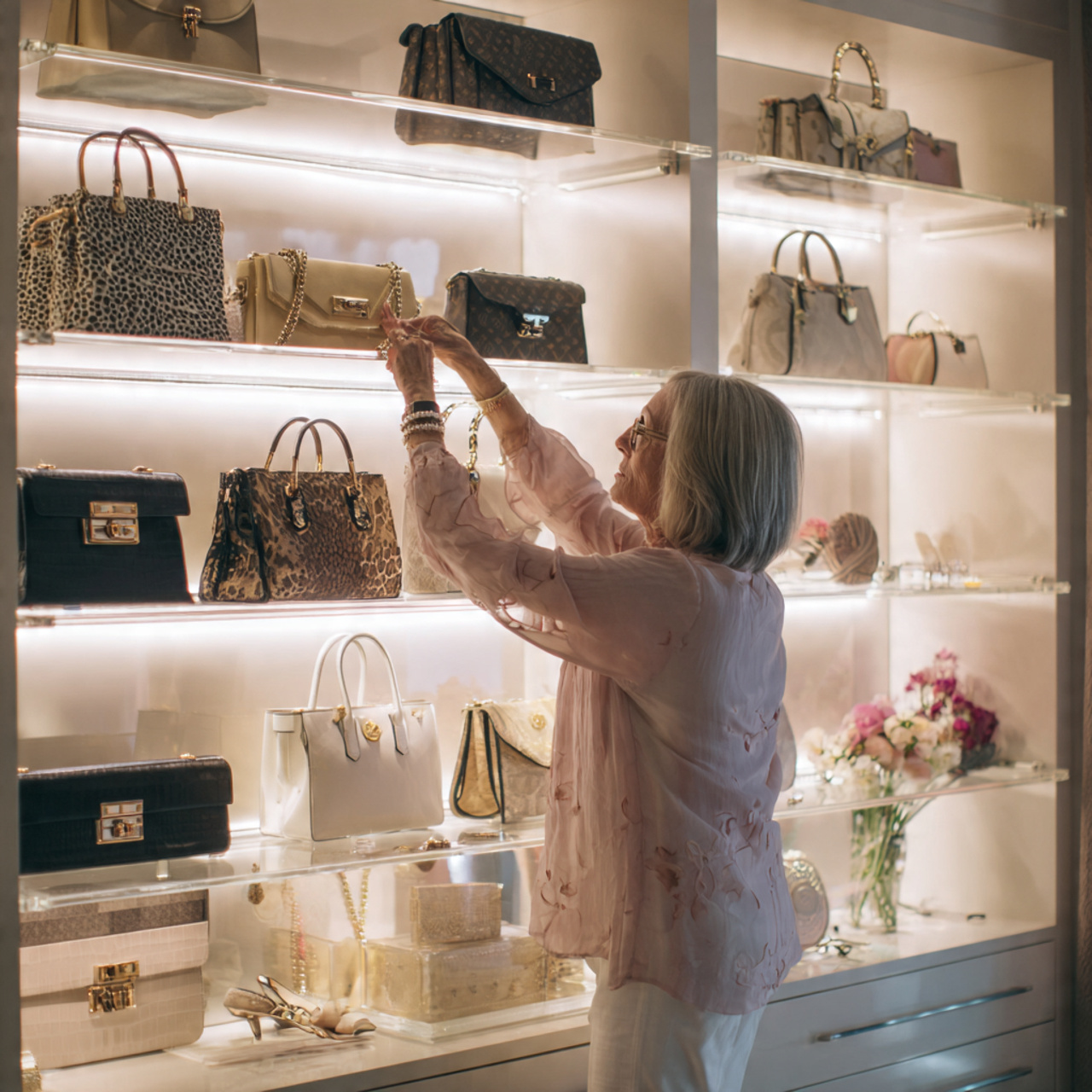
Handbags are both functional tools and investment pieces, and they deserve storage that protects their structure rather than compromising it. Stacking bags causes dented handles and collapsed sides, which shortens the usable life of quality leather pieces far faster than wear ever would. Adjustable shelf dividers from The Container Store or bag cubbies from Pottery Barn keep each piece upright, separated, and visible at a glance.
Eye-level open shelving with individual cubbies delivers a boutique-level presentation. Pieces from Coach or Kate Spade maintain their silhouette far longer when stored upright with room to breathe.
Best for: Anyone with five or more bags on regular rotation Product: The Container Store adjustable shelf dividers or Pottery Barn custom bag cubby shelving unit Pro tip: Stuff each bag lightly with acid-free tissue paper during storage to preserve body shape and prevent the sides from caving inward when not in use. Room Fit: Walk-in closets with available eye-level open shelving and good ambient lighting Designer language: Reference this as a curated handbag display with individual compartments and upright orientation for structural preservation. Room size: Works best in medium to large walk-in closets with dedicated eye-level shelf sections
Lighting and Aesthetic Enhancement Ideas
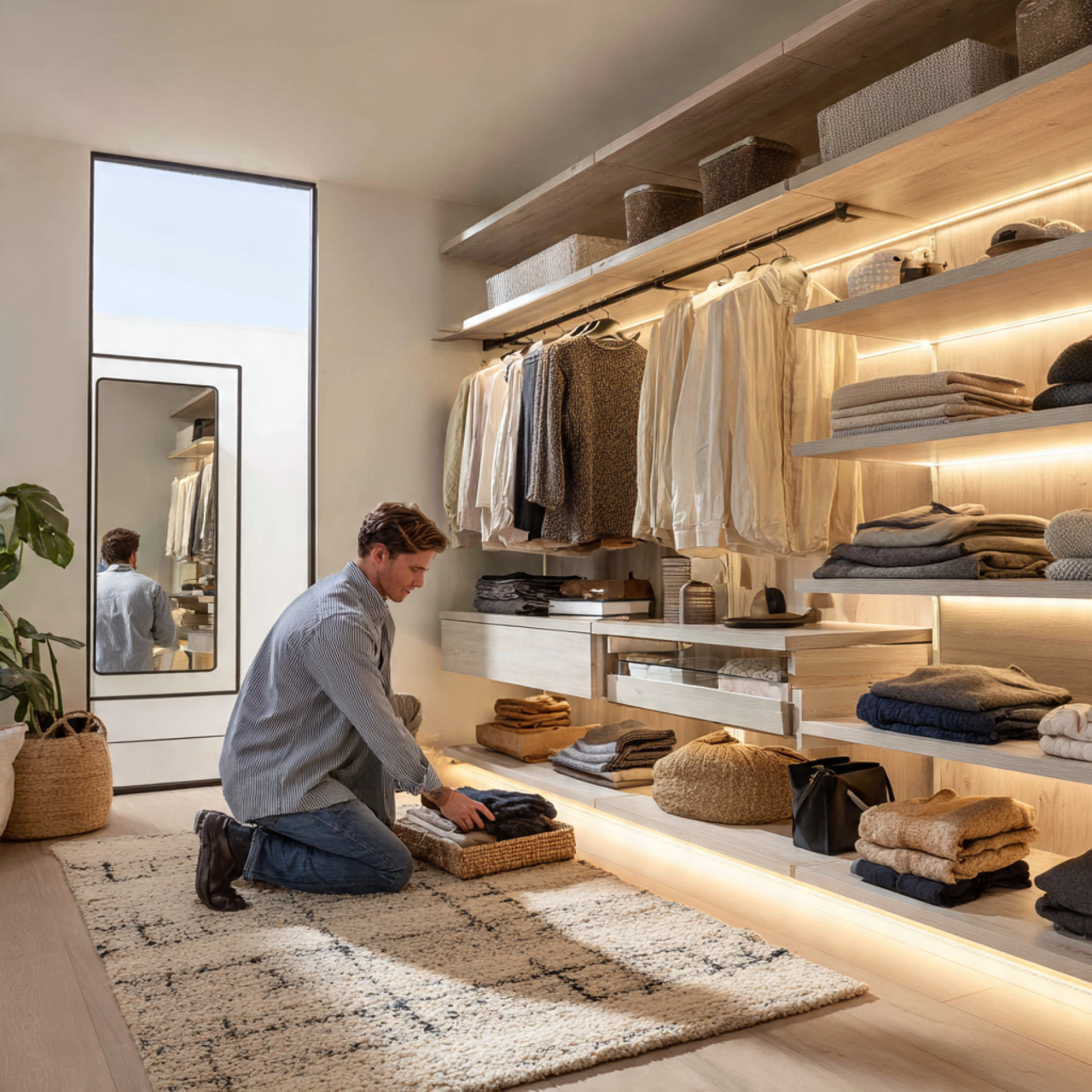
Lighting is one of the most overlooked closet upgrades and one of the highest-impact changes you can make because it affects how the entire space reads and functions. A poorly lit closet is harder to use and impossible to style because garment colors read incorrectly under insufficient light. Govee LED strip lights or the Philips Hue Lightstrip installed beneath each shelf level provide even, warm illumination that eliminates shadows completely.
Adding a small rug or framed art print transforms a utilitarian storage room into a space you genuinely want to spend time in. These details signal that the closet was designed with intention rather than simply assembled from a kit.
Best for: Anyone who wants their closet to feel like a boutique dressing room Product: Govee LED strip lights or Philips Hue Lightstrip Plus for under-shelf installation Pro tip: Select a warm white color temperature between 2700K and 3000K so garment colors render accurately and the space feels inviting rather than clinical. Room Fit: Walk-in closets and large master bedroom reach-in designs with visible open shelving Designer language: Specify layered closet lighting with under-shelf LED strips at a warm white color temperature and a dedicated ambient source above. Room size: Scales to any closet size; even a small reach-in benefits significantly from one run of LED lighting beneath the top shelf
Professional stylists position LED strips below shelves rather than above them in a closet context. This illuminates the face of displayed bags and garments without the UV exposure that fades leather, canvas, and fabric over time. It is a small technical detail with a meaningful long-term impact on material quality.
Capsule Wardrobe Implementation Ideas
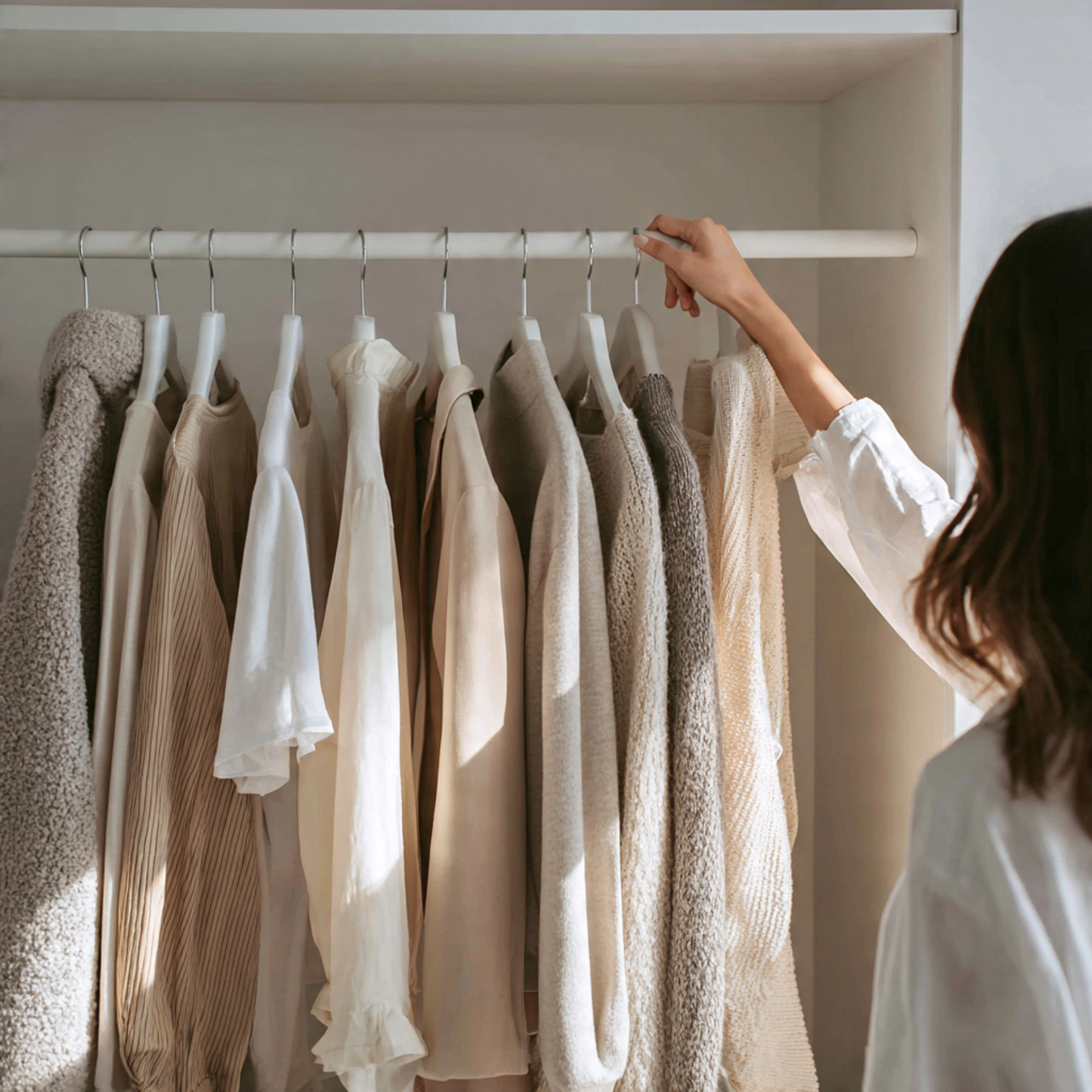
A capsule wardrobe reduces total clothing volume, which makes every organizational system perform better automatically. The concept centers on a limited selection of high-quality interchangeable pieces rather than a closet full of garments worn once and forgotten. Brands like Everlane and Quince are consistently recommended as practical starting points for building a quality capsule foundation without a luxury price tag.
The organizational benefit compounds over time. Fewer items mean more breathing room on the rod, more clarity on the shelves, and less morning decision fatigue. The capsule approach also significantly reduces how often the closet needs a full reset.
Best for: Anyone whose closet fills up faster than they can organize it Product: Everlane foundational cotton pieces or Quince wardrobe staples as the capsule anchor layer Pro tip: Set a firm item limit equal to the number of garments that hang with at least one inch of space between each hanger and treat that number as a permanent ceiling. Room Fit: Any bedroom closet, but most transformative in small and medium configurations Designer language: Reference this as a curated capsule wardrobe build with a defined item count ceiling and a coordinated neutral core palette. Room size: Most impactful in closets where current capacity is consistently exceeded regardless of available square footage
Visit Also: Utility Room Ideas & Organization Hacks
Laundry Hamper Integration Ideas
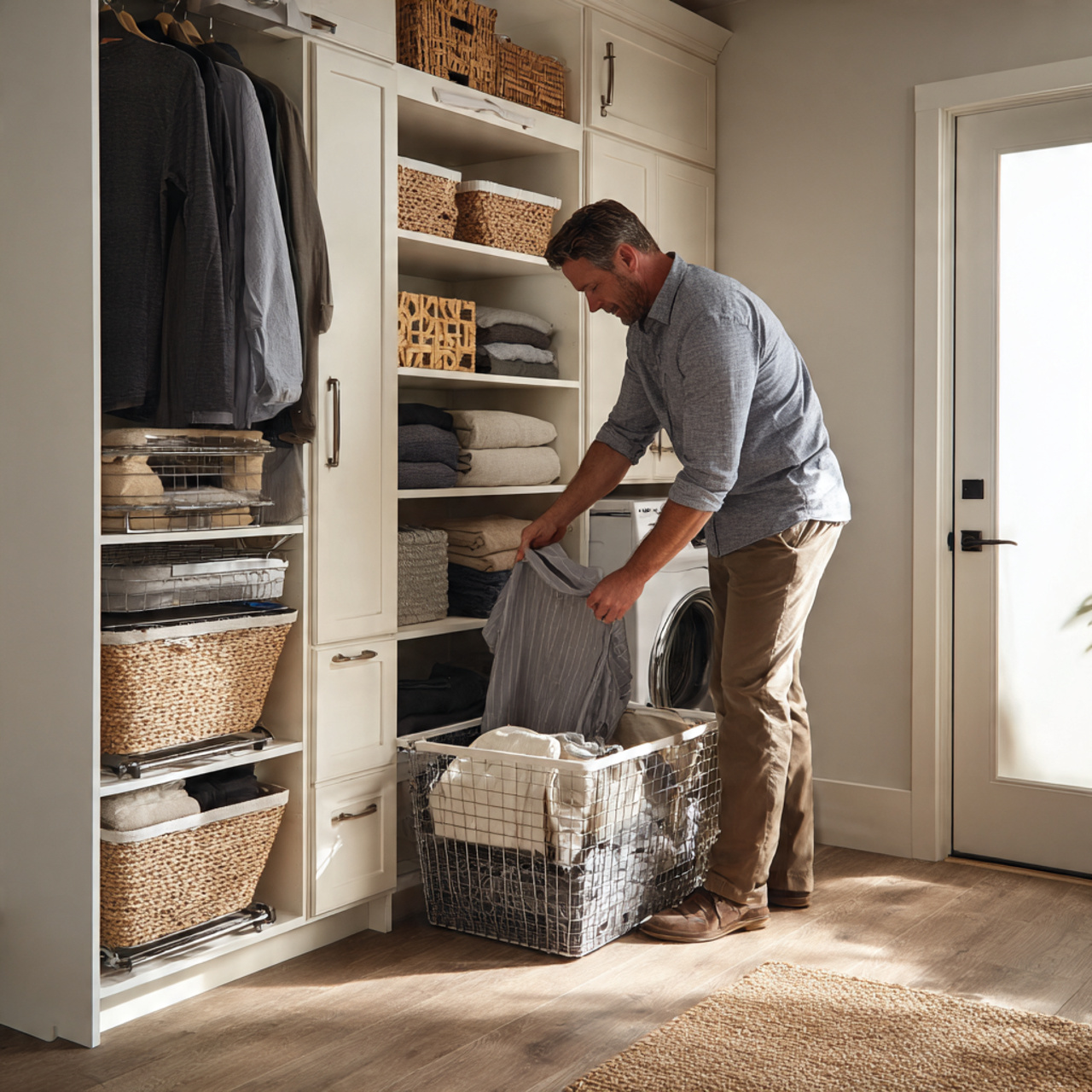
A built-in laundry hamper eliminates the floor pile that forms when there is no designated destination for worn but not-yet-washed clothes. Tilt-out hamper cabinets at the closet base or slim rolling frames from IKEA and The Container Store both serve this function without claiming unnecessary floor space. Worn clothes go directly to their next stop rather than accumulating on a chair elsewhere.
Sectioned hampers that separate lights from darks automatically make laundry day faster because sorting is done before anything reaches the machine. Professional organizers consistently name this one of the highest-impact additions for long-term maintenance.
Best for: Anyone whose floor routinely collects worn clothes between wash days Product: Rev-A-Shelf tilt-out hamper cabinet or IKEA PLUGGIS laundry bag with freestanding frame Pro tip: Choose a hamper with at least two compartments so lights and darks sort automatically rather than requiring a dedicated separation step each week. Room Fit: Walk-in closets and large reach-in designs with available base cabinet or floor space Designer language: Specify a built-in tilt-out hamper with dual-compartment sorting capacity installed at the base of the primary closet unit. Room size: Tilt-out versions require a base cabinet at least 15 inches wide; rolling versions fit any available floor footprint
Dedicated Fitness Gear Zone Ideas
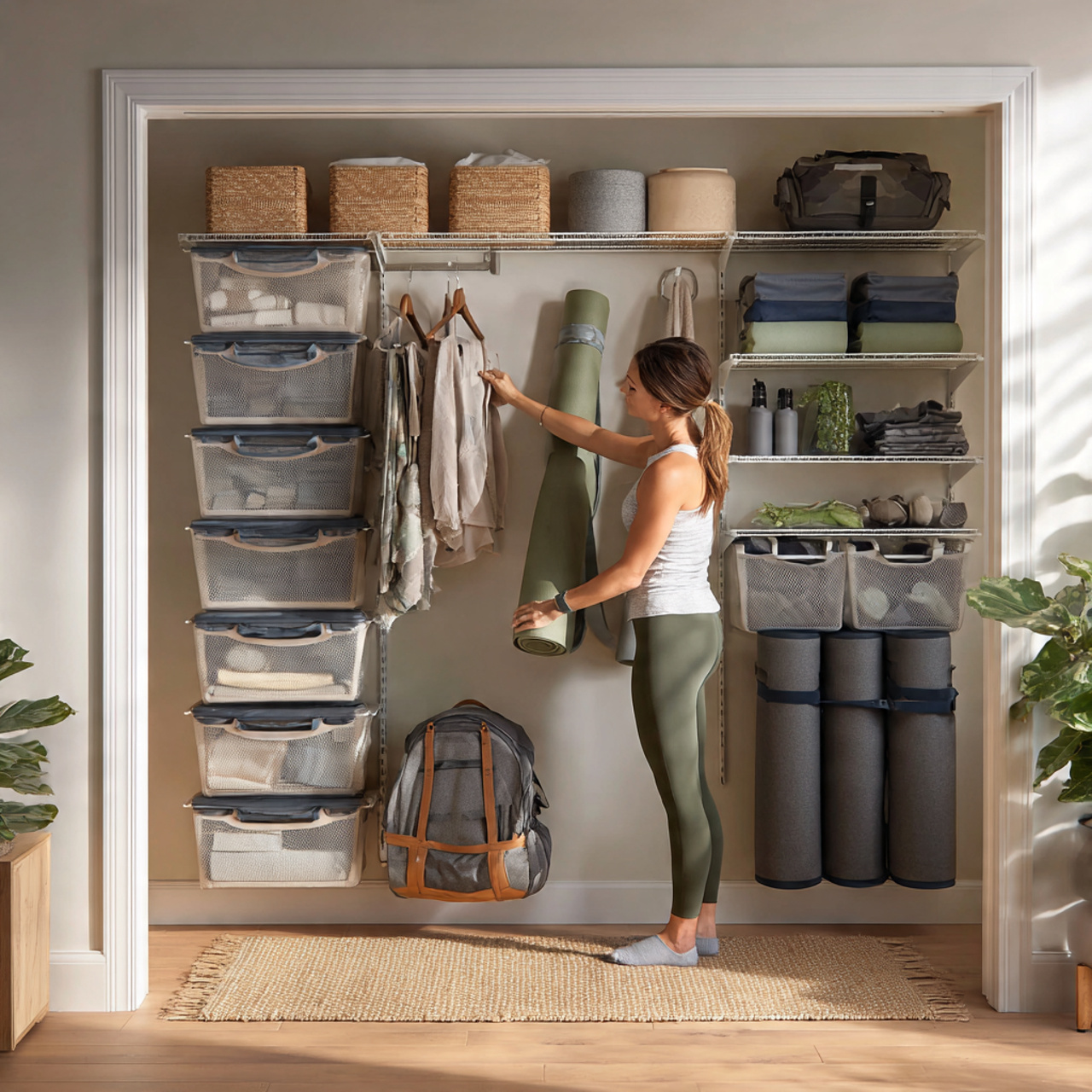
Workout clothes and accessories operate on a completely different cycle from the rest of the wardrobe, and mixing them creates odor transfer and daily frustration finding damp gear inside dry clothing sections. A dedicated zone with mesh-front open bins from The Container Store handles moisture far better than sealed cabinetry. These closet organization ideas for active lifestyles pay back their effort almost immediately.
Hooks on a spare wall or door panel manage yoga mats and foam rollers without consuming shelf space. Keeping the fitness zone near the closet entrance shortens the prep time on gym days and prevents gear from migrating to other rooms.
Best for: Anyone with a consistent fitness routine who stores workout gear in the bedroom Product: The Container Store open-front mesh bins or IKEA SKADIS pegboard for fitness accessories Pro tip: Install one dedicated hook specifically for your gym bag so it never ends up on the floor or competing for rod space with regular clothing. Room Fit: Walk-in and large reach-in closets with a spare wall section or accessible door panel Designer language: Specify a ventilated athletic storage zone with open mesh bins and wall-mounted hook rails for bulky equipment. Room size: Works in any closet where at least 18 inches of wall or door surface is available for dedicated athletic use
Wall-Mounted Pegboard Storage Ideas
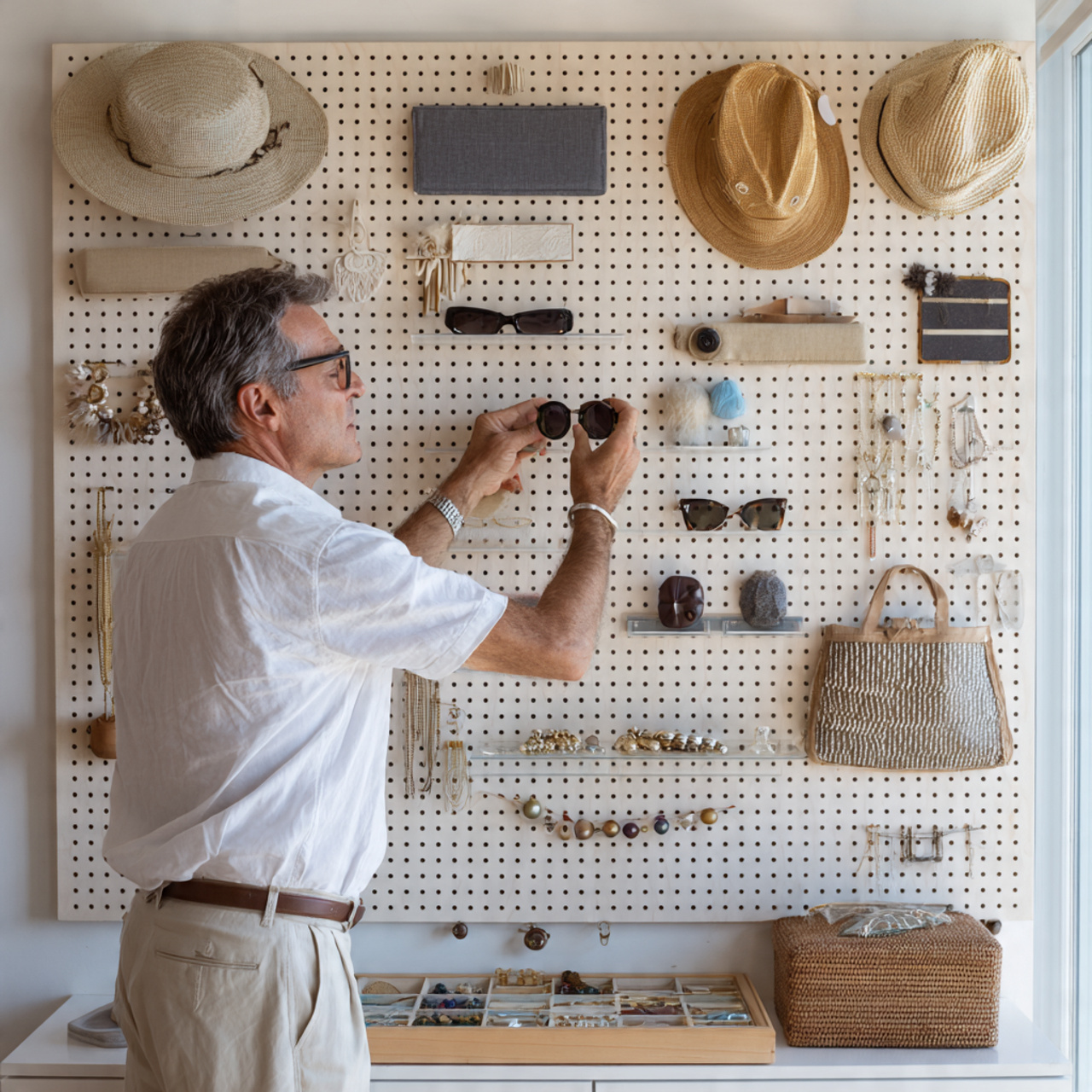
A pegboard on an unused closet wall is one of the most flexible organizational surfaces available because it rearranges in minutes as needs evolve. The grid accepts hooks, shelves, bins, and rails in any configuration without additional tools after the initial installation. IKEA SKADIS is the most widely used residential pegboard system, with an accessory range covering virtually every small-item storage scenario.
Pegboards work especially well for sunglasses, hats, small bags, and jewelry because these items are irregular in shape and poorly served by drawers. The display format makes it easy to see the full collection and reach for specific pieces without searching.
Best for: Anyone with many small irregularly shaped accessories that routinely get lost in drawers Product: IKEA SKADIS pegboard with assorted hooks, shelves, small bins, and cord organizer accessories Pro tip: Organize the pegboard by frequency of use rather than category so items you reach for every day sit at the most accessible height and position on the board. Room Fit: Walk-in closets and large reach-in designs with at least one unused flat wall section Designer language: Specify a wall-mounted pegboard display with a curated mix of hook, shelf, and container accessories scaled to the item types stored. Room size: Works on any flat wall section at least 20 inches wide and 24 inches tall
Streamlining Decluttering Process Ideas

No organizational system holds up without consistent maintenance, and a quarterly declutter habit is what separates closets that stay tidy from ones that collapse back into chaos within a month. A quarterly review combined with a strict one-in-one-out rule for new purchases keeps volume permanently manageable. Apps like Stylebook and Cladwell make tracking your wardrobe and identifying unworn pieces far easier than doing it by memory.
Thirty minutes every quarter creates far less total work over a year than one exhausting seasonal overhaul. That small recurring effort keeps the space in a state that actually supports the system you worked to build.
Best for: Anyone who reorganizes repeatedly and finds the closet reverts to chaos within weeks Product: Stylebook digital wardrobe tracking app or Cladwell outfit planning and decluttering app Pro tip: Keep one empty bin in the closet at all times for items you are uncertain about and donate whatever is still inside it after 90 days without reviewing the contents. Room Fit: Every closet regardless of size, style, or organizational system currently in use Designer language: Reference this as a recurring wardrobe curation practice with a defined seasonal declutter cadence and digital inventory management. Room size: Applies equally to all closet configurations from a small studio reach-in to a full luxury walk-in
Quick Comparison Table
| Idea | Room Type | Style | Budget Level | Wow Factor |
|---|---|---|---|---|
| Vertical Storage Maximization | Small Bedroom | Modern Minimalist | Low to Mid | ★★★★☆ |
| Seasonal Clothing Rotation | Any Bedroom | Any | Low | ★★★☆☆ |
| Color-Coded Wardrobe Display | Bedroom | Editorial | Low | ★★★★★ |
| Hidden Shoe Storage | Walk-in Closet | Contemporary | Mid | ★★★★☆ |
| Sliding Drawer System | Master Bedroom | Modern | Mid to High | ★★★★☆ |
| Jewelry and Accessory Integration | Walk-in Closet | Boutique | Mid | ★★★★☆ |
| Small Reach-In Closet Design | Guest Room or Studio | Minimal | Low to Mid | ★★★★☆ |
| Walk-In Closet Island Installation | Walk-in Closet | Luxury | High | ★★★★★ |
| Open Shelving for Folding | Bedroom | Minimalist | Low | ★★★☆☆ |
| Custom DIY Drawer Divider | Any Bedroom | Any | Low | ★★★☆☆ |
| Belt and Tie Hanging Solutions | Walk-in Closet | Refined | Low to Mid | ★★★☆☆ |
| Smart Hanging Rod Doubling | Any Bedroom | Modern | Low | ★★★★☆ |
| Repurposed Furniture Storage | Walk-in Closet | Eclectic Boutique | Low to Mid | ★★★★☆ |
| Back-of-the-Door Utilization | Any Bedroom | Functional | Low | ★★★☆☆ |
| Acrylic Bin and Container | Any Bedroom | Contemporary | Low to Mid | ★★★★☆ |
| Vanity/Dressing Area Integration | Walk-in Closet | Luxury | Mid to High | ★★★★★ |
| Under-Shelf Basket Storage | Any Bedroom | Minimal | Low | ★★★☆☆ |
| Utilizing Awkward Corner Space | Walk-in Closet | Modern | Mid | ★★★★☆ |
| Displaying Handbag Collection | Walk-in Closet | Boutique | Low to Mid | ★★★★☆ |
| Lighting and Aesthetic Enhancement | Walk-in Closet | Luxury | Mid | ★★★★★ |
| Capsule Wardrobe Implementation | Any Bedroom | Minimal | Any | ★★★★☆ |
| Laundry Hamper Integration | Walk-in Closet | Modern | Mid | ★★★☆☆ |
| Dedicated Fitness Gear Zone | Walk-in or Large Reach-in | Athletic | Low to Mid | ★★★☆☆ |
| Wall-Mounted Pegboard Storage | Walk-in Closet | Modern | Low | ★★★★☆ |
| Streamlining Decluttering Process | Any Closet | Any | Low | ★★★★☆ |
Frequently Asked Questions
What are the best closet organization ideas for someone starting completely from scratch? The best closet organization ideas for a fresh start combine a doubled hanging rod, floor-to-ceiling vertical shelving, and uniform storage containers selected before anything goes back inside. Build the structure first and add finishing details only once the core system is in place and tested.
How much should I realistically expect to spend on a closet upgrade? A meaningful reach-in upgrade using modular systems from IKEA or ClosetMaid typically runs between $150 and $400 depending on components selected. A custom walk-in design through California Closets or a similar professional service generally starts around $1,500 and scales with room size and features.
What should I do before buying any closet products at all? Measure the exact width, height, and depth of your closet before purchasing anything, then take a full physical inventory of your wardrobe by category. These two steps prevent the most expensive and common mistake in closet organizing, which is buying solutions before understanding the problem.
How do I maintain a closet once I have organized it properly? Follow a quarterly declutter review and apply a one-in-one-out rule every time a new garment enters the closet. Those two habits do more for long-term maintenance than any additional storage product or accessory ever could.
Can renters implement most of these ideas without risking their security deposit? Yes. The majority of these ideas use over-the-door systems, tension rods, Command hooks, freestanding shelving, and clip-on components requiring no permanent installation. Tilt-out hampers and wall-mounted pegboards typically require drilling and should be confirmed with the landlord first.
Final Thoughts
A closet that genuinely works for you is one of the most underrated quality-of-life improvements in the home. It reduces daily friction, saves real time every morning, and creates a pocket of order that makes the surrounding space feel more manageable. The investment is modest. The return is daily and compounding.
The ideas in this list are not about perfection or styling a space for a photograph. They are about building a system that matches how you actually live, how you actually dress, and how you move through your mornings. The best closet organization ideas are always chosen around a specific wardrobe and a specific routine, not borrowed from a generic blueprint.
Start with one section. Fix the hanging rod, add the lighting, or swap in a single drawer system. Build from there rather than waiting for the time and budget for a complete overhaul. Progress in a closet compounds faster than most people expect, and each improvement makes the next one easier to identify.
The closets that stay organized year after year are never the most expensive ones. They are the ones designed around the actual habits of the person who uses them every single day.